

Selling website assets has become a legitimate exit strategy for Australian business owners in 2026. Whether you've built a content site, an eCommerce store, or a SaaS platform, understanding how to properly value and sell your digital property can mean the difference between a disappointing sale and a life-changing payday. The market for digital assets continues to mature, with more buyers entering the space and valuation methods becoming increasingly sophisticated.
Understanding What You're Actually Selling
When you're selling website assets, you're not just selling code and content.
You're selling future cash flow potential. You're selling customer relationships. You're selling systems, data, rankings, and brand equity.
Most first-time sellers underestimate the complexity of this transaction. They think about their site like a physical product with a fixed value. But digital businesses behave differently.
What buyers actually evaluate:
- Consistent revenue history (minimum 12 months preferred)
- Traffic sources and their sustainability
- Operating margins and owner involvement
- Growth trajectory and market positioning
- Technical infrastructure and dependencies
The buyer isn't purchasing your past effort. They're purchasing future profit with reduced risk.
A Shopify store generating $8,000 monthly profit will sell for vastly different multiples depending on whether that profit comes from organic traffic, paid ads, or a locked-in wholesale agreement. Understanding this distinction shapes everything about your selling website strategy.
Valuation Methods That Actually Matter in 2026
The days of random guesswork are over.
Professional buyers use standardised methodologies that you need to understand before listing anything for sale. Website valuation approaches have evolved significantly, but most transactions still centre on earnings multiples.
The Earnings Multiple Method
This remains the dominant valuation approach for profitable websites.
Take your average monthly net profit over 12 months. Multiply by a number between 24 and 48. That's your starting valuation range.
The multiple depends on business model, traffic sources, growth rate, and operational complexity. A content site monetised through display ads might sell for 28-32x monthly profit. An eCommerce brand with owned inventory and email lists could command 38-45x monthly profit.

Asset-Based Valuation for Non-Profitable Sites
Not every valuable site generates profit yet.
If you're selling website properties with strong traffic but minimal monetisation, buyers look at other metrics. Domain authority, email list size, social following, and content volume all contribute to asset value.
A health and wellness blog with 50,000 monthly visitors and 12,000 email subscribers might sell for $15,000-$30,000 even with only $400 monthly revenue. The buyer sees untapped potential they can monetise better than you did.
Comparable Sales Analysis
Smart sellers research recent transactions in their niche.
Marketplaces like Flippa publish completed sale data. Understanding these platforms helps you benchmark realistic expectations against actual market behaviour rather than theoretical calculations.
If similar Australian eCommerce sites in your category sold for 32-36x monthly profit in the past six months, that's your reality. Your unique features might justify a 10-15% premium, but not double.
Preparing Your Site for Maximum Sale Value
Most sellers leave thousands on the table through poor preparation.
Six months before listing, start treating your site like a product you're packaging for someone else. Clean financials matter more than you think.
Critical preparation steps:
- Separate business and personal expenses completely
- Document all revenue sources with third-party verification
- Create standard operating procedures for every task
- Reduce owner dependence wherever possible
- Fix technical debt and security issues
The difference between "I handle customer service a few hours weekly" and "Here's the documented process our VA follows" might be worth $20,000 on a $100,000 sale.
Building Shopify stores that are systematised from day one creates more valuable assets than chaotic setups relying on founder knowledge.
Buyers pay premiums for businesses they can operate from day one. Every hour of your time required post-sale reduces what they'll pay upfront.
Where to Actually List Your Site
Platform choice dramatically impacts your selling website outcome.
Different marketplaces attract different buyer types with different budgets and expectations. Choosing wrong costs you time and money.
Flippa
The largest marketplace by volume. Good for sites valued under $100,000. Expect tire-kickers and lowball offers, but genuine buyers exist if you're patient. Auctions create urgency but can backfire if starting price is wrong.
Empire Flippers
Curated marketplace for established businesses. They vet both sellers and buyers. Minimum listing usually around $50,000. Higher quality buyers, more professional process, but they take a larger commission and have strict approval criteria.
Motion Invest
Specialises in content sites between $5,000 and $500,000. Quick sales if your site fits their model. They buy directly rather than just facilitating, which means faster transactions but potentially lower prices than open market.
Direct Outreach
Selling privately to someone in your industry often yields the best price. They understand the value better than general investors. Finding these buyers requires networking and patience but eliminates marketplace fees entirely.
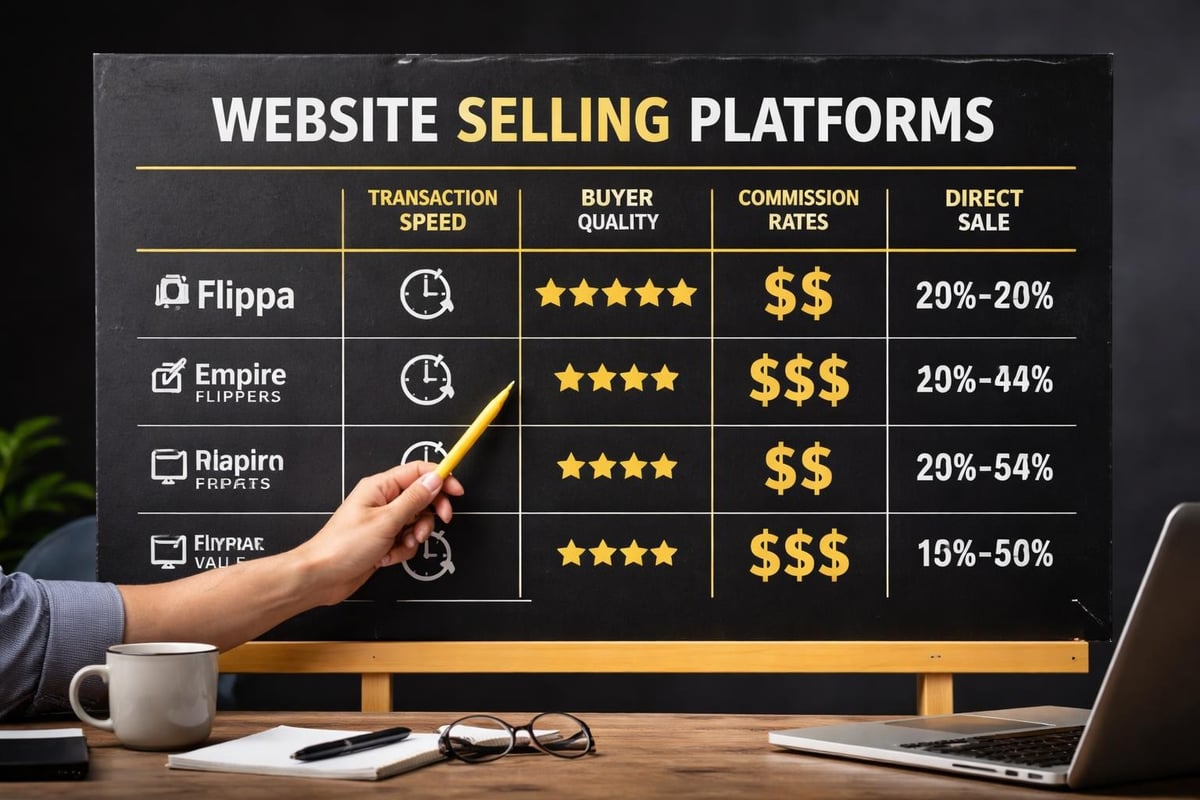
Effective selling strategies emphasise matching your business type to the right platform rather than defaulting to the biggest name.
The Real Sales Process Nobody Warns You About
Listing your site is the easy part.
Managing buyer questions, providing documentation, negotiating terms, and handling the transfer process takes significant time and emotional energy. Most sales fall through during due diligence, not because of price disagreement.
Due Diligence Period
Serious buyers will request access to everything.
Google Analytics, financial records, supplier agreements, traffic sources, email service provider data, social media insights. They're looking for red flags and verification of your claims.
Common deal-killers during due diligence:
- Traffic numbers that don't match claims
- Revenue concentrated in one or two customers
- Undisclosed technical issues or pending problems
- Owner involvement greater than disclosed
- Upcoming market changes affecting the business
Transparency from the start prevents these issues. Hiding problems until due diligence guarantees the deal dies and wastes everyone's time.
Negotiation Dynamics
First offer is rarely final offer on either side.
Professional buyers expect negotiation. They might start at 70-80% of asking price. This doesn't mean your price was wrong. It's standard practice.
Know your walk-away number before listing. Emotional attachment clouds judgment when real offers arrive. Decide in advance what price and terms you'll accept, then evaluate offers against that benchmark rather than reacting emotionally.
Transfer and Transition
Post-sale support expectations need clarity upfront.
Most agreements include 30-90 days of seller availability for questions. Define this clearly. "Reasonable assistance" means different things to different people.
Create detailed transfer checklists covering domains, hosting, social accounts, supplier relationships, customer data, and intellectual property. Missing something obvious like password access to a critical tool can sour the relationship quickly.
Common Mistakes That Kill Website Sales
You can do everything else right and still fail here.
Overvaluing Based on Potential
You see what the site could become. Buyers pay for what it is now.
"This could easily do $20k monthly with proper marketing" doesn't justify selling website pricing based on that theoretical future. Buyers discount heavily for anything requiring their effort to achieve.
If you believe in that potential, execute it first, then sell the improved business for more money.
Poor Financial Documentation
"I think revenue was around $X last year" tanks credibility instantly.
Buyers need bank statements, payment processor records, expense receipts, and profit calculations that reconcile precisely. Anything less signals either incompetence or dishonesty.
Using proper accounting software from day one makes this easier. For eCommerce businesses, connecting Shopify to accounting platforms like Xero creates the paper trail buyers demand.
Unrealistic Timelines
Most sales take 60-120 days from listing to money in bank.
Factor this into your planning. Needing money urgently forces acceptance of lowball offers. Starting the selling website process early gives you negotiating power to wait for the right buyer at the right price.
Ignoring Tax Implications
Capital gains tax applies to Australian business sales.
Consult an accountant before listing. The structure of the sale (asset sale versus share sale, payment timing, earnout clauses) affects your tax liability significantly. Optimising this legally can save tens of thousands on larger transactions.
Real Example: Australian Ecommerce Exit
Sarah built a sustainable homewares store over four years.
Annual revenue sat at $180,000 with $54,000 net profit after all costs including her modest salary. Monthly profit averaged $4,500.
She initially listed at $180,000 (40x monthly profit) based on strong growth trajectory and email list of 8,000 engaged subscribers. The business ran mostly hands-off with a part-time VA handling customer service.
First month brought tire-kickers offering $90,000-$110,000. She held firm.
Week six, a buyer with three existing eCommerce stores offered $160,000 with $40,000 upfront and $120,000 over 12 months tied to revenue performance. This earnout structure reduced their risk while giving Sarah upside if the business continued performing.
After negotiation, they settled at $165,000 with $50,000 upfront and the balance over 10 months. Sarah provided 60 days of handover support.
Total process took 94 days from listing to final transfer. She walked away with a business sale equivalent to over 36x monthly profit, reinvesting proceeds into a new venture.
Platform Fees and Real Costs
Every selling website platform takes a cut.
| Platform | Success Fee | Additional Costs | Total Impact |
|---|---|---|---|
| Flippa | 10% (varies by tier) | Listing upgrades optional | 10-15% of sale price |
| Empire Flippers | 15% under $700k | Included in fee | 15% of sale price |
| Motion Invest | 0% (they buy direct) | Lower sale price typically | 10-20% below market |
| Direct Sale | 0% platform fee | Legal fees $1,500-$5,000 | 2-5% for professional docs |
Factor these costs into your minimum acceptable price. A $100,000 sale through Empire Flippers nets you $85,000. Through direct sale with legal fees, you keep $96,500.
The trade-off is speed and buyer access versus cost. Empire Flippers' curated buyers close faster and with less hassle than managing fifty Flippa inquiries yourself.

When Not to Sell
Sometimes holding is smarter than selling.
If your site is growing 20-30% annually, that growth might generate more wealth than today's sale price over the next few years. A business doing $3,000 monthly profit today at 25% annual growth becomes $7,300 monthly profit in four years.
Selling at 35x monthly profit today gets you $105,000. Waiting four years and selling at the same multiple gets you $255,500. Plus you collected profit every month during that time.
Understanding eCommerce business growth helps you make this calculation realistically rather than emotionally.
Strong growth businesses command premium multiples too. That same calculation at 40x multiple in year four delivers $292,000 versus $120,000 today.
Sell when growth is plateauing, when you're burned out and performance is suffering, or when you have a better opportunity for the capital. Don't sell just because someone offered money.
Legal Structure and Contracts
Get proper legal advice before accepting offers.
Standard purchase agreements cover purchase price, payment terms, due diligence period, representations and warranties, non-compete clauses, and dispute resolution. Each clause affects your risk and outcome.
Critical contract elements:
- Earnout provisions and calculation methods
- Escrow arrangements for funds
- Length and scope of non-compete
- Limitation of liability caps
- Indemnification requirements
Many deals include earnouts where part of the price depends on future performance. These align incentives but create complexity. If 40% of your payment comes from year-one revenue targets, you care deeply about how the buyer operates the business post-sale.
Negotiate clear earnout metrics, measurement methods, and your rights to information. Ambiguous earnout clauses create disputes that cost more in legal fees than the disputed amount.
The 2026 Market Reality for Australian Sellers
Buyer demand remains strong but more sophisticated than five years ago.
Multiple aggregators have entered the Australian market specifically targeting profitable eCommerce stores. They understand Shopify businesses, know fair valuations, and close quickly with cash offers.
Interest rates and economic uncertainty affect multiples. In 2021's low-rate environment, some sites sold for 50-60x monthly profit. Today's environment sees 32-42x as normal for quality businesses.
Competition from sellers has increased too. More people understand digital businesses have value. Your site competes against hundreds of other listings. Standing out requires excellent presentation, solid financials, and realistic pricing.
Australian buyers often prefer Australian sites due to timezone alignment, similar business culture, and easier banking. Emphasise your Australian customer base, suppliers, and operational setup when marketing to local buyers.
Maximising Value in Your Last 90 Days
Final quarter before sale matters enormously.
Focus on metrics buyers care about. Increase profit by cutting unnecessary expenses. Improve traffic diversity by expanding beyond one source. Document everything in writing.
Small improvements compound. Boosting monthly profit from $4,000 to $4,500 through expense cuts adds $18,000 to sale price at 36x multiple. That's significant return for probably 10 hours of work.
For Australian eCommerce stores, building Shopify stores in one week from concept through launch demonstrates the speed possible with proper processes. Similarly, optimising existing stores before sale happens faster than most owners expect when approached systematically.
Three months gives enough time to show improved trends without being so long you lose motivation. Set specific targets and work backward to daily actions.
Selling website assets successfully requires preparation, realistic expectations, and understanding buyer psychology. Most Australian business owners undervalue or overvalue their digital properties because they lack market knowledge. Using proven valuation methods, choosing the right marketplace, and presenting professional documentation separates successful exits from disappointing outcomes. If you're building an eCommerce business you might eventually sell, starting with conversion-focused fundamentals and proper systems creates maximum value from day one. Kida Digital helps Australian eCommerce businesses build Shopify stores designed for both performance and eventual sale value, with streamlined processes that document themselves as you grow.


Be the first to comment