

Small business Shopify stores now account for 41% of all new Australian eCommerce launches in 2026, according to recent platform data. That's not because Shopify markets well. It's because small businesses need platforms that convert browsers into buyers without requiring a development degree. The reality is simpler than the advice industry makes it: you need a store that works, not a store that impresses other developers. Most small Australian businesses launching online don't fail because of their product. They fail because their store creates friction between interest and purchase.
Why Small Business Shopify Adoption Accelerated Past Other Platforms
The shift happened when traditional retail margins tightened and digital advertising costs climbed 67% between 2023 and 2026.
Small businesses couldn't afford both the learning curve and the revenue gap.
Shopify's architecture solved a specific problem: it removed technical barriers without removing control. A Geelong homewares business that previously spent eight weeks trying to configure WooCommerce launched on Shopify in eleven days. Their first-month conversion rate sat at 2.3%, above the Australian eCommerce average of 1.8%.
That's not luck. That's platform structure.
The Conversion Mathematics Small Businesses Actually Need
Most small business owners look at monthly subscription costs and miss the revenue equation.
A $79 monthly Shopify plan that converts at 2.5% generates more profit than a $15 WordPress hosting plan converting at 0.9%. The mathematics shifts when you calculate cost per acquisition against lifetime customer value.
Here's what matters for small Australian businesses in 2026:
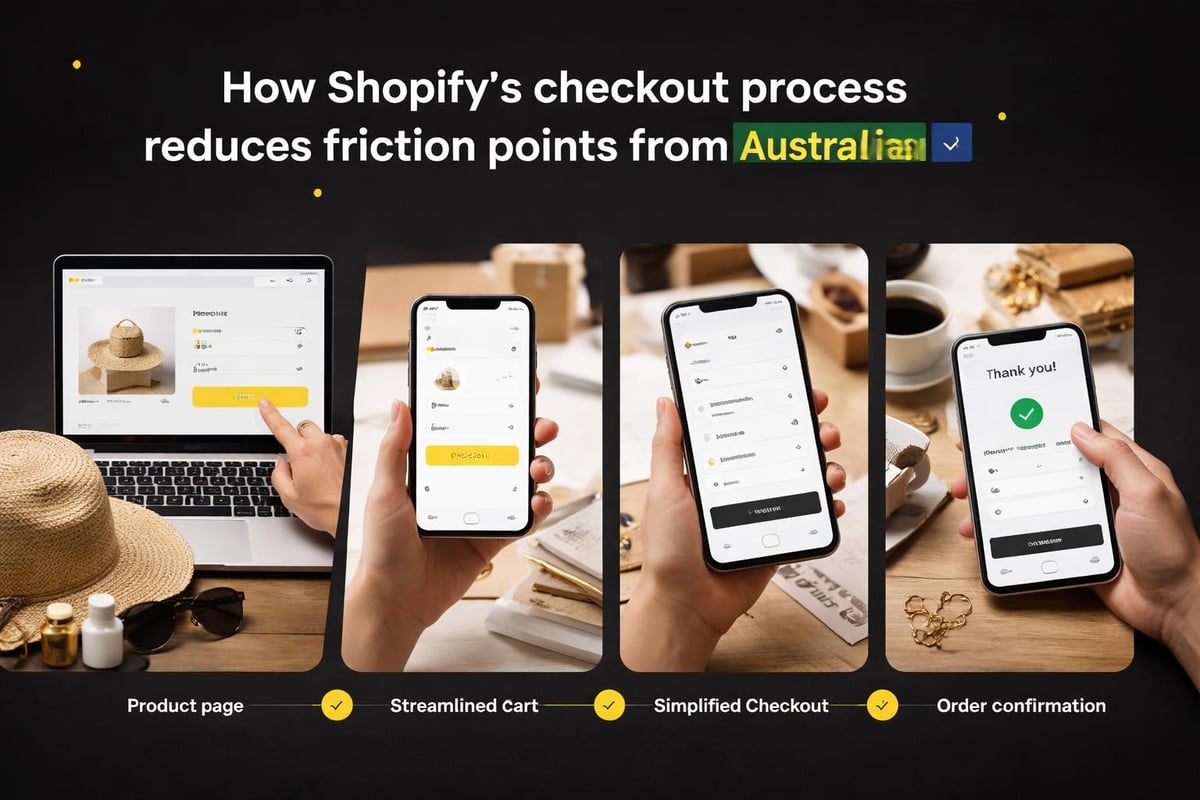
- Cart abandonment recovery built into the platform, not a third-party plugin
- Mobile-first checkout that doesn't require developer intervention
- Integrated payment processing that reduces checkout steps from seven to three
- Automatic tax calculation for Australian GST without manual configuration
Brisbane-based activewear brand Momentum Athletics saw their cart abandonment drop from 78% to 61% after migrating from a custom-built solution to Shopify. They changed nothing else. Same products, same pricing, same traffic sources.
The platform architecture handled friction removal.
What Small Business Shopify Success Actually Looks Like in Real Numbers
Industry case studies show polished brands with perfect photography and five-figure marketing budgets.
That's not representative.
Real small business Shopify success starts with different metrics: time to first sale, repeat purchase rate, average order value growth, and customer acquisition cost trends. A Ballarat candle maker launched their store in March 2025 with iPhone product photos and a $400 marketing budget. They generated $3,200 in revenue within their first 45 days.
Their conversion rate sat at 1.9%. Not exceptional, but profitable because their margins supported the customer acquisition cost. By month six, their repeat purchase rate reached 34%, which changed their business model from single-transaction to customer-lifetime-value focused.
The Technical Baseline That Separates Profitable from Struggling Stores
According to TechRadar’s comprehensive Shopify review, the platform's strength lies in its balance between simplicity and capability.
But simplicity doesn't mean automatic success.
Profitable small business Shopify stores in 2026 share specific technical configurations:
Product page load times under 2.1 seconds. Every additional second reduces conversion by 7%.
Mobile responsiveness that doesn't just resize, but restructures content hierarchy for thumb-based navigation.
Search functionality that handles Australian spelling variations and product synonyms without custom development.
Checkout that accepts multiple payment methods including Afterpay, which 43% of Australian consumers now expect as standard.
A Perth-based outdoor gear store increased their conversion rate from 1.4% to 2.8% by implementing these four technical baselines. They spent nothing on additional marketing. The same traffic converted at double the rate because the store removed purchasing friction.
This is what conversion-led Shopify development actually delivers: revenue increase without traffic increase.
The Cost Reality of Small Business Shopify in 2026
Platform fees represent the visible cost.
Development, apps, and opportunity cost represent the actual cost.
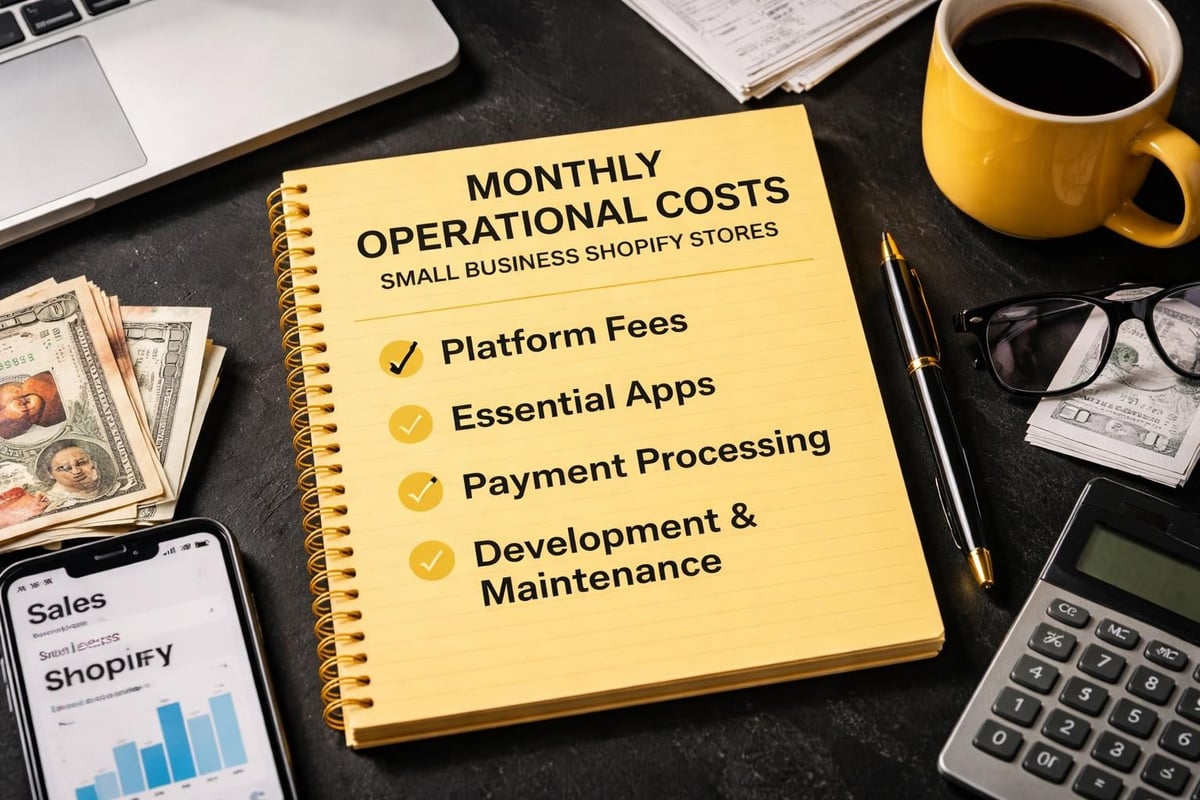
The Basic Shopify plan costs $79 AUD monthly. Most small businesses also need email marketing ($30-60 monthly), review collection ($15-30 monthly), and advanced analytics ($20-50 monthly). That's $144-219 monthly in predictable costs.
The unpredictable cost comes from three sources:
- Custom development when the business needs functionality beyond themes and apps
- Theme purchases and modifications that create visual differentiation
- Time spent learning platform specifics instead of running the business
A Sydney-based skincare brand spent $8,400 with an agency for a custom Shopify build that took fourteen weeks. A comparable Melbourne business used a structured four-week development process and spent $4,200. Both stores launched with similar functionality, similar conversion rates, and similar first-year revenue.
The difference wasn't quality. It was process efficiency and scope clarity.
| Cost Category | Agency Average | Structured Build | DIY Approach |
|---|---|---|---|
| Setup & Development | $6,000-15,000 | $3,500-5,500 | $0-800 |
| Time to Launch | 8-16 weeks | 3-5 weeks | 3-12 months |
| First-Year Apps | $1,800-3,600 | $1,200-2,400 | $600-1,800 |
| Revision Costs | $150-250/hour | Included in scope | Self-managed |
The comparison between platforms like Wix and Shopify often focuses on upfront costs while ignoring conversion performance. A lower monthly fee that converts poorly costs more than a higher monthly fee that converts well.
Small Business Shopify Apps That Actually Justify Their Monthly Cost
The Shopify App Store contains over 13,000 applications as of March 2026.
Most add complexity without adding revenue.
The apps that justify their cost for small Australian businesses solve specific conversion or operational problems. Email marketing apps like Klaviyo generate an average $42 in revenue for every dollar spent, according to platform benchmarks. That 42:1 ratio works because email connects to purchase intent, not general awareness.
Review collection apps like Judge.me or Loox increase conversion rates by 18-35% for product categories where social proof influences purchase decisions. A Hobart-based coffee roaster saw their conversion rate increase from 1.6% to 2.4% after implementing reviews with photo uploads from customers.
Apps small businesses should evaluate based on their business model:
- Subscription apps (Recharge, Seal Subscriptions) for consumable products with predictable replenishment cycles
- Upsell apps (Bold Upsell, Honeycomb) for stores with complementary product lines
- Loyalty programs (Smile.io, LoyaltyLion) for businesses where repeat purchase matters more than acquisition
- Inventory management (Stocky, TradeGecko) for businesses managing wholesale and retail simultaneously
The mistake isn't installing too many apps. It's installing apps before understanding the conversion problem they solve.
A Gold Coast activewear brand installed seven apps in their first month based on blog recommendations. Their site speed dropped 40%. Their conversion rate dropped from 2.1% to 1.3%. They removed five apps, kept two that addressed actual customer friction points, and their conversion recovered to 2.3%.
When Small Business Shopify Needs Custom Development
Most small businesses don't need custom development.
They need proper theme configuration.
Custom development becomes necessary when the business model requires functionality that doesn't exist in themes or apps. A subscription box business with complex variant logic and shipping rules might need custom checkout modifications. A wholesale business selling both B2B and B2C from the same store might need custom pricing logic.
But a standard retail store selling physical products?
Theme customisation handles 95% of requirements.
The business case for custom development requires clear ROI calculation. If custom filtering would increase conversion by 0.4% and the average customer lifetime value is $340, then the development cost needs to be recovered within a specific customer volume. For most small businesses launching their first store, that volume doesn't exist yet.
Focus on fundamentals first: product photography, clear descriptions, streamlined checkout, and basic SEO. Once those convert consistently, then evaluate custom development based on actual customer behaviour data.
For small Australian businesses launching their first Shopify store, a structured four-week development process covers everything needed to launch with clarity and momentum without agency bloat or missing fundamentals.
The SEO Reality for Small Business Shopify Stores in 2026
Shopify's technical SEO foundation is solid but not automatic.
The platform handles basics like mobile responsiveness, site speed architecture, and structured data. But ranking requires content strategy, not just technical compliance.
Small business Shopify stores compete in crowded product categories where established retailers dominate paid advertising and organic results. A new activewear brand won't outrank Lululemon for "women's leggings" regardless of their SEO strategy.
They can rank for "sustainable activewear Melbourne" or "chemical-free workout clothing Australia" because those queries have different competition levels and different search intent.
Shopify’s guide to small business SEO outlines the strategic approach: focus on long-tail keywords with purchase intent, build content around customer questions, and optimize for local search when relevant.
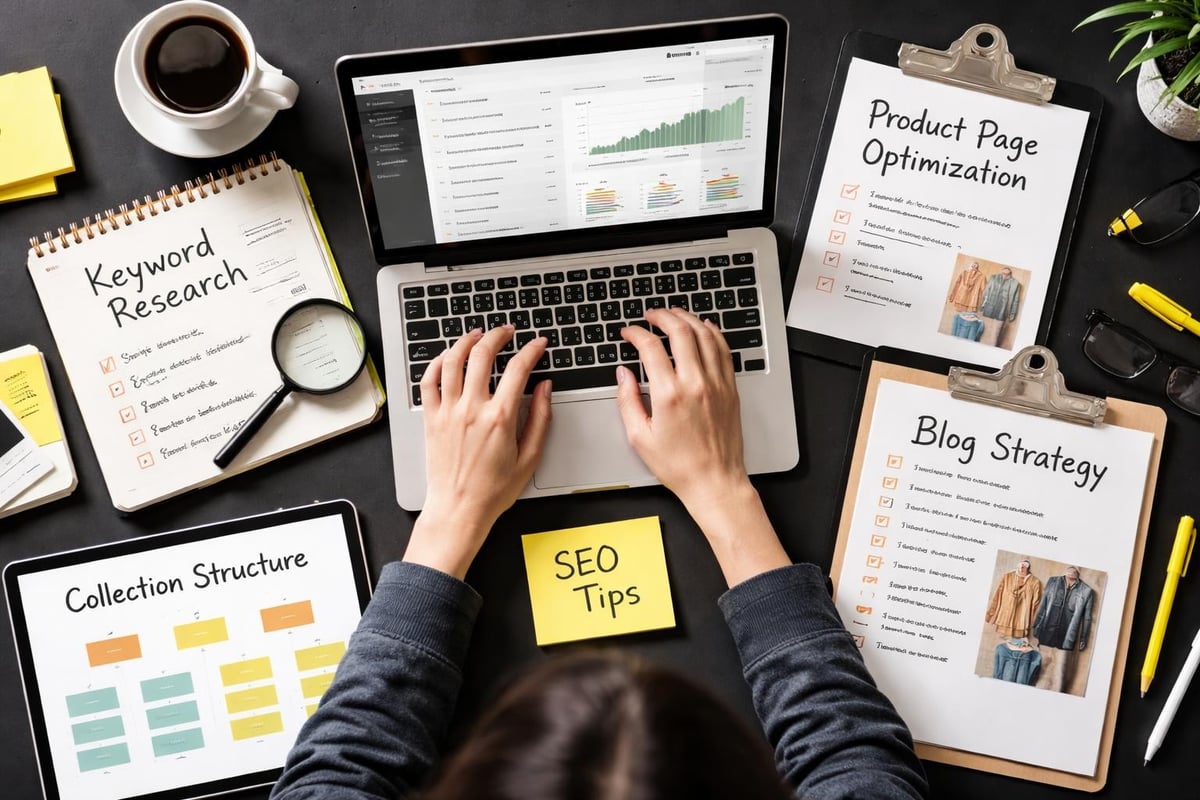
The technical implementation for Australian small businesses includes:
- Product page optimization with clear titles, detailed descriptions, and customer-focused language
- Collection page structure that groups products logically and targets category keywords
- Blog content that answers customer questions and builds topical authority
- Local SEO signals for businesses with physical locations or regional service areas
A Canberra-based furniture maker generated 40% of their first-year traffic from organic search by targeting specific queries like "custom timber dining tables Canberra" and "handmade furniture Australian hardwood." They didn't rank for "dining tables" or "furniture." They ranked for specific, intent-driven queries their target customers actually searched.
That's the SEO opportunity for small business Shopify stores: specific beats general when you lack domain authority and advertising budget.
Small Business Shopify Payment Processing and Transaction Costs
Shopify Payments removes a friction point but isn't always the cheapest option.
The platform's integrated payment processing charges 1.6% + 30¢ per transaction on the Basic plan for Australian businesses. Third-party payment gateways like PayPal or Stripe add an additional 0.5-2% platform fee on top of their own processing fees.
For most small businesses, Shopify Payments makes sense because:
- No additional transaction fees beyond credit card processing rates
- Faster payouts compared to third-party processors
- Integrated reporting that doesn't require reconciliation between systems
- Reduced cart abandonment because customers stay within the Shopify checkout flow
But businesses processing significant volume might negotiate better rates with dedicated payment processors. A business processing $50,000 monthly could save $200-400 monthly with a negotiated rate through a direct processor relationship.
The calculation depends on transaction volume, average order value, and processing rate differences.
For businesses under $20,000 monthly revenue, Shopify Payments typically offers the best combination of cost and convenience. Above that threshold, comparative analysis becomes worthwhile.
The Point-of-Sale Integration Most Small Businesses Overlook
Shopify's POS system connects online and offline inventory in real time.
This matters for businesses selling through multiple channels.
A Brisbane boutique selling both in-store and online had constant inventory discrepancies before implementing Shopify POS. They'd oversell products online that had just sold in-store. Customer frustration led to refunds and lost trust.
After POS integration, their inventory synchronized automatically. Online stock levels updated immediately when in-store sales occurred. They reduced overselling incidents from 12-15 monthly to zero.
According to TechRadar’s review of POS systems, Shopify's solution ranks among the most capable for small businesses needing omnichannel integration. The investment makes sense when the business has both physical and digital sales channels.
The Migration Decision: When Small Businesses Move to Shopify
Most small business Shopify migrations happen after frustration with existing platforms.
The trigger isn't feature comparison. It's conversion performance and operational efficiency.
A Melbourne homewares business spent eighteen months on WooCommerce with a 1.1% conversion rate. They migrated to Shopify and within six weeks their conversion rate reached 2.0%. Same products, same traffic sources, same marketing approach.
The platform change removed friction they didn't know existed.
Common migration triggers for small Australian businesses:
- Cart abandonment rates above 75% that don't improve with optimization attempts
- Page load speeds that degrade as product catalogues grow
- Plugin conflicts that break checkout functionality or create security vulnerabilities
- Mobile conversion rates significantly below desktop despite mobile traffic volume
The migration process takes 2-4 weeks for most small businesses with standard product catalogues under 500 SKUs. Complex migrations involving custom functionality, large product databases, or extensive content libraries can extend to 6-8 weeks.
Data preservation matters more than speed. Customer data, order history, and product information need accurate transfer to maintain business continuity and customer relationships.
According to NerdWallet’s Shopify analysis, the platform's migration tools handle standard eCommerce transitions efficiently, though businesses with custom databases or unique configurations might need development support.
The Small Business Shopify Theme Selection Process
The Shopify Theme Store contains 188 themes as of March 2026.
Most small businesses choose based on visual appeal rather than conversion architecture.
That's backwards.
Theme selection should prioritize structure over aesthetics because visual customization is straightforward while structural changes require development knowledge. A theme with poor collection page layout, weak product page information hierarchy, or inefficient checkout flow will underperform regardless of how polished it looks.
Structural elements that matter for conversion:
- Product image galleries that support multiple angles and zoom functionality
- Variant selection that clearly communicates available options without overwhelming choice
- Trust signals positioned near add-to-cart buttons (reviews, guarantees, shipping information)
- Mobile navigation that provides clear pathways without hamburger menu reliance
A Sydney-based jewellery business initially chose a theme based on its minimal aesthetic. Their conversion rate plateaued at 1.3% because the theme's product pages buried critical information like sizing, materials, and shipping details.
They switched to a theme with better information architecture and their conversion rate increased to 2.1% within three weeks. The new theme was less visually distinctive but functionally superior.
For small businesses evaluating themes, the detailed platform reviews from Business.org provide comparative analysis of theme capabilities beyond surface-level design.
Small Business Shopify Customer Service Architecture
Customer service becomes a bottleneck as small business Shopify stores scale.
A business managing five daily orders handles customer questions through email without issues. At fifty daily orders, that same approach creates response delays, missed questions, and frustrated customers.
The architecture needs to scale before the volume forces it.
Research on Shopify customer service challenges shows that small businesses struggle most with question volume during growth phases. Pre-purchase questions about products, sizing, or shipping need faster responses than post-purchase support issues.
Service architecture that scales with small business growth:
- FAQ pages addressing the 20 most common questions reduces inquiry volume by 30-40%
- Live chat during peak browsing hours (typically 6-9 PM AEST) improves conversion by 15-20%
- Automated email responses acknowledging receipt and setting expectations reduces perceived wait time
- Help desk software organizing inquiries by urgency and topic prevents missed questions
A Perth-based skincare brand implemented a tiered support system: automated responses for common questions, live chat during business hours, and email follow-up for complex issues. Their customer satisfaction scores increased from 3.8 to 4.6 out of 5 while their support time investment decreased by 20%.
The system cost $89 monthly in tools but saved approximately 12 hours weekly in manual email management.
The Technology Adoption Challenge for Australian Small Businesses
Technology investment creates revenue opportunity but requires upfront cost and learning time.
According to recent research on SMB technology adoption, 68% of small businesses want to leverage technology for growth but 54% cite cost as a significant barrier.
That's the small business Shopify paradox: the platform investment that would improve conversion requires capital that constrained conversion rates make difficult to generate.
The solution isn't waiting until cash flow improves. It's structuring implementation to generate return quickly. A phased launch that prioritizes revenue-generating functionality over perfect customization generates cash flow that funds subsequent improvements.
Phase 1: Core product catalogue, functional checkout, basic theme customization (weeks 1-2)
Phase 2: Email collection, review integration, essential apps (weeks 3-4)
Phase 3: Content development, SEO optimization, conversion rate testing (months 2-3)
This approach gets the store generating revenue within four weeks while building toward comprehensive functionality over three months. A Ballarat outdoor equipment business launched using this phased approach and generated $6,800 in revenue during their first partial month with a minimal product catalogue and basic theme setup.
They used that revenue to fund expanded product photography, additional product variants, and email marketing infrastructure in month two.
What Small Business Shopify Analytics Actually Reveal
Most small businesses track revenue and order volume.
Those are outcome metrics, not decision metrics.
The analytics that inform better decisions reveal why conversion happens or doesn't: traffic sources that convert versus those that browse, product pages where visitors abandon, checkout steps where cart abandonment spikes, and device types with conversion rate differences.
A Adelaide-based coffee roaster discovered through analytics that their mobile conversion rate was 0.9% compared to 2.4% desktop. The issue wasn't mobile traffic quality. It was their product page image gallery that didn't function properly on mobile devices.
They fixed the gallery code and mobile conversion increased to 2.1% within a week. Same traffic, same products, dramatically different revenue because they addressed the actual friction point.
Analytics worth reviewing weekly for small business Shopify stores:
- Conversion rate by traffic source to identify which marketing channels generate buyers versus browsers
- Cart abandonment by checkout step to reveal where purchase intent breaks down
- Product page exit rates to identify listings that fail to communicate value
- Average order value trends to understand whether customers are buying more or less per transaction
These metrics inform specific improvements rather than general optimization attempts.
The Competitive Reality for Small Business Shopify Success in 2026
Over 2.1 million businesses use Shopify globally as of March 2026.
That's not a limitation. That's validation.
The platform's ubiquity means proven conversion patterns, extensive app ecosystems, abundant development resources, and established customer trust. When a customer sees "Checkout by Shopify," they recognize the process and trust the security.
Small Australian businesses compete on positioning, not platform uniqueness. A handmade jewellery business doesn't win by choosing an obscure platform. They win by communicating their craftsmanship, sustainability practices, or design philosophy more clearly than competitors.
The platform facilitates the transaction. The business creates the differentiation.
According to OnDeck’s guide to small business Shopify use, successful businesses focus platform investment on conversion optimization while directing creative energy toward brand differentiation and customer relationships.
That balance determines whether small business Shopify stores survive their first year or scale into sustainable revenue engines.
The reality of small business Shopify success in 2026 comes down to removing friction between customer intent and completed purchase. Most businesses don't need revolutionary platforms or custom development. They need proper structure, clear processes, and conversion-focused implementation. If you're a small Australian eCommerce business ready to launch a store that converts browsers into buyers without agency bloat or endless DIY confusion, Kida Digital specializes in building scalable Shopify stores from concept to launch in four weeks with clarity, momentum, and a strategy that prioritizes revenue from day one.


Be the first to comment