

Launching ecommerce for small business isn't the mystery it was five years ago, but it's still far from simple.
You're competing against established brands with bigger budgets and more resources. You're learning technical systems while running your actual business. And you're making decisions that will either support growth or create costly headaches later. The good news? You don't need a six-figure budget or a tech degree to build something that works. You need clarity, the right foundation, and a plan that matches where you are right now.
Understanding the Ecommerce Landscape for Australian Small Businesses
The ecommerce market in Australia hit $63.6 billion in 2025, with projections showing continued growth through 2026 and beyond.
Small businesses now account for 42% of that revenue, proving you don't need warehouse-scale operations to compete.
But size doesn't determine success. Strategy does.
What separates thriving stores from struggling ones:
- Clear target audience definition before building anything
- Product-market fit validated through real customer conversations
- Systems that scale without constant manual intervention
- Focus on conversion rate, not just traffic volume
The biggest mistake small business owners make is treating ecommerce like a website project. It's not. It's a sales channel that needs the same strategic thinking as your physical location or wholesale partnerships.
Platform Selection Matters More Than You Think
Choosing the wrong platform is expensive.
Not just in money, but in time, momentum, and opportunity cost.
Selecting the best ecommerce platform comes down to three factors: what you're selling, how you operate, and where you want to be in two years.
Shopify dominates the Australian small business space for good reason:
- 99.99% uptime means your store doesn't go down when you're sleeping
- Built-in payment processing removes one major technical hurdle
- App ecosystem solves specific problems without custom development
- PCI compliance is handled automatically
WooCommerce suits businesses already invested in WordPress or needing extreme customisation. BigCommerce works for larger catalogues with complex variations. Wix appeals to design-focused businesses with simpler product ranges.
None of these choices are wrong. But they're not all right for your specific situation.

Building Your Store Foundation Without Agency Bloat
The average agency charges $10,000 to $25,000 for a Shopify store that could launch in four weeks.
They're not scamming you. They're covering overhead, account managers, revision rounds, and profit margins.
But most small businesses don't need that structure. They need a functional store that converts visitors into customers without the bloat.
Core elements every ecommerce store actually needs:
- Clean product pages with high-quality images
- Transparent shipping and return policies
- Mobile-responsive design (72% of Australian ecommerce traffic is mobile)
- Fast page load times under 3 seconds
- Simple checkout with guest purchase option
- Basic email capture and abandoned cart recovery
That's it for launch. Everything else is optimisation.
The Done-for-you Shopify package at Kida Digital covers these fundamentals in a four-week timeline, providing small Australian eCommerce businesses with a conversion-focused foundation without agency pricing or DIY uncertainty.
Product Cataloguing Strategy
How you structure products determines how easily customers find what they need.
Flat catalogues with poor categorisation create friction. Too many options without guidance creates decision paralysis.
| Catalogue Size | Recommended Structure | Navigation Priority |
|---|---|---|
| Under 50 products | Single-level categories | Featured collections |
| 50-200 products | Two-level categories | Search + filters |
| 200+ products | Multi-level with tags | Advanced filtering |
Use product tags for cross-category attributes like "vegan," "gift-ready," or "Australian-made."
Collections should tell a story or solve a problem, not just group items by type.
Content and Authority in Ecommerce for Small Business
Product pages aren't enough to rank in Google or build customer trust.
You need content that demonstrates expertise and answers questions your customers are actually asking.
This is where establishing authority in your ecommerce niche becomes non-negotiable.
Content types that actually drive traffic and conversions:
- Buying guides comparing products or explaining selection criteria
- How-to articles showing product usage in real scenarios
- Category pages with educational content above product grids
- Customer stories and use cases (not just testimonials)
- FAQ content addressing objections and concerns
Blog posts sitting in isolation don't help. They need to connect to products, link to category pages, and guide customers toward purchase decisions.
Write for humans first, search engines second. But don't ignore SEO fundamentals.
SEO Foundations for Small Business Stores
Ecommerce SEO isn't complicated, but it is specific.
Optimising Shopify product pages requires attention to title tags, meta descriptions, image alt text, and structured data.
Page speed matters more in 2026 than it did in 2024. Google's Core Web Vitals now directly impact rankings for ecommerce sites.
Technical SEO checklist for small stores:
- XML sitemap submitted to Google Search Console
- Robots.txt properly configured
- Canonical tags preventing duplicate content issues
- HTTPS enabled across entire site
- Structured data markup for products and reviews
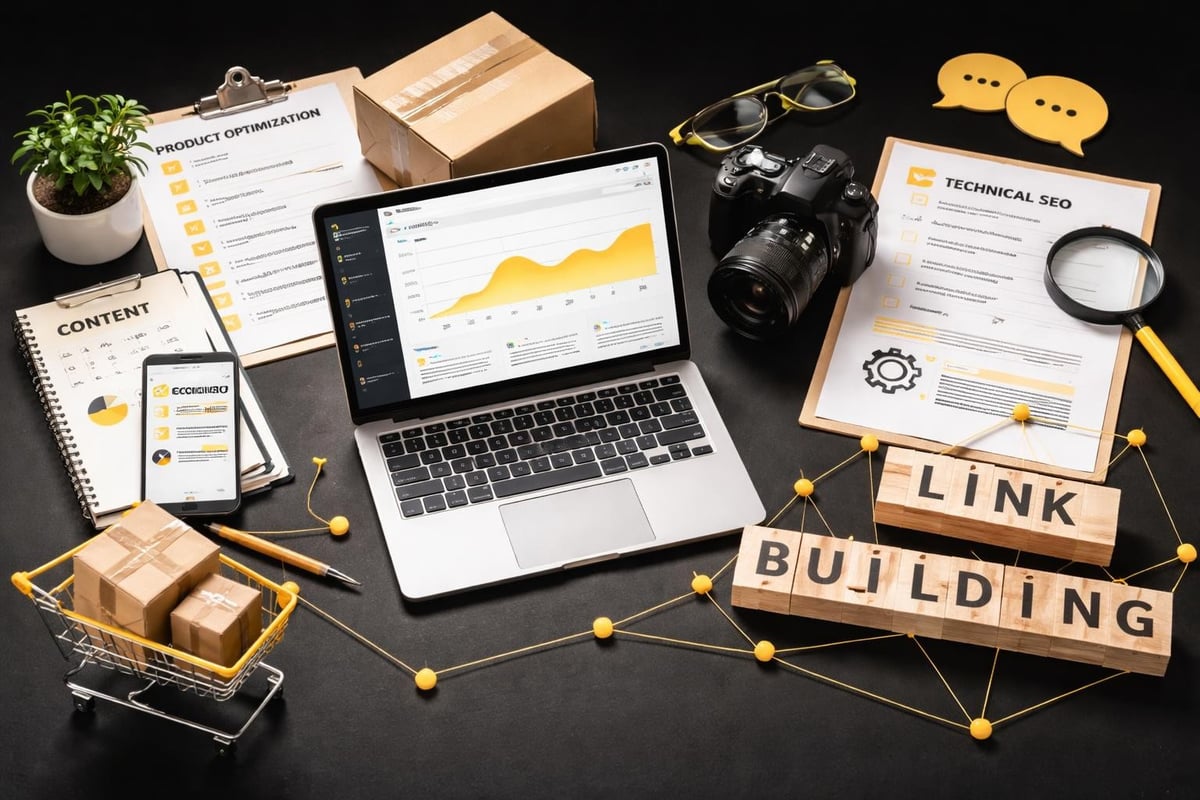
Link building for small ecommerce sites requires a different approach than content sites. Focus on quality over quantity in your link-building strategy through partnerships, supplier relationships, and genuine business connections.
Conversion Rate Optimisation From Day One
Traffic without conversions is expensive validation.
The average Australian ecommerce conversion rate sits between 1.8% and 2.5% in 2026. Anything below 1.5% signals fundamental issues.
Common conversion killers in small business stores:
- Unclear shipping costs or policies
- Complicated checkout requiring account creation
- Poor mobile experience
- Missing trust signals (reviews, security badges, contact info)
- Slow page loads breaking user patience
- Weak product photography
Fix these before spending money on traffic.
Trust particularly matters for new stores. Customers need reassurance you're legitimate, reliable, and won't disappear after taking their money.
Building Trust Without Years in Business
New stores face a credibility gap.
You can't claim "trusted since 1995" or showcase thousands of reviews.
Trust signals that work for new businesses:
- Clear contact information with Australian phone number
- About page with real photos and story
- Transparent policies written in plain language
- Industry certifications or memberships
- Social proof through early customer reviews
- Active social media presence
Security badges from your payment processor (Shopify Payments, Stripe, PayPal) belong in your footer and checkout.
Money-back guarantees reduce purchase anxiety, especially for higher-priced items.
Marketing Your Store Beyond "Build It and They'll Come"
No one finds your store by accident.
You need deliberate marketing channels driving targeted traffic.
Understanding ecommerce best practices includes knowing which marketing channels actually work for small budgets.
Effective channels for small business ecommerce:
- Google Shopping ads (highest intent traffic)
- Email marketing (best ROI for repeat purchases)
- Meta ads (Facebook and Instagram for discovery)
- SEO (long-term organic traffic)
- Partnerships (complementary businesses and influencers)
Skip TikTok unless your audience lives there. Ignore LinkedIn unless you're B2B.
Email Marketing as Your Revenue Engine
Email drives 25-30% of revenue for established ecommerce stores.
It's not optional.
Start collecting emails from day one through pop-ups, checkout, and content downloads.
Essential email flows to set up immediately:
- Welcome series introducing your brand and bestsellers
- Abandoned cart recovery (recovers 5-10% of lost sales)
- Post-purchase follow-up requesting reviews
- Win-back campaign for inactive customers
Don't overthink design. Plain text emails from a real person often outperform branded templates.
Send value before asking for purchases. Educational content, tips, and behind-the-scenes updates build relationships.

Operations and Fulfilment Reality Check
Selling products is the fun part.
Packing boxes at 10 PM while managing customer enquiries and updating inventory is the reality.
Operational decisions to make before launch:
- In-house fulfilment vs third-party logistics (3PL)
- Inventory management system or spreadsheets
- Customer service platform (help desk, email, or phone)
- Returns process and who pays shipping
- Packaging supplies and branding
Start simple. You can always upgrade systems as volume increases.
Aussie Post, Sendle, and CouriersPlease all integrate with Shopify. Compare rates based on your average package size and destinations.
Inventory Management Without Losing Your Mind
Stockouts kill momentum.
Overstock kills cash flow.
Inventory management for small businesses balances both risks.
| Inventory Approach | Best For | Risk Level |
|---|---|---|
| Made-to-order | Custom/handmade products | Low stock risk, high lead time |
| Small batch pre-order | Testing demand | Medium risk, builds anticipation |
| Conservative stock levels | Proven sellers | Balanced approach |
| Dropshipping | Testing products | No stock risk, less control |
Use actual sales data, not optimism, to inform reorder quantities.
Most platforms track inventory automatically. Set low-stock alerts so you're not caught surprised.
Payment Processing and Financial Management
Payment processing seems straightforward until you're comparing transaction fees, payout schedules, and currency conversion rates.
Shopify Payments (powered by Stripe) is the path of least resistance for Australian stores. Zero transaction fees beyond credit card processing (around 2.4% + 30 cents per transaction).
PayPal adds 2.6% + 30 cents but some customers prefer it.
Afterpay and other buy-now-pay-later options increase average order value by 20-30% but charge 4-6% in merchant fees.
Financial systems to implement:
- Separate business bank account
- Accounting software (Xero integrates with Shopify)
- Sales tax compliance (GST for Australian businesses)
- Profit tracking by product line
Know your numbers weekly, not quarterly.
Cash flow management matters more than total revenue. A $100,000 revenue month means nothing if your costs were $105,000.
Growth Without Burning Out
Scaling ecommerce for small business requires systems, not just hustle.
The businesses that survive year three automate repetitive tasks and build processes that don't require constant oversight.
Automation opportunities in small stores:
- Email flows triggered by customer behaviour
- Inventory alerts and reorder reminders
- Review request campaigns
- Social media post scheduling
- Customer support FAQs and chatbots
You'll never eliminate manual work completely. But you can reduce it from 60 hours a week to 20.
How fast you can actually build a Shopify store depends on preparation. Having products, images, and copy ready before touching the platform makes the build phase quick.
When to Hire Help vs DIY
Not everything belongs on your plate.
Product photography, conversion rate optimisation, and technical SEO deliver better ROI when handled by specialists.
Basic content creation, customer service, and social media management stay in-house longer.
The question isn't "can I do this myself?" but "should I?"
Your time has a dollar value. Calculate it honestly.
Platform-Specific Considerations for Shopify Users
Shopify owns 32% of the Australian ecommerce platform market in 2026.
It's not perfect, but it's predictable.
Understanding Shopify web development helps you make smarter decisions about themes, apps, and customisation.
Shopify strengths:
- Reliability and uptime
- App ecosystem solving specific problems
- Regular platform updates and security patches
- Strong community support
Shopify limitations:
- Monthly fees regardless of sales
- Transaction fees if not using Shopify Payments
- Blog functionality is basic
- Advanced customisation requires developer help
Most small businesses never hit Shopify's limitations. The basic plan handles everything needed for $39 AUD monthly.
Choose a theme based on your product type, not just aesthetics. Fashion needs different layouts than homewares or digital products.
Real Numbers Behind Ecommerce Success
Averages lie, but they provide context.
Small business ecommerce data shows most stores hit profitability between months 6 and 12.
Year one is building foundations. Year two is optimising. Year three is scaling.
Realistic benchmarks for new stores:
- First month sales: $500-$2,000
- Month 6 sales: $3,000-$8,000
- Year 1 total revenue: $30,000-$80,000
- First-year profit margin: 15-25% (if you're lucky)
These numbers assume consistent marketing effort and product-market fit.
Some businesses exceed them. Many don't hit them. The point is having realistic expectations.
Customer acquisition cost (CAC) in year one often exceeds customer lifetime value (LTV). That's normal. You're buying data and learning what works.
By year two, LTV should be at least 3X your CAC. That's when the business model proves itself.
Ecommerce for small business works when you match strategy to resources and stay focused on fundamentals over trends. The platform matters less than the approach. If you're ready to launch a Shopify store without agency bloat or DIY uncertainty, Kida Digital builds conversion-focused foundations for Australian small businesses in four weeks. Clear process, no fluff, just the systems you need to start selling.


Be the first to comment