
Building an online store in 2026 means navigating dozens of platform options, security requirements, and conversion strategies before writing a single product description. Most small Australian businesses get stuck at the planning stage or launch something that looks professional but doesn't convert browsers into buyers. Ecommerce site development isn't about creating the prettiest website. It's about building a system that turns traffic into revenue while you sleep.
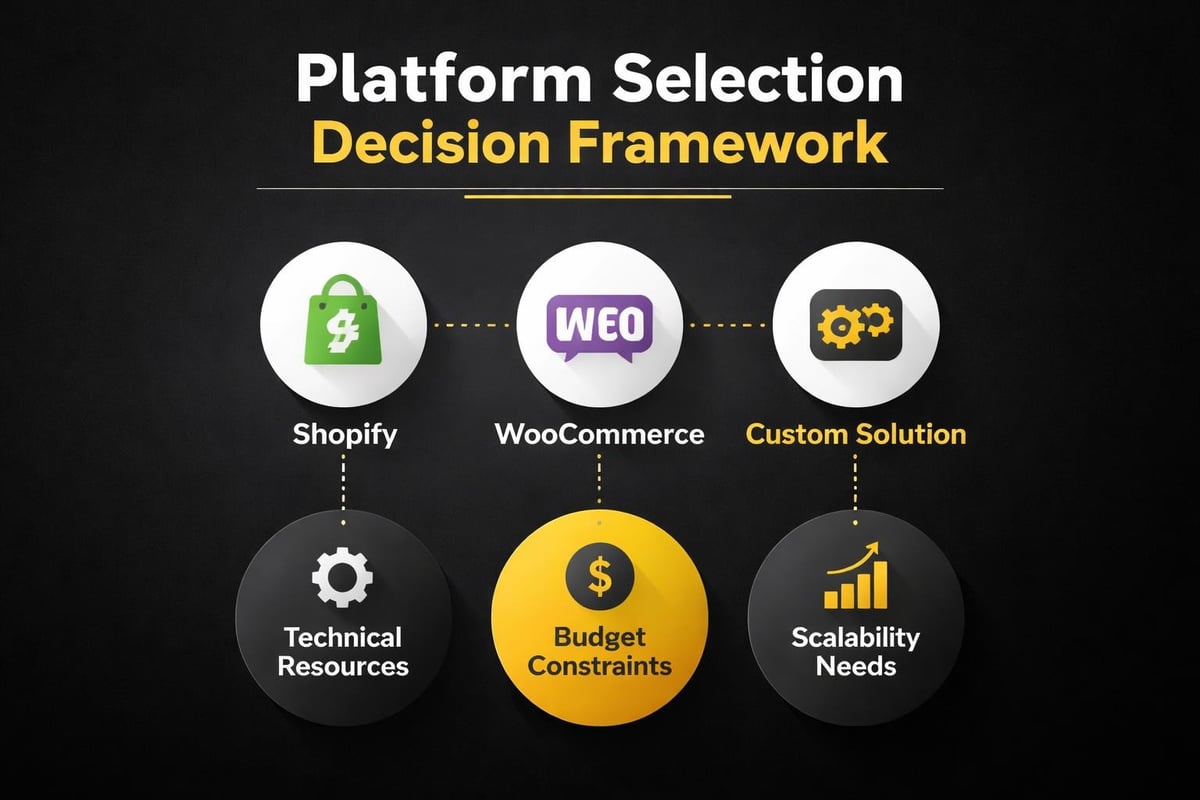
Platform Selection Sets Your Growth Ceiling
Your platform choice determines everything from transaction fees to scalability limits.
Shopify dominates the Australian ecommerce landscape with 32% market share, while WooCommerce holds 22% and Wix captures 8%. These numbers matter because switching platforms later costs thousands in migration fees and lost momentum.
Shopify offers the fastest path to revenue for product-based businesses.
The platform handles hosting, security updates, and PCI compliance automatically.
You avoid technical debt that accumulates with self-hosted solutions.
WooCommerce gives more control but demands ongoing maintenance.
You'll manage plugin conflicts, security patches, and hosting performance yourself.
This works for businesses with in-house technical teams or specific customization needs.
| Platform | Monthly Cost | Technical Skills Required | Time to Launch |
|---|---|---|---|
| Shopify | $39-$399 | Minimal | 2-4 weeks |
| WooCommerce | $30-$200+ hosting | Moderate-High | 4-8 weeks |
| Custom Build | $500+ hosting | High | 12-24 weeks |
The core Shopify package approach eliminates the technical complexity small Australian businesses face when launching their first store, providing everything needed within four weeks without agency overhead.
Design Fundamentals That Actually Drive Sales
Beautiful design means nothing if customers can't find the checkout button.
Conversion-focused ecommerce site development prioritizes user flow over aesthetics.
Your homepage should answer three questions within five seconds: what you sell, why it matters, and where to start browsing.
Navigation structures determine whether visitors explore or exit.
Limit your main menu to five to seven categories maximum.
Every additional menu item reduces decision-making speed by 8%, according to Nielsen Norman Group research.
Product pages need specific elements in consistent locations:
- High-resolution images with zoom functionality
- Clear pricing without hidden calculation requirements
- Prominent add-to-cart buttons above the fold
- Trust signals like reviews and security badges
- Detailed specifications in scannable formats
Mobile commerce represents 67% of Australian online sales in 2026.
Your site must load within three seconds on 4G connections.
Google data shows 53% of mobile visitors abandon sites that take longer than three seconds to load.
Consistent branding across every touchpoint builds recognition and trust, as outlined in ecommerce website development best practices.
Fast loading times directly impact your bottom line.
A one-second delay in page load time reduces conversions by 7%.
For a store generating $10,000 monthly, that's $700 lost to slow hosting.
Security Requirements Aren't Optional Anymore
Customers won't enter credit card details on sites that look unsafe.
SSL certificates moved from optional to mandatory in 2018.
Browsers now display "Not Secure" warnings for any site without HTTPS encryption.
This single warning reduces conversion rates by up to 85% on checkout pages.
Security requirements include HTTPS protocol, SSL encryption, and PCI DSS compliance for any business processing credit cards.
Modern ecommerce site development demands layered security:
Payment gateway integration handles sensitive data processing off your server.
This reduces your PCI compliance burden significantly.
Shopify and similar platforms manage this automatically, while self-hosted solutions require manual configuration.
Two-factor authentication protects admin access from unauthorized logins.
The Australian Cyber Security Centre reports that 2FA prevents 99.9% of automated attacks.
Enable it for every account with administrative privileges.
Regular security scanning identifies vulnerabilities before hackers do.
Adding an automatic scanner to your website provides continuous monitoring for malware, SQL injections, and cross-site scripting attempts.
Data backup systems save businesses when attacks succeed.
Daily automated backups to separate servers prevent total loss during ransomware attacks.
Test restoration procedures quarterly to verify backup integrity.

Payment and Checkout Optimization
Cart abandonment rates average 70% across Australian ecommerce sites.
Checkout friction kills conversions faster than any other single factor.
Reduce form fields to absolute minimums.
Every additional field decreases completion rates by 5-10%.
Guest checkout options increase completed purchases by 23% according to Baymard Institute research.
Multiple payment options match customer preferences.
Offer credit cards, PayPal, and buy-now-pay-later services like Afterpay or Zip.
Australian shoppers expect Afterpay specifically, with 3.6 million active users nationwide.
Express checkout buttons eliminate unnecessary steps.
Shop Pay, Apple Pay, and Google Pay auto-fill shipping and payment details.
These one-click options boost mobile conversion rates by 40%.
Transparent shipping costs prevent checkout abandonment.
Display total costs including shipping before customers enter payment details.
Unexpected fees at checkout cause 48% of cart abandonments.
Progress indicators show customers how close they are to completion.
Simple "Step 2 of 3" messaging reduces abandonment by 12%.
Visual progress bars work even better for maintaining momentum.
Technical Infrastructure for Growth
Your ecommerce site development choices today determine your scaling costs tomorrow.
Hosting performance impacts every metric from SEO rankings to conversion rates.
Shared hosting costs $10 monthly but crashes during traffic spikes.
Managed cloud hosting costs $50-200 monthly but handles 10x traffic without slowdowns.
Content delivery networks (CDNs) accelerate global performance.
They cache your site content across worldwide servers.
Australian customers load pages from Sydney servers while US visitors access Los Angeles nodes.
This geographical distribution reduces load times by 40-60%.
Database optimization prevents slowdowns as product catalogues grow.
Stores with 10,000+ SKUs need proper indexing and caching strategies.
Regular database cleanup removes orphaned data that bloats file sizes.
API integrations connect your store to essential business tools.
Inventory management systems sync stock levels across multiple sales channels.
Email marketing platforms trigger abandoned cart sequences automatically.
Accounting software like Xero imports transactions without manual data entry.
Content Strategy Beyond Product Descriptions
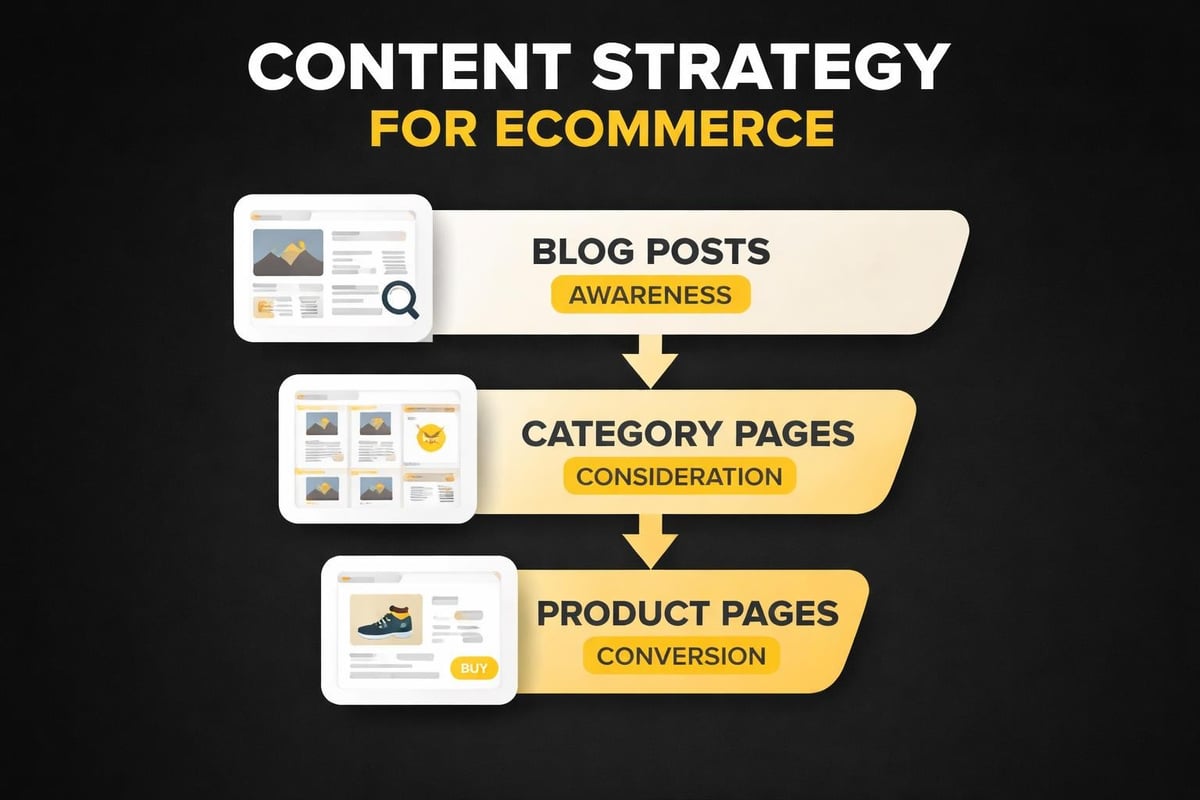
Ecommerce site development includes the content foundation that drives organic traffic.
Product pages need optimization for both customers and search engines.
Write unique descriptions for every product instead of copying manufacturer text.
Include specific details buyers search for: dimensions, materials, compatibility, care instructions.
SEO optimization for Shopify product pages requires strategic keyword placement without sacrificing readability.
Category pages rank for broader search terms that drive discovery traffic.
Optimize category descriptions with 300-500 words of helpful buying guidance.
Explain differences between product variations and recommend use cases.
Blog content builds authority and captures research-phase traffic:
- How-to guides related to your products
- Comparison articles between different options
- Industry trend analysis and insights
- Customer success stories and case studies
Educational content converts at lower rates but builds trust with future buyers.
Someone reading "How to Choose Running Shoes" today might purchase next week.
They're five times more likely to buy from the site that educated them.
Mobile-First Development Requirements
Desktop-first design thinking died in 2020 when mobile surpassed 60% of traffic.
Responsive design adjusts layouts for different screen sizes.
Mobile-first development builds for small screens then enhances for larger displays.
This approach ensures core functionality works on every device.
Touch targets need minimum 44×44 pixel dimensions.
Smaller buttons cause mis-taps and frustration on mobile devices.
Spacing between interactive elements prevents accidental clicks.
Simplified mobile navigation reduces cognitive load:
Hamburger menus hide complex navigation until needed.
Sticky headers keep search and cart access available while scrolling.
Bottom navigation bars place key actions within thumb reach.
Image optimization cuts mobile data usage and load times.
Serve appropriately sized images based on device capabilities.
A 2000×2000 pixel image wastes bandwidth on 400-pixel-wide phone screens.
Accelerated Mobile Pages (AMP) prioritize speed over features.
AMP product pages load in under one second on 3G connections.
This extreme optimization trades some functionality for maximum accessibility.
Testing and Quality Assurance
Launching without testing is like opening a physical store without checking if the doors work.
Cross-browser compatibility ensures consistent experiences.
Test on Chrome, Safari, Firefox, and Edge at minimum.
Mobile testing requires iOS Safari and Android Chrome specifically.
User acceptance testing reveals real-world problems:
Give five people $20 each to complete test purchases.
Watch them navigate your site without assistance or guidance.
Note every point of confusion or hesitation.
A/B testing optimizes conversion elements scientifically.
Test one variable at a time: button colors, headline copy, image placement.
Run tests until reaching statistical significance, typically 100+ conversions per variation.
Load testing simulates traffic spikes before they happen.
Tools like LoadImpact or BlazeMeter stress-test your infrastructure.
Identify breaking points before your first viral social post crashes the site.
Security testing protects customer data and business reputation.
Common web application vulnerabilities include SQL injections, cross-site scripting, and brute force attacks that automated scanners can detect.
Post-Launch Optimization
Ecommerce site development continues long after the initial launch.
Analytics implementation tracks customer behavior and revenue sources.
Google Analytics 4 shows which products generate revenue and which landing pages convert best.
Enhanced ecommerce tracking reveals exactly where customers abandon checkout sequences.
Heatmap tools like Hotjar or Crazy Egg visualize user interactions.
See which homepage sections get attention and which get ignored.
Discover if customers try clicking non-clickable elements.
Conversion rate optimization follows data, not opinions:
Review analytics weekly for the first month post-launch.
Identify the three biggest drop-off points in your funnel.
Address the highest-impact issue first, then retest.
Customer feedback provides qualitative insights analytics miss.
Post-purchase surveys ask "What almost stopped you from buying?"
Exit-intent surveys capture abandonment reasons in real time.
Performance monitoring alerts you to technical issues immediately.
Uptime monitoring services like Pingdom notify you within minutes of downtime.
Speed monitoring tracks load times and alerts when pages slow beyond thresholds.
Integration Ecosystem Planning
Your store doesn't exist in isolation from your business operations.
Inventory management systems prevent overselling and stockouts.
Real-time sync between your warehouse and website eliminates manual updates.
Multi-channel inventory tools manage stock across your store, Amazon, and eBay simultaneously.
Customer relationship management (CRM) platforms centralize customer data.
Track purchase history, support tickets, and email engagement in one system.
Klaviyo and Omnisend specialize in ecommerce customer journeys.
Accounting integration eliminates duplicate data entry:
Automatic transaction imports save 10-15 hours monthly.
Xero and QuickBooks sync orders, refunds, and fees daily.
Tax calculation updates based on current rates and regulations.
Shipping carrier integration streamlines fulfillment processes.
Generate shipping labels directly from order management screens.
Provide real-time tracking information to customers automatically.
Marketing automation connects customer behavior to communication sequences.
Abandoned cart emails recover 10-15% of lost sales.
Post-purchase sequences request reviews and suggest complementary products.
Maintenance and Growth Planning
Technical maintenance prevents small issues from becoming catastrophic failures.
Plugin and theme updates patch security vulnerabilities.
Test updates on staging environments before applying to live sites.
WordPress and WooCommerce sites require monthly update cycles minimum.
Regular content audits keep information current:
Review product information quarterly for accuracy.
Update seasonal landing pages before peak periods.
Refresh blog content that ranks well but contains outdated information.
Performance audits identify accumulating technical debt.
Page load times gradually increase as you add products and features.
Quarterly performance reviews catch slowdowns before they impact conversions.
Backup verification ensures disaster recovery plans actually work.
Monthly restoration tests confirm backups contain complete, usable data.
Many businesses discover backup failures only after disasters strike.
Security audits protect against evolving threats.
Hardening user authentication and access control prevents unauthorized administrative access.
Annual third-party security assessments provide independent vulnerability verification.
The difference between Shopify websites that thrive and those that stagnate comes down to consistent optimization cycles.
Ecommerce site development requires strategic decisions about platforms, security, design, and infrastructure that impact your business for years. Getting these fundamentals right the first time prevents costly rebuilds and lost revenue opportunities. Kida Digital helps Australian small businesses launch conversion-focused Shopify stores in four weeks, handling the technical complexity while you focus on your products and customers.


Be the first to comment