

Setting up a Shopify store is the easy part. Making it profitable is where most Australian small businesses hit a wall. You can follow every tutorial, choose a beautiful theme, and launch in a weekend, but conversion rates tell a different story. The gap between "store online" and "store making sales" is where strategy, structure, and experience separate functional stores from revenue-generating assets. This isn't about perfection or endless tweaking – it's about building with intent from day one.
Why Most Shopify Stores Don't Convert
The platform itself is solid.
Shopify powers over 4.8 million stores globally, with Australian merchants representing a growing segment of that ecosystem.
But having a store doesn't guarantee sales.
Most new store owners focus on aesthetics before strategy.
They choose themes based on appearance rather than conversion architecture.
They add products without considering how customers actually navigate purchase decisions.
The result is a shopify store that looks professional but doesn't guide visitors toward checkout.
Common structural failures include:
- Navigation that confuses rather than directs
- Product pages missing key trust elements
- Checkout friction that abandons 70% of carts on average
- Mobile experience treated as an afterthought when 60% of traffic comes from phones
The issue isn't the platform.
It's the approach.
The Foundation Most Stores Skip
Before you upload a single product, your shopify store needs a conversion framework.
That means understanding your customer journey from landing page to thank-you screen.
It means knowing which integrations support sales versus which create bloat.
It means building for scalability, not just launch.
Australian stores face specific challenges here.
Shipping costs, GST compliance, Australia Post integration, payment gateway options suited to local preferences.
These aren't optional considerations you add later – they're foundation elements that affect customer trust and operational efficiency from the start.

What Actually Drives Sales on Shopify
Speed matters more than you think.
A one-second delay in page load time can reduce conversions by 7%, according to multiple industry studies.
Your shopify store might look beautiful, but if it takes four seconds to load on a phone, you've lost the sale before they see your hero image.
Product pages carry the conversion weight.
Every element on that page either builds trust or creates doubt.
High-quality images (multiple angles, lifestyle context), clear descriptions that answer objections, visible reviews, transparent shipping information, and a friction-free add-to-cart experience.
Essential conversion elements:
- Social proof through reviews and ratings
- Clear return policy displayed prominently
- Security badges near checkout triggers
- Stock indicators creating appropriate urgency
- Multiple payment options including local preferences
For small Australian businesses, this means prioritizing Afterpay or Zip integration, displaying shipping costs upfront, and using AusPost tracking.
These aren't premium features – they're table stakes for competitive conversion rates.
Building vs Optimizing Your Store
There's a critical difference between launching and building properly.
Most DIY store owners launch quickly, then spend months patching gaps and wondering why traffic doesn't convert.
The alternative is building with strategy from the foundation, which actually saves time overall.
A properly structured shopify store includes:
| Foundation Element | Why It Matters | Timeline Impact |
|---|---|---|
| Conversion-focused theme selection | Determines customer journey architecture | Sets up or prevents future optimization |
| Strategic app integration | Affects site speed and functionality overlap | Hard to untangle after launch |
| Product organization and taxonomy | Impacts navigation and SEO from day one | Restructuring later breaks links and rankings |
| Payment and shipping logic | Directly affects cart abandonment rates | Changes after launch disrupt customer experience |
The step-by-step setup process covers mechanics, but it doesn't address strategic sequencing.
You can follow instructions and still build a store that underperforms because the underlying structure wasn't conversion-led.
This is where the four-week build approach makes sense for Australian small businesses.
Not because setup takes that long, but because building properly – with strategy, integrations, testing, and structured content – requires more than weekend enthusiasm.
It requires a framework.
The Real Timeline for Conversion-Ready Stores
Week one focuses on foundation: strategy, theme selection based on conversion architecture, core integrations.
Week two builds product architecture: collections, navigation logic, SEO structure.
Week three adds content: product pages with proper optimization, policy pages, trust elements.
Week four tests, refines, and prepares for launch with analytics and tracking properly configured.
Compare that to the "launch in a weekend" approach where you're live Monday but spending the next six months fixing fundamental issues while trying to drive traffic to an underperforming store.

Optimization Strategies That Move Revenue
Once your shopify store is live with proper foundations, optimization becomes about testing and refinement rather than fundamental fixes.
This is where proven optimization strategies deliver measurable results.
High-impact optimization areas:
- Product page conversion elements (image quality, description clarity, trust signals)
- Cart abandonment recovery sequences
- Mobile checkout friction reduction
- Page speed improvements
- Navigation simplification
The difference between 1.5% and 3% conversion rate isn't subtle changes – it's doubling revenue from the same traffic.
For a store generating 1,000 visitors monthly with an average order value of $80, that shift means moving from $1,200 to $2,400 monthly revenue.
Same traffic, same products, different structure.
SEO Foundations for Shopify
Search visibility isn't separate from conversion strategy.
Your shopify store needs both to succeed.
Comprehensive SEO optimization starts with technical foundations: proper URL structure, optimized meta titles and descriptions, image alt text, structured data markup.
But SEO on Shopify goes deeper.
Collection pages need strategic targeting for category keywords.
Product pages require unique descriptions (not manufacturer copy) with natural keyword integration.
Blog content (if you're using it) should support product discovery, not just exist for SEO sake.
Australian businesses need to consider local SEO factors: location-specific content where relevant, Australian spelling and terminology, local business schema markup, and citations in Australian directories.
The technical side matters too.
Shopify handles hosting and core performance, but your theme choice, app stack, and image optimization directly impact load times.
A bloated store with fifteen apps and unoptimized images won't rank well regardless of keyword strategy.
For businesses looking to improve established stores, SEO optimization often reveals structural issues that need addressing before content changes deliver results.
The App Ecosystem Reality
Shopify's app store contains over 8,000 apps.
That's opportunity and trap simultaneously.
Every app adds code to your store.
More code means slower load times, potential conflicts, and increased monthly costs.
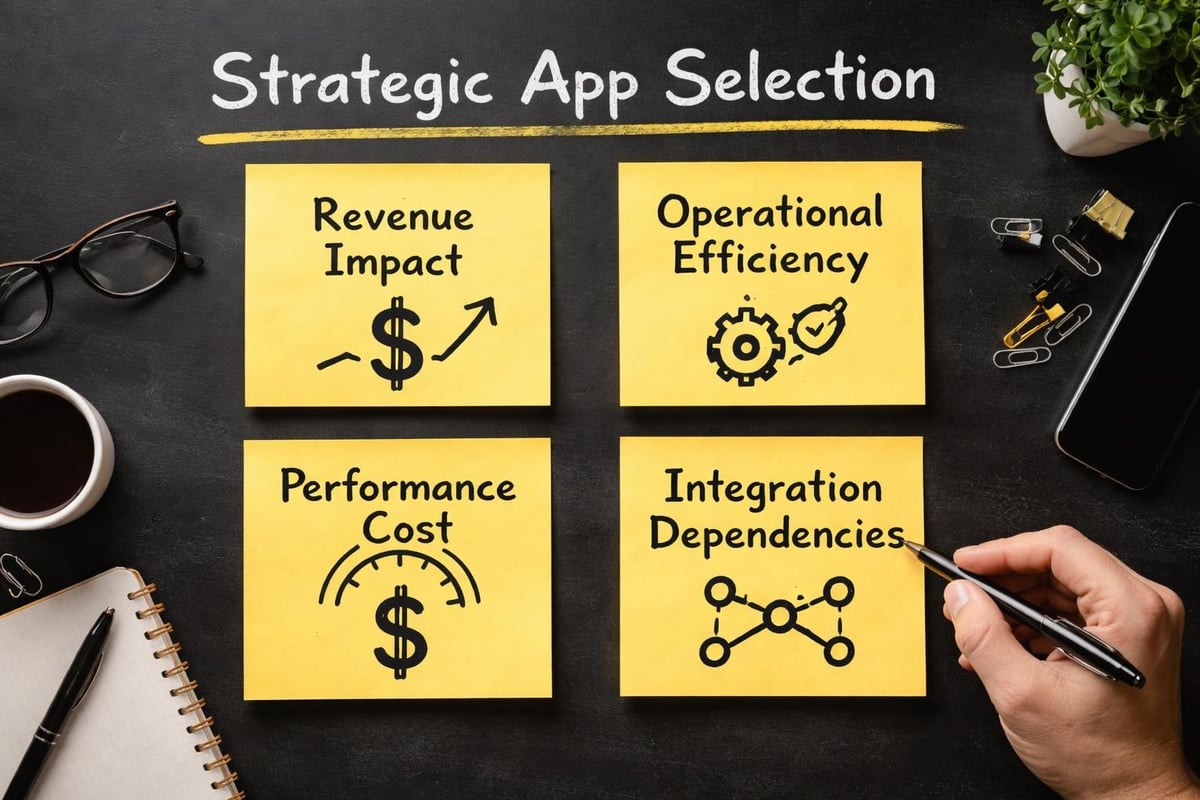
The key is selecting apps that directly support revenue generation or operational efficiency, not just "nice to have" features.
Essential app categories:
- Email marketing and automation
- Product reviews and social proof
- SEO and optimization tools
- Analytics beyond Shopify's native tracking
- Shipping and fulfillment support
For Australian stores, this might include AusPost integration, local payment options like Afterpay, and review platforms that support Australian English and local trust signals.
The mistake is adding apps reactively.
You see a feature on a competitor's store, install an app, then repeat until your shopify store runs slowly and your monthly costs balloon.
Strategic app selection during the build phase prevents this trap.
Performance vs Features Trade-Off
Every feature has a cost, even if the app is free.
That cost shows up in load times, which directly impacts conversion rates and SEO rankings.
App audit criteria:
- Does this directly increase revenue or decrease costs?
- Can native Shopify features handle this instead?
- Is this app adding redundant functionality to other apps?
- What's the performance impact on mobile devices?
- Does the ongoing cost justify the value delivered?
Most stores can operate effectively with 8-12 well-chosen apps.
More than that typically indicates feature bloat rather than strategic enhancement.
Theme Selection Strategy
Your theme determines conversion potential more than any other single decision.
This isn't about which looks prettiest – it's about conversion architecture, mobile responsiveness, page speed, and how well it supports your specific product type and customer journey.
Free themes can work for some businesses.
Premium themes offer more flexibility and better support.
Custom development delivers exactly what you need without compromise.
The wrong choice creates compounding problems.
If your theme doesn't support the product layout you need, you'll either compromise your presentation or spend money on custom development to modify a theme that wasn't right to begin with.
Theme evaluation framework:
| Criteria | Why It Matters | Red Flags |
|---|---|---|
| Mobile-first design | 60%+ traffic comes from phones | Desktop-focused layouts with mobile as afterthought |
| Page speed | Direct conversion and SEO impact | Heavy animations, bloated code, poor image optimization |
| Conversion features | Built-in trust elements and cart optimization | Minimal product page options, basic checkout flow |
| Customization depth | Future flexibility without rebuilding | Limited sections, hard-coded elements |
For Australian small businesses selling physical products, themes like Dawn (Shopify's free reference theme) provide solid foundations without bloat.
Premium options like Prestige or Empire offer more sophisticated features for growing catalogs.
The theme you choose should match your current needs while supporting growth.
Starting with an overly complex theme "for future expansion" often means paying for features you won't use for years while sacrificing speed today.
Common Launch Mistakes
Even with proper planning, certain mistakes appear repeatedly.
Knowing them helps you avoid the pattern.
Launching without testing checkout flow completely.
This means testing every payment method, shipping option, and discount code combination.
A broken checkout on launch day turns marketing spend into wasted traffic.
Missing essential legal pages.
Privacy policy, terms of service, refund policy, shipping policy – these aren't optional.
They're legal requirements in Australia and trust signals for customers.
Template policies don't cut it; they need to reflect your actual business practices.
No analytics or tracking configured.
If you can't measure traffic sources, conversion paths, and customer behavior, you can't optimize.
Google Analytics 4, Facebook Pixel (if using Meta ads), and Shopify's native analytics should all be configured before launch.
Launching without email capture strategy.
Most visitors won't buy on first visit.
If you're not capturing emails through popups, lead magnets, or account creation incentives, you're losing future revenue.
These mistakes are fixable, but they're easier to prevent than repair.
Each one represents lost revenue or wasted marketing spend during those critical early weeks when momentum matters most.
Beyond Launch: What Success Looks Like
A successful shopify store isn't static.
It evolves based on data, customer feedback, and market changes.
Month one focuses on fixing what data reveals.
You'll see which products attract traffic, where visitors drop off, which traffic sources convert, and where friction exists in your checkout flow.
Months two and three build on those insights.
You optimize high-traffic pages, expand successful product lines, refine targeting, and potentially test new marketing channels.
By month six, you should have clarity on unit economics: customer acquisition cost, average order value, lifetime value, and which marketing channels deliver profitable growth.
For businesses working with affordable Shopify development alternatives, this post-launch phase benefits from having strategic foundations in place rather than constantly fixing structural issues.
Measuring What Matters
Vanity metrics feel good but don't drive decisions.
Traffic numbers mean nothing without conversion context.
Critical metrics for Shopify stores:
- Conversion rate (overall and by traffic source)
- Average order value
- Cart abandonment rate
- Customer acquisition cost by channel
- Return customer rate
- Revenue per visitor
These metrics tell you whether your shopify store is healthy and where to focus optimization efforts.
A high traffic count with low conversion rate signals different problems than low traffic with high conversion.
Monthly reviews of these metrics, compared against previous periods and industry benchmarks, guide strategic decisions about where to invest time and money for maximum impact.
Integration Complexity and Reality
Your shopify store doesn't exist in isolation.
It connects to payment processors, shipping carriers, email platforms, accounting software, and potentially wholesale or inventory management systems.
Each integration point represents potential failure if not configured properly.
More importantly, these integrations need to work together seamlessly.
For Australian businesses, common integrations include:
- AusPost for shipping calculations and label generation
- Xero or MYOB for accounting
- Afterpay, Zip, or other BNPL services
- Klaviyo or Mailchimp for email marketing
- Google Merchant Center for shopping ads
The complexity isn't in individual integrations – it's in how they interact and share data.
Your inventory levels need to sync with your accounting platform.
Your shipping calculations need accurate product weights and dimensions.
Your email platform needs accurate purchase data to trigger abandoned cart sequences.
This interconnected system works smoothly when built properly from the start, but becomes a maintenance nightmare when added reactively without planning.
The DIY vs Professional Build Decision
You can absolutely build a shopify store yourself.
The platform makes it possible for non-technical founders to get online.
But "possible" and "optimal" aren't the same thing.
The DIY path works when you have time to learn, test, and iterate.
It struggles when you need to launch quickly, lack eCommerce experience, or can't afford the opportunity cost of months spent learning rather than selling.
The alternative – working with experienced Shopify developers who understand conversion strategy – compresses the timeline and builds foundations properly.
For Australian small businesses launching their first online store, the four-week structured build approach provides everything needed without agency bloat or DIY gaps.
This isn't about capability.
It's about efficiency and opportunity cost.
Can you learn Shopify development while running your business?
Yes.
Should you?
That depends on what else you could be doing with those 100+ hours.
When Professional Help Makes Sense
If you're launching your first eCommerce venture, the learning curve is steepest.
Product selection, pricing strategy, market positioning, customer acquisition – these challenges exist regardless of platform.
Adding "learn Shopify development" to that list often becomes the thing that delays launch indefinitely.
If you've tried DIY and gotten stuck, professional support helps you move forward.
Many businesses spend months tweaking their store without addressing fundamental conversion issues because they don't know what they don't know.
If speed to market matters, compressed timelines require experience.
What takes an experienced developer two hours might take a first-timer two days, multiplied across every task required to launch.
The resources available for store optimization help, but they assume you have foundations worth optimizing.
If your structure is fundamentally misaligned with conversion principles, optimization tips deliver minimal results.
Mobile Commerce Reality
Over 60% of eCommerce traffic comes from mobile devices in 2026.
Your shopify store must work flawlessly on phones, not just adequately.
This goes beyond responsive design.
Mobile users behave differently, have different patience thresholds, and abandon carts for different reasons than desktop users.
Mobile-specific optimization priorities:
- Thumb-friendly navigation and buttons
- Minimal text input requirements
- Fast-loading images optimized for mobile networks
- Streamlined checkout with autofill support
- Click-to-call for customer service access
- Mobile wallet payment options
Testing your store exclusively on desktop misses how most customers experience it.
Every page, every interaction, every checkout step needs mobile testing under real-world conditions (slower networks, smaller screens, interrupted sessions).
Australian mobile users expect the same functionality as desktop, but with less friction.
Long forms, complex navigation, or slow-loading pages drive them straight to competitors.
Mobile Conversion Barriers
Cart abandonment on mobile averages 85%, compared to 70% on desktop.
The gap isn't random – it's structural.
Common mobile abandonment triggers include forced account creation, complicated shipping calculators, unclear total costs, and checkout forms requiring excessive typing.
Each represents a conversion leak that costs revenue.
Mobile optimization isn't a separate project – it's integrated into every decision about your shopify store structure.
From theme selection to app integration to checkout configuration, mobile performance needs equal weighting with desktop considerations.
Payment and Shipping Logistics
Getting products to customers efficiently and affordably determines whether your shopify store scales.
Payment friction kills conversions.
Shipping complexity drives support costs and customer dissatisfaction.
Australian businesses face specific challenges here.
Shipping costs relative to product values, delivery timeframes across vast distances, and customer expectations set by Amazon and other major retailers.
Shipping strategy considerations:
- Flat rate vs calculated shipping
- Free shipping thresholds
- Express options and pricing
- Local pickup for Melbourne/Sydney/Brisbane customers
- International shipping capabilities
Payment options need to match customer preferences.
Credit cards remain important, but BNPL services like Afterpay and Zip drive conversion for price-sensitive customers.
Digital wallets (Apple Pay, Google Pay) reduce friction for mobile users.
The goal is removing barriers, not adding options indiscriminately.
Too many payment methods creates decision paralysis.
Too few limits your addressable market.
Shipping calculations need accuracy.
Overcharging customers hurts conversion.
Undercharging erodes margins.
Integration with carrier APIs provides real-time rates based on actual package dimensions and destination.
Building a shopify store that converts requires more than following tutorials and choosing themes. It demands strategic foundations, conversion-focused structure, and understanding of how Australian customers behave online. Whether you're planning your first store or looking to fix an underperforming one, the difference between functional and profitable comes down to intentional decisions made during the build phase. Kida Digital specializes in helping Australian small businesses launch conversion-ready Shopify stores in four weeks, providing the strategic framework and technical execution that turns platforms into profit engines without agency costs or DIY guesswork.


Be the first to comment