

Every Australian business operating today faces the same reality. Your website isn't just a digital brochure anymore. It's your hardest-working employee, your 24/7 shopfront, and often the first impression that determines whether someone becomes a customer or clicks away. The gap between businesses with strategic websites and those treating them as afterthoughts has never been wider. According to recent data from the Australian Bureau of Statistics, 67% of Australian small businesses now have a web presence, yet only 38% report their website actively generates revenue. That disconnect tells us everything about the difference between having a website and having one that works.
Why Most Business Websites Miss the Mark
The average small business website gets built once and forgotten.
It sits there, static and unchanged, while the business evolves around it. The owner knows it needs work but doesn't know where to start. This pattern repeats across thousands of Australian businesses every year.
The problem isn't lack of trying. Most business owners understand they need a website for businesses to compete. They either pay someone to build it, use a DIY platform, or inherit something cobbled together years ago. Then life gets busy. The website becomes background noise until someone mentions it looks dated or isn't working on mobile.
Three critical failures plague most business websites:
- They're built around what the business wants to say, not what customers need to know
- They lack a clear path from visitor to customer
- They're maintained reactively instead of strategically
A 2025 study by Deloitte Digital found that 68% of website visitors abandon sites that don't clearly communicate value within seven seconds. Your homepage needs to answer three questions immediately: what you do, who it's for, and why someone should care. Everything else is secondary.

The Platform Decision That Shapes Everything
Choosing where to build matters more than most realise.
Your platform determines your costs, your capabilities, and how much time you'll spend managing versus growing. Selecting the right website builder requires understanding your business model first, not browsing features in isolation.
For product-based businesses, ecommerce platforms like Shopify dominate because they're purpose-built for selling. Service businesses often succeed with Squarespace or WordPress. The distinction matters because retrofitting ecommerce onto a content platform creates friction. Building content features into an ecommerce platform happens seamlessly.
Platform costs vary dramatically:
A basic Squarespace site runs $252 annually. A Shopify store starts at $468 yearly for the basic plan. WordPress hosting ranges from free to thousands depending on your setup. But comparing price tags misses the point entirely. The question isn't what the platform costs. It's what it costs you in time, lost sales, and growth limitations.
What Actually Makes a Website for Businesses Effective
Start with mobile because that's where your customers are.
Google reports that 73% of Australian web traffic now comes from mobile devices. If your website doesn't work flawlessly on a phone, you're turning away three-quarters of potential customers before they read a word. Mobile-first design isn't optional anymore. It's baseline expectation.
Speed determines whether people stay long enough to see your offer. According to research from Google, 53% of mobile users abandon sites taking longer than three seconds to load. Every additional second increases bounce rates by roughly 20%. Your beautiful design means nothing if visitors leave before seeing it.
Building an effective business website requires balancing aesthetics with performance. Visual appeal attracts attention. Speed and clarity convert that attention into action.
The Conversion Path Nobody Plans
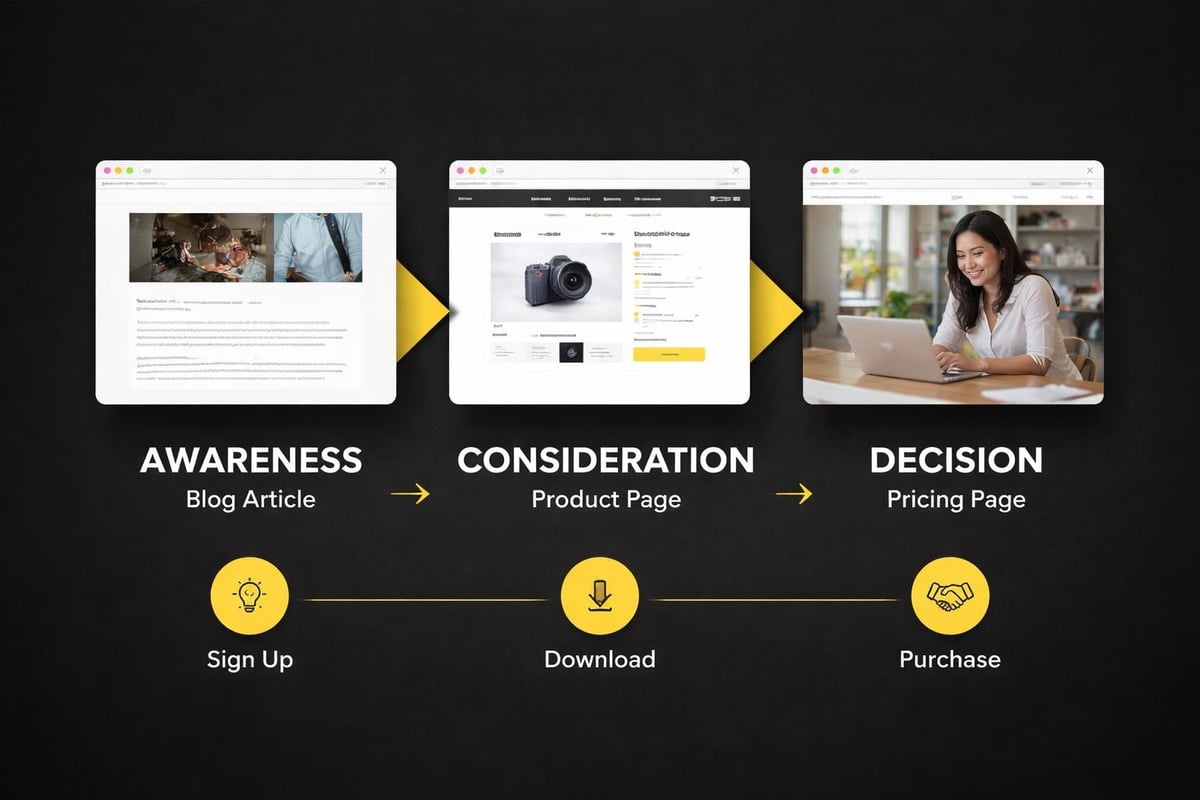
Most websites lack a clear customer journey.
Visitors land on your homepage and face decision paralysis. Too many options. No clear next step. No reason to choose one path over another. They leave because you made them think instead of making it obvious.
Every page needs one primary action:
- Homepage: Get them to your core offer or category pages
- Product pages: Add to cart or request quote
- About page: Build trust then direct to contact or products
- Blog posts: Subscribe, share, or explore related products
Each page should guide visitors toward the next logical step. That step should align with where they are in their buying journey. Someone reading a blog post about gift ideas isn't ready to buy yet. Someone viewing a specific product page needs minimal friction between them and checkout.
For Australian ecommerce businesses specifically, building a Shopify store with a streamlined four-week process removes the complexity and ensures every element serves conversion. The alternative is months of back-and-forth with agencies or DIY platforms that promise simplicity but deliver confusion.
Content Strategy Beyond Blog Posts
Your website for businesses needs content that serves business goals.
Random blog posts about industry trends don't move needles. Strategic content answers questions your customers ask before buying. It builds authority. It captures search traffic. It moves people closer to purchase decisions.
Data from HubSpot shows that businesses publishing 16+ blog posts monthly get 3.5 times more traffic than those publishing zero to four. But volume without strategy wastes time. One well-researched article answering genuine customer questions outperforms ten generic posts every time.
What Content Actually Works
Product descriptions sell or they waste space.
Generic manufacturer descriptions that every competitor uses do nothing. Descriptions written for your specific customer, addressing their concerns and highlighting relevant benefits, convert. The difference shows in bounce rates and cart additions.
High-performing business websites include:
- Clear service or product pages with benefits, not just features
- Customer success stories with specific results
- FAQ pages addressing real objections
- Educational content related to product use or industry expertise
- Trust signals: reviews, certifications, guarantees
A Melbourne-based skincare brand increased their conversion rate from 1.8% to 4.3% by rewriting product descriptions. They stopped listing ingredients. They started explaining what each product does, who it's for, and why it works. Same products. Different approach. Revenue doubled in six months.
Technical Foundations That Support Growth
Search visibility determines whether anyone finds your website.
You can build the most beautiful site in Australia. If Google can't find it or doesn't rank it, you're invisible. SEO isn't mysterious. It's methodical. Title tags. Meta descriptions. Header structure. Image optimization. Mobile responsiveness. Page speed. Clean URLs. Internal linking.
According to BrightEdge, organic search drives 53% of all website traffic. Paid advertising drives 15%. Social media drives 5%. Everything else combines for 27%. If you're ignoring SEO, you're ignoring your primary traffic source.
| SEO Element | Impact Level | Difficulty | Time Investment |
|---|---|---|---|
| Title Tags & Meta | High | Low | 2-4 hours |
| Mobile Optimization | Critical | Medium | 1-2 days |
| Page Speed | High | Medium | 1-3 days |
| Content Quality | Critical | High | Ongoing |
| Backlinks | High | High | Ongoing |
Understanding modern website building approaches shows how AI tools and streamlined platforms have reduced technical barriers. But strategy still separates effective websites from digital clutter.
Security and Trust Signals
Australian consumers notice security indicators.
An SSL certificate (the padlock in the browser bar) is non-negotiable. Browsers now label non-HTTPS sites as "Not Secure." That warning destroys trust instantly. SSL certificates cost between $0 and $300 annually depending on provider and validation level. Most hosting includes basic SSL free.
Payment security matters even more for ecommerce. PCI compliance protects customer data and your business liability. Platforms like Shopify handle this automatically. DIY solutions require careful implementation. Getting it wrong exposes you to data breaches, legal liability, and reputation damage that can destroy businesses.
Trust badges from recognised organisations increase conversion rates by an average of 42% according to research from Baymard Institute. Display security certifications. Show payment method logos. Include review ratings. Make Australian location prominent if you're competing against international sellers.

Managing Costs Without Compromising Quality
Website expenses scale with complexity and ambition.
A basic brochure site built on Squarespace costs $500 to $2,000 for professional setup plus $252 annual hosting. An ecommerce store starts around $5,000 for proper development plus platform fees and apps. Agency builds run $10,000 to $50,000+ depending on scope and who's building.
The hidden costs hurt more than obvious ones. Choosing the wrong platform means rebuilding later. Skipping proper planning means constant revisions. Ignoring maintenance means security vulnerabilities and broken features. Going cheap up front usually costs more long term.
Real cost of website ownership includes:
- Platform or hosting fees: $200-$800 annually
- Domain registration: $15-$50 annually
- SSL certificate: $0-$300 annually
- Apps and plugins: $0-$500 monthly
- Maintenance and updates: $100-$500 monthly
- Content creation: $500-$2,000 monthly
- Marketing and advertising: Variable, often $500-$5,000 monthly
For small businesses, time costs often exceed direct expenses. Learning platform quirks. Troubleshooting broken features. Updating content. Managing plugins. These tasks add up to hours weekly for business owners who should focus on revenue-generating activities.
When to DIY and When to Delegate
Some businesses should absolutely build their own websites.
If you're service-based with simple needs, enjoy technology, and have time to learn, DIY platforms work well. If you need ecommerce functionality, inventory management, payment processing, and conversion optimization, DIY becomes expensive through trial and error.
The question isn't whether you can build a website. Most modern platforms make that possible. The question is whether you should spend 40+ hours learning instead of earning while someone experienced delivers better results faster.
The True DIY Cost Calculation
Track your hourly business rate honestly.
If you bill $100 per hour or could generate $100 hourly revenue in your business, every hour spent on your website costs $100 in opportunity. Forty hours of website work equals $4,000 in lost revenue. Paying someone $3,000 to build your site while you focus on $4,000 worth of business makes financial sense.
This logic applies double for ecommerce. Product photography. Description writing. Category structure. Payment setup. Shipping configuration. Tax rules. Inventory systems. Marketing integration. Each component requires specific knowledge. Learning everything takes months. Getting it wrong costs sales daily.
A Sydney-based homewares business spent six months building their own Shopify store. They launched with missing features, slow load times, and a confusing checkout process. Their conversion rate sat at 0.8%. After hiring developers to rebuild properly, conversion jumped to 3.2%. The six months DIY cost them approximately $45,000 in lost revenue based on their traffic levels.
Future-Proofing Your Business Website
Technology changes but principles don't.
Your website for businesses needs flexibility to adapt as your business evolves. That means choosing platforms with strong developer communities. It means building on established systems instead of proprietary solutions. It means prioritising portability of your content and data.
Website longevity averages three to five years before requiring significant updates or rebuilds. Planning for evolution prevents panic rebuilds when your current site becomes limiting. Start with clear goals. Build room for growth. Review analytics quarterly. Adjust based on data, not guesses.
| Update Type | Frequency | Complexity | Impact |
|---|---|---|---|
| Security patches | Weekly | Low | Critical |
| Content updates | Weekly | Low | Medium |
| Design refresh | 2-3 years | Medium | High |
| Platform migration | 3-5 years | High | Critical |
| Feature additions | Quarterly | Medium | Medium |
Selecting website templates strategically provides flexibility while maintaining professional design. Templates aren't limiting if chosen for adaptability rather than current trends.
Australian businesses specifically need to consider local payment preferences. BPAY for invoices. Afterpay for retail. Local shipping integrations with Australia Post and alternatives. GST handling. These regional requirements matter more than global features you'll never use.
Measuring What Matters
Install Google Analytics before launch day.
You can't improve what you don't measure. Analytics reveal which pages work, where visitors leave, how they found you, and what converts them. This data transforms guesswork into strategy.
Essential metrics for business websites:
- Traffic sources: Where visitors come from
- Bounce rate: Percentage leaving immediately
- Time on page: Engagement indicator
- Conversion rate: Percentage completing desired actions
- Revenue per visitor: Overall effectiveness metric
Most business owners check total visitor numbers and stop there. That metric means nothing without context. 1,000 visitors generating zero sales is worse than 100 visitors generating ten sales. Focus on conversion metrics tied to revenue.
A Brisbane-based fitness equipment retailer discovered 78% of their traffic came from mobile devices but their mobile conversion rate was 1.2% versus 4.7% on desktop. They prioritised mobile optimization. Within three months, mobile conversion reached 3.8%. Revenue increased 42% without spending extra on advertising.
Platform-Specific Considerations for Australian Businesses
Different industries need different solutions.
Retail businesses selling physical products belong on Shopify, WooCommerce, or similar ecommerce platforms. Service businesses often thrive on Squarespace or WordPress. Booking-based businesses need integrated scheduling. Subscription businesses require recurring payment handling.
The platform decision determines your daily workflow. Shopify excels at product management and order processing. WordPress dominates content publishing and customization. Squarespace balances design and simplicity. Comparing website builders thoroughly prevents expensive platform migrations later.
Integration Capabilities Matter More Than Features
Your website connects to other business systems.
Email marketing platforms. Accounting software. CRM systems. Inventory management. Shipping providers. Payment gateways. Each integration saves hours of manual work weekly. Poor integration support means data entry, exports, imports, and constant manual reconciliation.
Shopify's app ecosystem includes 8,000+ integrations covering virtually every business need. WordPress offers similar breadth through plugins. Proprietary platforms or custom builds limit integration options severely. This limitation compounds over time as your business tools evolve.
Australian businesses specifically benefit from local integrations. Xero for accounting. Sendle or Australia Post for shipping. eWAY or Pin Payments for processing. Afterpay or Zip for buy-now-pay-later. Global platforms offer these, but verify Australian support before committing.
Building a website for businesses in 2026 requires balancing immediate needs with long-term strategy. The right approach depends on your business model, technical comfort, budget, and growth plans. If you're an Australian ecommerce business ready to launch or level up your online store without agency costs or DIY uncertainty, Kida Digital delivers conversion-focused Shopify stores in four weeks with everything you need to start selling strategically.


Be the first to comment