

Building an ecommerce site in 2026 isn't about fancy features or endless customisation. It's about getting the fundamentals right so customers can find you, trust you, and buy from you. Small Australian businesses face a unique challenge: competing with global retailers while working with limited budgets and tight timelines. The good news is that you don't need agency-level spending to launch a professional online store. You need clarity on what actually matters, a platform that scales with your growth, and the discipline to launch before you're perfect. This guide cuts through the noise to show you exactly what your ecommerce site needs to succeed.
Why Your Ecommerce Site Foundation Matters More Than Features
Most small business owners start building their ecommerce site by asking the wrong questions. They focus on Instagram integrations and pop-up tools before nailing the basics. The foundation of your online store determines everything that follows.
Your platform choice sets the pace for your growth. Shopify currently powers over 4.4 million ecommerce sites globally, with Australian businesses representing a significant and growing portion of that market. The platform's dominance isn't accidental-it removes technical barriers that previously required developers for basic tasks.
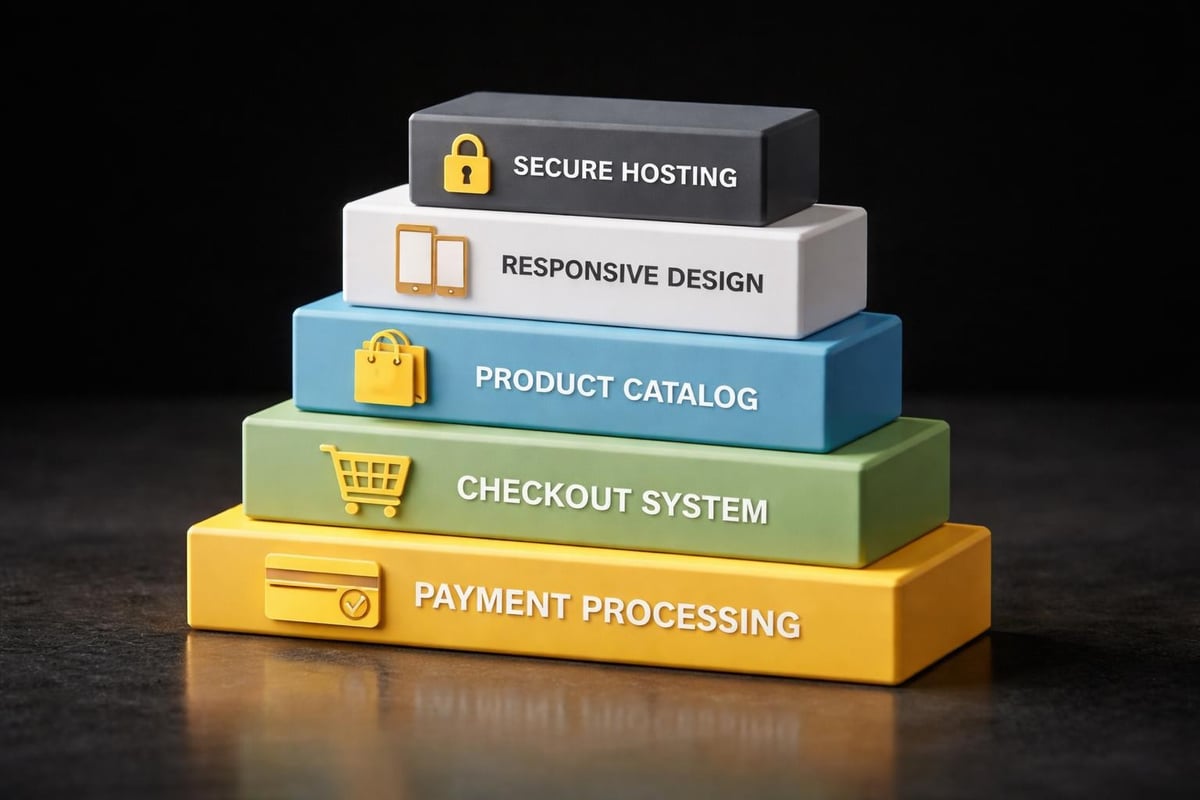
The non-negotiable elements every ecommerce site must have:
- Mobile-responsive design (over 60% of Australian shoppers browse on mobile)
- SSL certificate for secure transactions
- Fast page load speeds (under 3 seconds)
- Clear navigation structure
- Professional product photography
- Detailed product descriptions
- Transparent shipping information
- Visible return policy
- Customer service contact details
Your site needs to work perfectly on a smartphone before anything else matters. Research from Australia Post shows that 72% of Australian online shoppers have made a purchase via mobile device. If your checkout process breaks on an iPhone, you've lost that sale and likely that customer forever.
Security and Trust Signals That Convert Browsers to Buyers
An ecommerce site without proper security is like a shop with broken locks. Customers won't hand over their credit card details if they don't trust your site. Ecommerce security has become more critical as cyber threats have increased by 38% in Australia over the past two years.
SSL certificates are the baseline. Every ecommerce site must have HTTPS in the address bar. This encrypts data between your customer and your server. Shopify includes SSL certificates automatically, which removes one technical headache for small business owners.
But security goes deeper than certificates. You need regular software updates, secure payment gateways, and proper data handling practices. According to GoDaddy’s security guide, businesses should implement multiple layers of protection including firewalls, regular backups, and monitoring systems.
Trust Badges and Social Proof
Australian consumers are cautious online shoppers. They look for specific signals before purchasing:
- Customer reviews (preferably verified)
- Trust badges from recognised providers
- Clear contact information with Australian phone numbers
- Professional email addresses (not Gmail)
- Active social media presence
- Secure payment logos (PayPal, Visa, Mastercard)
A Melbourne-based skincare brand increased conversions by 23% simply by adding verified customer reviews to their product pages. The reviews weren't all five-star ratings-authenticity mattered more than perfection.
Your ecommerce site should display your ABN, physical address, and clear terms of service. These elements might seem boring, but they signal legitimacy to first-time visitors who've never heard of your brand.
Product Pages That Actually Sell
Your product page is where browsing turns into buying. Most small business owners underestimate how much detail customers need before clicking "Add to Cart."
Professional product photography isn't optional anymore. Customers can't touch or try your products online, so images carry the entire burden of communication. You need multiple angles, detail shots, and lifestyle images showing products in use.
Effective product descriptions answer these questions:
- What problem does this solve?
- Who is this for?
- What makes it different?
- What are the specifications?
- How do I use or care for it?
A Brisbane furniture retailer saw returns drop by 31% after adding detailed dimension diagrams and fabric care instructions to every product page. Customers weren't disappointed by reality when the product arrived because expectations were set accurately upfront.
Your pricing needs to be crystal clear. Australian consumers want to know the total cost before checkout. Display shipping costs early, mention GST inclusion, and show any applicable discounts prominently.

Checkout Process That Doesn't Lose Sales
The average cart abandonment rate for Australian ecommerce sites sits around 69%. That means seven out of ten shoppers who add items to cart never complete the purchase. Your checkout process is likely responsible for a significant portion of these lost sales.
Simplify everything. Every extra field in your checkout form increases abandonment. Ask only for information you genuinely need to fulfill the order.
Guest checkout should always be an option. Forcing account creation before purchase is one of the fastest ways to lose a sale. Customers can create accounts after they've bought, when trust has been established.
Express checkout options like Shop Pay, Apple Pay, and Google Pay remove friction for returning customers. These services auto-fill shipping and payment information, turning a five-minute checkout into a fifteen-second transaction.
Payment Gateway Selection
Your payment gateway needs to support Australian customers properly. Popular options include:
| Gateway | Transaction Fee | Features |
|---|---|---|
| Shopify Payments | 1.75% + 30c | No monthly fee, integrated reporting |
| PayPal | 2.6% + 30c | Familiar to customers, buyer protection |
| Afterpay | 4% + 30c | Buy now pay later, higher conversion |
| Stripe | 1.75% + 30c | Developer-friendly, international support |
Offering multiple payment methods increases conversion. Some customers trust only PayPal. Others prefer credit card. Buy now pay later services like Afterpay appeal to younger demographics and typically increase average order value by 20-30%.
Site Speed and Performance Optimisation
An ecommerce site that loads slowly hemorrhages revenue. Google research shows that 53% of mobile users abandon sites that take longer than three seconds to load. Every additional second increases bounce rate by approximately 20%.
Page speed affects more than user experience-it directly impacts your search rankings and advertising costs. Google's Core Web Vitals now form part of search ranking algorithms. Slow sites rank lower, which means fewer organic visitors finding your products.
Common speed killers on ecommerce sites:
- Unoptimised images (photos uploaded at full resolution)
- Too many third-party scripts (tracking pixels, chat widgets)
- Bloated themes with unused features
- Lack of browser caching
- Poor hosting infrastructure
A Sydney fashion retailer reduced their homepage load time from 8.2 seconds to 2.1 seconds by compressing images and removing redundant apps. Their organic traffic increased 47% within three months as Google rewarded the improved user experience.
Shopify handles most infrastructure concerns automatically, but you still need to optimise your specific site. This means choosing lightweight themes, compressing images before upload, and being selective about which apps you install.
Navigation and Site Structure for Conversions
Customers who can't find products quickly will leave. Your ecommerce site navigation needs to be intuitive, consistent, and comprehensive. Understanding how effective site structure impacts SEO helps you plan navigation that serves both users and search engines.
Keep your main menu simple. Seven items or fewer is ideal. Use clear category names that customers actually search for, not creative internal jargon.
Breadcrumb navigation helps customers understand where they are in your site structure. It also reduces bounce rates by making it easy to navigate back to broader categories.
Search functionality is critical for stores with more than 20 products. Your search bar should be prominent, support autocomplete, and handle common misspellings. Approximately 30% of ecommerce site visitors use search, and these searchers convert at 2-3 times the rate of regular browsers.
Collection and Category Organisation
Logical product grouping improves discoverability. Customers should be able to find products through multiple paths-by category, by price range, by brand, or by use case.
Filter options reduce friction in product discovery. Let customers narrow results by size, color, price, rating, and other relevant attributes. A homewares store saw time-on-site increase by 41% after implementing comprehensive filtering across their collections.
Content and SEO Fundamentals
An ecommerce site without organic traffic is burning money on paid advertising. Building SEO into your foundation creates a long-term traffic source that compounds over time. According to BrightEdge research, organic search drives 53% of all trackable website traffic.
Every product page is an opportunity to rank for specific search terms. Small Australian businesses can compete effectively for long-tail keywords that bigger retailers ignore.
Content marketing supports product discovery. Blog posts that answer customer questions build authority and create entry points to your ecommerce site. A Queensland outdoor gear retailer generated 34% of their 2025 revenue from customers who first found them through buying guides and how-to articles.
SEO elements your ecommerce site needs:
- Unique product descriptions (never copy manufacturer text)
- Optimised title tags and meta descriptions
- Descriptive URL structure
- Alt text on all images
- Internal linking between related products
- Schema markup for products and reviews
- XML sitemap submission to Google
Local SEO matters for Australian businesses even when selling nationally. Including location references, maintaining a Google Business Profile, and encouraging local reviews all strengthen your visibility in search results.
Customer Service and Post-Purchase Experience
Your ecommerce site's job doesn't end at checkout confirmation. The post-purchase experience determines whether customers return and whether they recommend you to others.
Clear communication throughout the fulfillment process reduces anxiety and support tickets. Automated emails should confirm the order, provide tracking information, and request feedback after delivery.
Returns and exchanges need dedicated policies and processes. Australian Consumer Law provides strong protections for online shoppers. Your ecommerce site should clearly explain rights and procedures, making returns straightforward rather than punitive.
Live chat support increases conversion rates by an average of 12% according to Forrester Research. Customers have questions during the buying process, and immediate answers remove barriers to purchase. Even simple chatbots that answer common questions provide value.
Building Repeat Business
First-time customers are expensive to acquire. Repeat customers drive profitability. Your ecommerce site should capture email addresses and permission to communicate about new products, sales, and relevant content.
Loyalty programs work particularly well for consumable products. A Melbourne coffee roaster built a subscription model that now represents 43% of total revenue, providing predictable cash flow and reduced customer acquisition costs.
Post-purchase emails should provide value beyond "buy more stuff." Care instructions, usage tips, and complementary product suggestions based on actual purchase history demonstrate understanding of customer needs.
Mobile Commerce Optimisation
Mobile isn't the future of ecommerce-it's the present. Australia has one of the highest smartphone penetration rates globally at 91%. Your ecommerce site must work flawlessly on devices of all sizes.
Thumb-friendly design matters. Buttons and links need adequate spacing for finger taps. Critical actions like "Add to Cart" should be easily accessible without scrolling or pinching.
Mobile page speed is even more critical than desktop. Mobile users are often on cellular connections with variable speeds. Optimising for mobile-first ensures the fastest possible experience regardless of device.
Progressive web app (PWA) functionality can transform your ecommerce site into an app-like experience without requiring customers to download anything. PWAs work offline, send push notifications, and load nearly instantly for returning visitors.
Analytics and Continuous Improvement
You can't improve what you don't measure. Your ecommerce site needs analytics tracking from day one. Google Analytics 4 provides free, comprehensive data about visitor behavior, traffic sources, and conversion paths.
Key metrics every ecommerce site owner should monitor:
- Conversion rate (overall and by traffic source)
- Average order value
- Cart abandonment rate
- Traffic sources and their quality
- Product page bounce rates
- Time to conversion
- Customer lifetime value
A Perth electronics retailer discovered through analytics that customers arriving from Pinterest had 3x the conversion rate of other social traffic. They shifted resources toward Pinterest content creation and saw a 56% increase in qualified traffic over six months.
Heat mapping tools like Hotjar show where visitors actually click, how far they scroll, and where they get stuck. This visual data often reveals usability issues that aren't obvious from standard analytics.
Platform Selection and Technical Foundation
Choosing the right platform for your ecommerce site determines your technical possibilities and limitations for years. For small Australian businesses, Shopify dominates because it balances power with accessibility. Many business owners find themselves exploring options for ecommerce site development that don't require technical expertise or massive budgets.
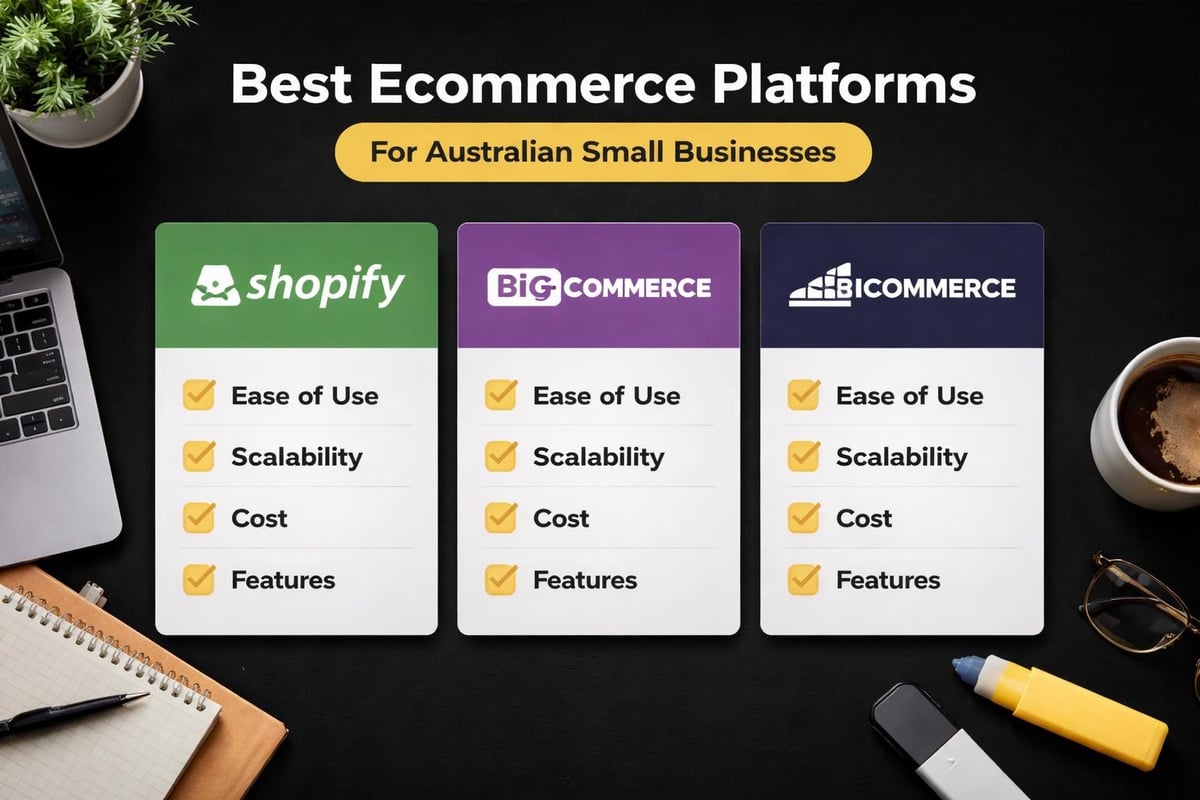
WordPress with WooCommerce offers flexibility but requires more technical knowledge. BigCommerce provides enterprise features but can feel overwhelming for beginners. Squarespace and Wix are simpler but less scalable as businesses grow.
The platform you choose should match your technical comfort level and growth ambitions. A platform that's too simple will constrain you within a year. A platform that's too complex will delay your launch by months.
For small Australian businesses ready to launch their first ecommerce site, Kida Digital’s done-for-you Shopify builds cover everything needed to launch within four weeks with clarity and momentum. This structured approach removes the paralysis of endless platform research and DIY tutorials that lead to abandoned projects.
Marketing Integration and Traffic Generation
An ecommerce site without traffic is just an expensive digital brochure. You need multiple traffic sources feeding qualified visitors to your store. Following ecommerce best practices from established platforms helps you avoid common marketing mistakes.
Email marketing remains the highest-ROI channel for ecommerce. Building an email list from day one creates an owned audience you can market to without paying for each impression.
Social media works differently for different products. Visual products thrive on Instagram and Pinterest. B2B products find audiences on LinkedIn. Understanding where your specific customers spend time prevents wasted effort on irrelevant platforms.
Paid advertising can accelerate growth but requires careful management. Google Shopping campaigns convert well for product-focused searches. Facebook and Instagram ads work for visual products and targeted demographics. Retargeting campaigns remind visitors about products they viewed but didn't purchase.
Content Marketing for Long-Term Growth
Product-focused content answers the questions customers ask before buying. Comparison guides, sizing charts, usage tutorials, and buying guides all drive qualified traffic while building authority.
A Canberra cycling accessories business built their entire traffic strategy around comprehensive bike maintenance guides. These guides ranked for hundreds of long-tail keywords, generated backlinks from cycling forums, and positioned them as experts. Product recommendations within the guides converted at 18%, far higher than cold traffic.
Video content increasingly influences purchase decisions. Product demonstrations, unboxing videos, and customer testimonials build confidence and answer questions more effectively than text alone.
Building an ecommerce site that actually generates revenue requires getting fundamentals right before chasing advanced features. Focus on security, speed, mobile optimisation, and clear customer communication before anything else. Most small business failures come from launching incomplete stores or never launching because perfection seems impossible. If you're ready to build a conversion-focused Shopify store without the agency price tag or DIY overwhelm, Kida Digital specialises in getting small Australian businesses online in four weeks with everything needed to start selling immediately.


Be the first to comment