

You're looking at your Shopify store, knowing it could be better. Maybe you need custom functionality, conversion optimisation, or a complete build from scratch. The obvious next question: what's the shopify expert cost going to be? The answer isn't simple, and that's frustrating when you're trying to budget. But understanding what drives pricing, where experts sit in the market, and what you're actually paying for makes the decision clearer. Let's break down the real numbers, the variables that shift them, and how to know what's fair for your specific situation.
What Actually Determines Shopify Expert Cost
The shopify expert cost isn't pulled from thin air. Several concrete factors shape what you'll pay.
Experience level is the most obvious driver. A junior developer fresh into Shopify might charge between $50 and $80 per hour in Australia. They can handle theme customisation, basic apps, and standard builds.
Mid-level experts with 3-5 years typically charge $80 to $150 per hour. They solve complex problems, optimise conversion rates, and manage intricate integrations. Senior developers or specialists command $150 to $250+ per hour because they bring strategic thinking, not just technical execution.
Geographic location matters, even in 2026's remote work landscape. Australian-based experts generally charge more than offshore teams in Asia or Eastern Europe. The hourly rates vary significantly by region, with Australian developers averaging 30-50% higher than global alternatives.
That premium buys you timezone alignment, cultural understanding, and simpler communication.

Project complexity shifts pricing dramatically. A theme installation and basic setup is fundamentally different from a multi-currency, subscription-based store with custom checkout flows.
The more moving parts, the higher the shopify expert cost. Custom app development, API integrations, headless commerce builds – these all push rates and timelines up.
Hiring model changes everything too. Freelancers offer flexibility and lower overhead. Agencies bring teams, processes, and accountability but charge premium rates. Shopify Partners through the official marketplace might offer certifications and guarantees but vary wildly in quality and cost.
Hourly Rates vs Project-Based Pricing
Most experts offer both models, and choosing the right one depends on your situation.
Hourly billing makes sense for ongoing support, incremental improvements, or undefined scope. You pay for time spent, which offers flexibility but less cost certainty. Australian Shopify developers typically charge $80 to $200 per hour depending on expertise.
The challenge? Hours can blow out if scope isn't tightly managed. What starts as a "quick fix" becomes a three-day investigation into your theme code.
Project-based pricing locks in a fixed cost for defined deliverables. You know upfront what you're paying for a new store build, migration, or specific feature. Project-based pricing often provides better value for well-scoped work because it incentivises efficiency.
The risk shifts to the developer – if the project takes longer, that's their problem. For clients, it means predictable budgets and clear expectations.
Breaking Down Real Project Costs
Let's look at actual shopify expert cost across common project types.
Basic store setup – theme installation, basic customisation, essential apps – typically runs $2,000 to $5,000. This gets you a functional store but minimal custom work.
Full custom build with unique design, custom features, and strategic setup ranges from $8,000 to $25,000. This is where understanding why agencies charge what they do becomes important.
Store migration from another platform to Shopify sits around $3,000 to $10,000 depending on product count, data complexity, and SEO preservation requirements.
Ongoing support and optimisation might be a monthly retainer of $1,000 to $5,000, covering updates, troubleshooting, conversion testing, and incremental improvements.
| Project Type | Typical Range (AUD) | Timeline | Best For |
|---|---|---|---|
| Theme setup | $2,000 – $5,000 | 1-2 weeks | Simple stores, tight budgets |
| Custom build | $8,000 – $25,000 | 4-8 weeks | Unique brands, specific requirements |
| Migration | $3,000 – $10,000 | 2-4 weeks | Platform switches |
| Monthly retainer | $1,000 – $5,000/mo | Ongoing | Growth-focused businesses |
These numbers reflect Australian market rates in 2026. Offshore teams might quote 40-60% lower, but factor in communication overhead, timezone gaps, and potential quality variance.
Hidden Costs That Catch Businesses Out
The quoted shopify expert cost rarely tells the full story.
Third-party apps add up fast. That email marketing tool costs $50 monthly. The review app is another $30. Advanced shipping, subscriptions, loyalty programs – suddenly you're paying $200-500 monthly in app fees on top of your Shopify subscription.
Content creation isn't usually included in development quotes. Product photography, copywriting, blog content – most experts build the structure but expect you to provide the words and images.
Training and handover might cost extra if you want proper documentation and walkthroughs. Some developers include basic training; others charge hourly for it.
Post-launch tweaks inevitably happen. You'll spot things that need adjusting after going live. Budget for at least 10-20% additional for these refinements.
Agency vs Freelancer: The Real Cost Difference
The shopify expert cost comparison between agencies and freelancers goes beyond hourly rates.
Agencies typically charge 50-100% more than individual freelancers for the same work. You're paying for redundancy, project management, multiple specialists, and established processes. The cost structure reflects team overhead but also risk mitigation.
If your developer gets sick or leaves, an agency has backup. If the project needs design and development, they have both in-house.

Freelancers offer direct communication, lower costs, and often faster turnarounds for smaller projects. The trade-off is single-person dependency and potentially narrower expertise.
A freelance developer might excel at Liquid code but outsource design work. They might be brilliant technically but less structured in project management.
Specialised consultants sit between these extremes. They charge near-agency rates ($150-300 per hour) but work solo or with small teams, focusing on high-value strategic work rather than execution.
For Australian small businesses, choosing between development approaches often comes down to project complexity and internal capacity.
What You Actually Get for Different Price Points
Understanding value at each price tier clarifies whether you're getting fair shopify expert cost.
Budget tier ($2,000 – $5,000) typically means theme-based builds with minimal customisation. You'll use existing themes, standard layouts, and off-the-shelf apps. This works fine for straightforward product catalogues with standard requirements.
Mid-range ($5,000 – $15,000) brings custom design elements, strategic app selection, conversion optimisation basics, and proper technical setup. This is where most Australian small businesses should aim if they're serious about eCommerce.
Premium tier ($15,000 – $50,000+) delivers fully custom design, advanced functionality, custom app development, comprehensive strategy, and ongoing optimisation. These enterprise-level builds suit established businesses with complex requirements.
The difference isn't just about code quality. Higher tiers include strategic thinking, conversion focus, scalability planning, and support structures that budget builds skip.
How to Evaluate If a Quote Is Fair
You've received quotes and need to assess whether the shopify expert cost makes sense.
Compare scope carefully. Three quotes at $8,000, $12,000, and $15,000 might actually be for different deliverables. One might include 50 products uploaded; another expects you to do it. One includes SEO setup; another doesn't.
Create a detailed scope document before requesting quotes. Understanding the development process helps you specify what you actually need.
Check portfolio relevance. An expert charging $200 per hour who's built twenty stores in your industry is likely better value than a $100 per hour generalist who's never touched your product category.
Assess communication quality. How quickly do they respond? How clearly do they explain technical concepts? Poor communication costs you time and money throughout the project.
Verify credentials. Shopify Partner status, certifications, and client testimonials matter. Different experts specialise in different aspects, from development to design to strategy.
Red Flags That Signal Pricing Issues
Certain patterns suggest a shopify expert cost quote won't deliver value.
Significantly below market rates often means inexperience, offshore teams not disclosing their location, or corners being cut. A $3,000 custom build in Australia should make you question what's missing.
Vague scope without detail means you'll face scope creep and additional charges. "Full Shopify store setup" could mean almost anything. Get specifics.
No questions about your business suggests they're not tailoring the solution. Good experts ask about your products, customers, goals, and challenges before quoting.
Upfront payment of 100% is unusual and risky. Standard practice is a deposit (30-50%) with milestones or final payment on completion.
Alternative Models Worth Considering
The traditional shopify expert cost models aren't the only options.
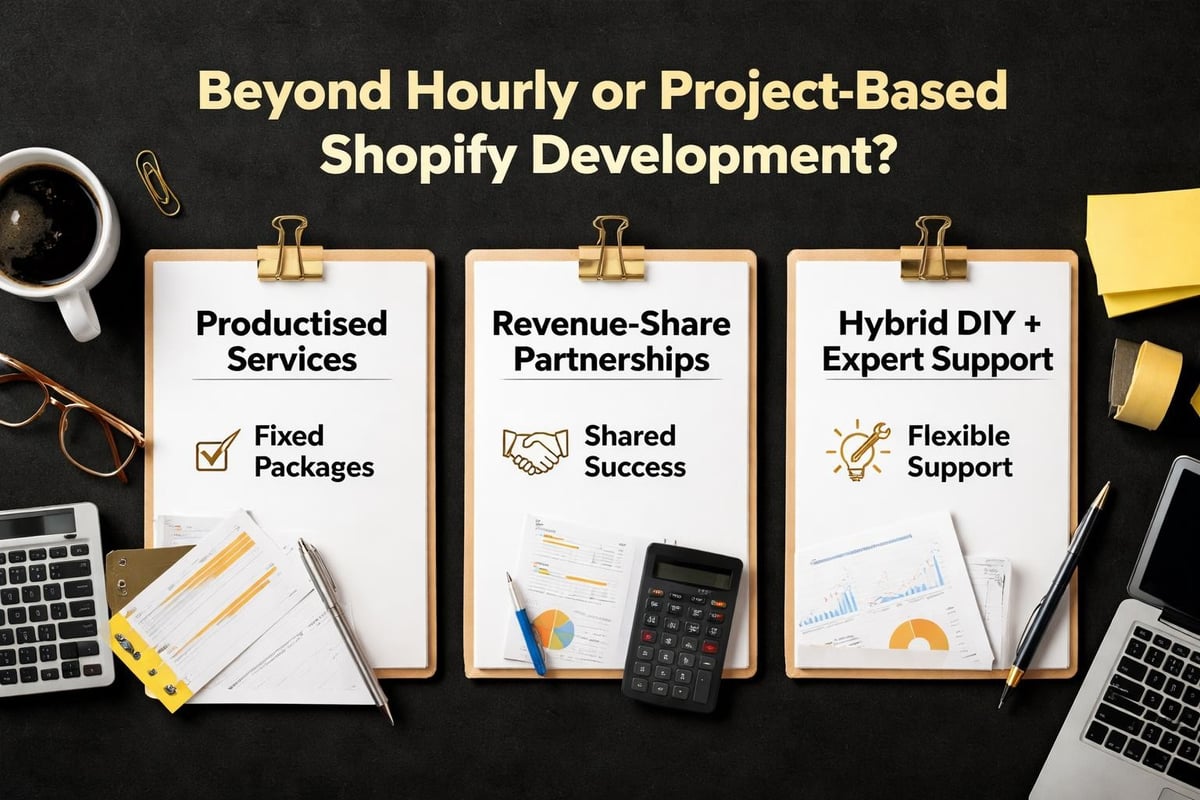
Productised services offer fixed-scope packages at set prices. You get a standard build process with defined deliverables and timelines. This reduces decision fatigue and typically costs less than fully custom approaches.
For small Australian businesses launching their first store, Done-for-you Shopify Builds provide everything needed to launch within four weeks without agency bloat or missing fundamentals.
Revenue-share arrangements occasionally work for established businesses with proven concepts. The expert builds or optimises your store in exchange for a percentage of sales. This aligns incentives but requires careful contracts.
DIY with expert support combines learning platforms, templates, and hourly consultations. You do the implementation; experts guide you through complex decisions. This can reduce total shopify expert cost by 60-80% if you have time and technical aptitude.
Ongoing partnerships replace one-off projects with monthly retainers covering support, optimisation, and growth initiatives. This spreads cost over time and ensures continuous improvement rather than launch-and-abandon.
| Model | Upfront Cost | Ongoing Cost | Best For | Risk Level |
|---|---|---|---|---|
| Project-based | High | Low | Clear, defined projects | Medium |
| Monthly retainer | Medium | Medium | Growing businesses | Low |
| Productised | Medium | Variable | Standard requirements | Low |
| Revenue-share | Low/None | High (% of sales) | Proven concepts | High |
| DIY + Support | Low | Low | Time-rich, cash-poor | Medium |
Making the Investment Decision
Ultimately, shopify expert cost should be evaluated against expected return, not just compared to competitors' quotes.
Calculate potential revenue impact. If improved conversion rates from professional development generate an extra $5,000 monthly, a $12,000 investment pays back in under three months.
Consider your opportunity cost. The months spent struggling with DIY builds while your business stagnates have value. Getting to market faster often matters more than saving a few thousand dollars.
Factor in your skillset realistically. You might be capable of building a Shopify store yourself, but is that the highest-value use of your time? Your core business might generate more revenue than you'd save on development costs.
Think long-term scalability. Cheap builds often need complete rebuilds within 12-18 months as businesses grow. Investing in proper foundations from the start – including solid eCommerce fundamentals – usually proves more cost-effective.
Questions to Ask Before Committing
Before accepting any shopify expert cost proposal, get clear answers to these questions:
What exactly is included in the quoted price? What constitutes additional charges? What's the payment structure and timeline? Who owns the code and design files after completion? What happens if timelines slip or requirements change? What support is included post-launch? How will communication happen throughout the project?
These aren't aggressive questions. They're standard due diligence that protects both parties and ensures alignment before work begins.
Regional Variations in Australian Markets
The shopify expert cost varies noticeably across Australian cities and regions.
Sydney and Melbourne command premium rates, with developers averaging $120-200 per hour. Higher living costs and competitive markets drive these figures.
Brisbane, Adelaide, and Perth typically see rates 10-20% lower, ranging $100-180 per hour for comparable expertise.
Regional areas might offer even lower rates, though the pool of experienced Shopify specialists shrinks significantly outside major cities.
Remote-first experts increasingly charge consistent rates regardless of location, basing pricing on market value rather than geographic cost of living. This has compressed regional variations since the remote work shift of the early 2020s.
For small businesses, choosing local versus remote expertise often comes down to communication preferences and whether face-to-face meetings add value.
When Premium Pricing Makes Sense
Higher shopify expert cost isn't always unjustified. Premium rates make sense when:
Your store requires complex custom functionality that standard themes can't accommodate. You're in a competitive niche where conversion optimisation directly impacts profitability. You need strategic guidance, not just technical execution. Timeline is critical and you need guaranteed delivery. You want ongoing partnership and growth support, not just a launch.
Premium development services typically include conversion rate optimisation, user experience design, performance optimisation, and strategic app selection that budget builds skip entirely.
Current Market Trends Affecting Pricing
Several 2026 trends are shifting shopify expert cost expectations.
AI-assisted development is reducing time requirements for certain tasks, potentially lowering costs for standard builds. Experts using AI tools can deliver faster without sacrificing quality.
Headless commerce adoption is increasing complexity and costs for businesses needing advanced customisation. Traditional Shopify builds remain simpler and cheaper.
Subscription models are becoming more common, with experts offering managed services rather than one-off projects. This spreads cost but increases long-term spend.
Quality polarisation is intensifying. The market is splitting between cheap, commoditised builds and premium strategic services, with less middle ground.
The Shopify platform itself continues evolving, with new features reducing the need for custom code in some areas while enabling more sophisticated commerce in others.
Budget Strategies That Actually Work
Managing shopify expert cost effectively doesn't mean always choosing the cheapest option.
Phase your build. Launch with core functionality, then add advanced features post-launch as revenue grows. This spreads investment and validates demand before heavy customisation.
Separate strategy from execution. Pay for expert strategic guidance upfront, then use that plan with a less expensive developer for implementation.
Invest in foundations. Spend on proper technical setup, conversion-focused design, and scalable structure. Cheap builds create technical debt that costs more long-term.
Negotiate payment terms. Many experts accept monthly payments or milestone-based structures rather than large upfront sums.
Be prepared and organised. Having content, products, and requirements ready before development starts reduces billable hours significantly.
The goal isn't minimising shopify expert cost at all costs. It's maximising value per dollar spent by being strategic about where you invest.
Understanding shopify expert cost helps you make informed decisions rather than gambling on quotes. The right investment level depends on your specific situation, growth plans, and internal capabilities. If you're a small Australian business ready to launch a conversion-focused Shopify store without agency bloat or DIY overwhelm, Kida Digital offers a streamlined four-week process that covers everything you need. The goal is getting you to market with momentum, clarity, and a store built to actually sell.


Be the first to comment