

Getting your eCommerce business off the ground feels like standing at the base of a mountain. You've got the product idea, maybe some suppliers lined up, and the determination to make it work. But the technical side? That's where most Australian small business owners hit their first wall. The good news is that when you Shopify start your journey in 2026, you're working with a platform that's matured significantly while staying accessible. The challenge isn't the platform itself. It's knowing what actually matters when you're launching your first store.
Why Small Businesses Choose Shopify to Start
The eCommerce platform market is crowded. WooCommerce, BigCommerce, Wix, Squarespace. They all want your business. Yet Shopify holds approximately 28% of the global eCommerce platform market share in 2026, and there's a reason for that dominance.
The platform removes technical barriers without limiting growth potential.
When you Shopify start, you're not hiring developers to set up payment gateways. You're not configuring server infrastructure or worrying about security certificates. Those fundamentals come handled. This matters enormously when you're running a small operation where your time splits between product sourcing, marketing, customer service, and everything else.
The hosting infrastructure alone saves headaches. Shopify manages server capacity, handles traffic spikes during sales periods, and maintains 99.98% uptime across their network. For a small Australian business launching during peak shopping seasons, that reliability isn't negotiable.
The Real Cost of Getting Started
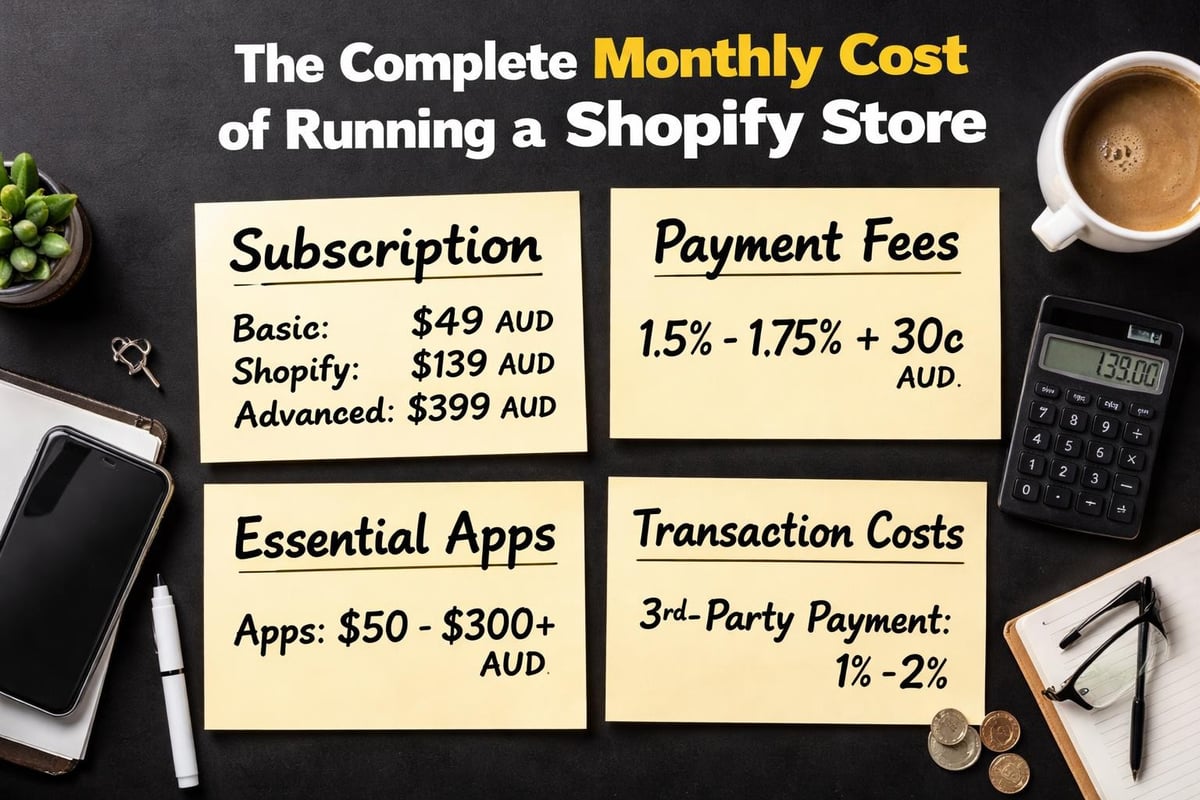
Pricing transparency matters when you're working with tight margins. Shopify's Basic plan sits at $39 AUD monthly in 2026. That gets you unlimited products, 24/7 support, and everything needed to process orders. The Shopify plan at $105 monthly adds professional reports and better shipping rates. Advanced sits at $399 for larger operations.
But the subscription fee tells only part of the story.
Apps extend functionality. Payment processing fees take a percentage of each sale. Transaction fees apply if you're not using Shopify Payments. A realistic monthly operating cost for a new store typically lands between $100-200 AUD once you factor in essential apps and processing fees.
That's still considerably less than custom development or enterprise platforms. And it's predictable, which helps when you're building financial projections.
The First 48 Hours After You Shopify Start
Those initial days set the foundation. Rush through them and you'll spend months fixing structural problems. Take them seriously and you build on solid ground.
Day one focuses on store settings and fundamentals. You'll choose your store name, set up your domain, configure your currency and timezone for Australian operations. These seem basic but changing your domain later breaks SEO. Switching currency settings after you've started processing orders creates accounting nightmares.
Your business details need entering accurately. ABN, business address, contact information. These appear on invoices and legal pages. Getting them right matters for tax reporting and customer trust.
Payment gateway configuration comes next. Shopify Payments integrates seamlessly for Australian merchants and offers competitive rates. Alternative providers like PayPal or Afterpay require additional setup but give customers more payment options. Data from 2026 shows stores offering multiple payment methods convert 23% better than single-option stores.
Day two builds your store structure. Collections organize your products. Navigation menus guide customers. Legal pages protect your business. This groundwork feels tedious but impacts every customer interaction moving forward.
The step-by-step guide to setting up your Shopify store covers these technical details thoroughly, walking through each configuration screen and explaining what actually matters versus what you can skip initially.
Product Setup That Actually Converts
Adding products isn't just uploading photos and prices. Each product page is a conversion opportunity or a bounce point.
Start with product photography. Clean, well-lit images showing multiple angles. Shopify allows unlimited images per product. Use that generously. Include lifestyle shots showing products in use. Australian consumers particularly respond to authentic imagery over stock photos.
Product descriptions need structure. Open with the main benefit. List specifications clearly. Address common questions preemptively. Keep paragraphs short. Use bullet points for features. Write for scanning, not deep reading.
| Element | Impact on Conversion | Common Mistake |
|---|---|---|
| Product images | 35% influence on purchase decision | Using only manufacturer photos |
| Descriptions | 28% influence on purchase decision | Writing for yourself, not customers |
| Pricing clarity | 41% influence on purchase decision | Hidden fees revealed at checkout |
| Stock visibility | 19% influence on purchase decision | Not showing stock levels |
Inventory tracking prevents overselling. Shopify's system updates stock automatically when orders process. Set low stock alerts to avoid disappointments. Nothing damages trust faster than cancelling orders because you've oversold.
Collections and Navigation Strategy
Collections group products logically. "Summer Dresses" makes sense. "Products We Like" doesn't help customers find anything. Think about how people shop your category, not how you organize your warehouse.
Automated collections use rules to add products dynamically. A collection for "Under $50" automatically includes new products matching that price point. Manual collections give precise control but require ongoing maintenance.
Navigation menus should never exceed seven main items. Human working memory handles about seven chunks of information. Beyond that and decision paralysis sets in. Dropdown menus can house additional categories but keep top-level navigation tight.
For Australian eCommerce businesses figuring out their Shopify web development strategy, these structural decisions impact every future marketing effort.
Theme Selection Without Analysis Paralysis
Shopify's theme store contains hundreds of options. Free themes work perfectly well for launches. Paid themes offer more customization and unique layouts but aren't necessary for validation.
Dawn is Shopify's default theme for 2026. It's fast, accessible, and flexible. Unless you have specific design requirements, starting with Dawn removes one decision from your plate.
The theme impacts page speed. Google's Core Web Vitals factor heavily into search rankings in 2026. A bloated theme with excessive features you'll never use drags performance. Choose minimal and fast over flashy and slow.
Customization happens through the theme editor. No coding required for basic changes. Colors, fonts, layout options all adjust through visual controls. This accessibility lets you refine design without hiring developers for every tweak.
When you do need custom functionality, that's where Shopify store development services become valuable, but many businesses successfully launch with theme-editor customization alone.

Essential Apps Versus Nice-to-Haves
The Shopify App Store contains over 8,000 apps in 2026. Installing everything that looks useful kills your store's performance and creates subscription bloat.
Start with three categories only.
Email marketing connects with customers post-purchase. Klaviyo dominates for eCommerce. Mailchimp offers simpler pricing for smaller lists. Either works. The important part is collecting emails from day one.
Reviews build social proof. Judge.me offers solid features at lower pricing than Yotpo. Loox focuses on photo reviews. Pick one, install it, and request reviews systematically.
Analytics beyond Shopify's built-in reports. Google Analytics 4 is free and comprehensive. Microsoft Clarity shows session recordings revealing how customers actually use your site.
Everything else waits until you identify a specific problem. Don't install a abandoned cart app until you have enough traffic to generate meaningful cart abandonment. Don't add a loyalty program until you have repeat customers to reward.
Each app adds code to your store. That code takes time to load. Page speed drops with every addition. Be ruthless about what actually serves your current stage of growth.
Shipping Configuration for Australian Markets
Shipping makes or breaks eCommerce profitability. Customers want free shipping. Your margins can't always support it. Finding that balance requires strategy.
Australia Post dominates domestic shipping. Their integration with Shopify pulls accurate rates automatically. Sendle offers competitive pricing for parcels. Couriers Please handles larger items.
Flat rate shipping simplifies operations. Charge $9.95 for standard delivery. Offer free shipping over $100. This encourages larger order values while covering costs on smaller orders.
Real-time carrier rates show exactly what shipping costs but can shock customers at checkout. A small item with $15 shipping often results in cart abandonment. Testing both approaches reveals what works for your products and price points.
International shipping opens markets but multiplies complexity. Customs declarations, duties, taxes. Start domestic until you've smoothed operations, then expand strategically.
The complete guide to launching a Shopify store includes detailed shipping strategy recommendations worth reviewing before you finalize your approach.
Tax Settings That Keep You Compliant
Australian tax requirements aren't optional. Getting GST wrong creates problems with the ATO.
If your business turns over more than $75,000 annually, you must register for GST. Shopify can calculate and collect GST automatically once configured. Enter your ABN in tax settings. Enable automatic tax calculation. Set your rates correctly for Australian locations.
International orders require different handling. Goods valued under $1,000 imported to Australia incur GST. Orders you ship internationally follow the destination country's rules. This complexity is why most new stores stick to domestic markets initially.
Keep records of everything. Shopify generates reports showing tax collected. Your accountant needs these for BAS statements. Integration with Xero or MYOB streamlines this process significantly.
Testing Before Launch Day
You've built your store. Products are loaded. Shipping works. Payments process. Now you test everything like you're trying to break it.
Place test orders using Shopify's test payment gateway. Walk through the entire customer journey. Add to cart. Enter shipping details. Complete checkout. Verify order confirmation emails arrive and display correctly.
Test on mobile devices. Over 67% of Australian eCommerce traffic comes from mobile in 2026. If your store doesn't work smoothly on phones, you're losing the majority of potential customers.
Check every link. Dead links signal poor quality. They also hurt SEO. Broken navigation frustrates customers. Click through your entire menu structure and footer links.
Review your legal pages. Privacy policy, terms of service, refund policy. These protect your business legally. They also appear in payment gateway reviews. Missing or incomplete policies can delay payment approvals.

Marketing Foundations From Day Zero
Traffic doesn't appear magically. Even the best-designed store needs customers finding it.
SEO groundwork happens during build. Product titles include search terms. Descriptions use natural language people actually search. Image alt text describes products accurately. URL structures stay clean and keyword-friendly.
Google Business Profile connects your physical location if you have one. Even online-only businesses benefit from local search visibility. Verification takes days, so start the process early.
Social media accounts claim your brand name across platforms. You might not use all of them immediately, but securing consistent handles prevents future complications. Instagram and Facebook dominate Australian social commerce in 2026.
Email collection starts immediately. A simple popup offering 10% off first orders builds your list from day one. That list becomes your most valuable marketing asset over time.
The insights on starting a business from Shopify's resource library cover marketing foundations well, with practical advice applicable to Australian markets.
Launch Timing and Momentum
Picking launch day matters more than most realize. Avoid major holidays when you'll struggle to handle unexpected issues. Choose a Tuesday or Wednesday when you're mentally fresh and support resources are readily available.
Build anticipation before going live. Tell your network. Post on social media. Create a launch email for your list. Small initial momentum compounds faster than starting from complete silence.
Plan for problems. Something will break. An app won't work as expected. A customer will find the one bug you missed. That's normal. What matters is response time and professionalism when issues arise.
Monitor everything closely for the first week. Check orders multiple times daily. Respond to customer questions within hours. Watch analytics for unusual patterns. This intensive period reveals what needs immediate adjustment.
For Australian small businesses ready to launch without the technical overwhelm, the done-for-you Shopify builds approach handles the entire setup process within four weeks, letting you focus on products and customers rather than platform configuration.
Post-Launch Optimization Cycle
Launch day isn't the finish line. It's the starting gun.
Week one focuses on conversion rate. Where do people drop off? What products get viewed but not purchased? Which pages have high bounce rates? Google Analytics and Shopify's reports reveal these patterns.
Week two addresses identified friction points. Simplify complicated checkout flows. Improve product descriptions that aren't converting. Add missing information customers ask about repeatedly.
Month one builds your baseline metrics. Average order value, conversion rate, customer acquisition cost. These numbers only mean something in comparison to future performance. Track them consistently.
The TechRadar review of Shopify for 2026 highlights the platform's strengths in iteration and optimization, noting how the ecosystem supports continuous improvement without requiring platform changes.
When to Get Professional Help
DIY tutorials take you far. They can't take you everywhere.
Custom functionality requirements often justify professional development. Integration with specific wholesale systems. Custom calculator tools. Advanced subscription models. These exceed theme capabilities.
Design that truly differentiates requires professional input. Stock themes serve functional purposes. Custom design creates brand recognition and memorable experiences.
Strategic guidance prevents costly mistakes. Experienced developers spot structural problems before they compound. They configure foundations properly the first time rather than requiring expensive rebuilds later.
The difference between a four-week launch and a six-month struggle often comes down to knowing what you don't know. Professional Shopify development addresses that gap systematically.
Starting your eCommerce journey on Shopify in 2026 means working with a mature platform that removes technical barriers while maintaining scalability. The path from concept to launch is clearer than ever, though it still requires strategic thinking and careful execution. If you're ready to launch without the technical overwhelm or agency price tags, Kida Digital specializes in conversion-focused Shopify builds for Australian small businesses, delivering complete stores in four weeks with clarity, structure, and momentum from day one.


Be the first to comment