

Running a small online store in Australia today means competing with global brands, marketplace giants, and thousands of other businesses fighting for the same customers. But here's the reality: small ecommerce businesses have distinct advantages when they build with intention, avoid costly mistakes, and focus on what actually drives sales. The barrier to entry has never been lower, yet success requires more strategic thinking than ever before.
Why Platform Choice Makes or Breaks Small Stores
Your ecommerce platform isn't just where you list products.
It's your entire sales infrastructure, your customer experience, and often the difference between a store that converts and one that bleeds marketing budget.
According to 2025 research from Statista, 47% of small ecommerce businesses cite platform limitations as a primary growth constraint within their first two years. That's nearly half of all new stores hitting walls they didn't see coming.
The platform you choose determines your monthly costs, your ability to scale, your integration options, and critically, how much technical debt you'll accumulate.
What Small Ecommerce Businesses Actually Need From a Platform
Most platforms market themselves to everyone, which means they're optimized for no one.
Small Australian stores need specific capabilities that match their stage and resources:
- Native Australian payment processing without international transaction fees eating margins
- Built-in mobile optimization since 73% of Australian ecommerce traffic now comes from mobile devices
- Inventory management that doesn't require third-party apps for basic stock control
- Subscription capability if your product model supports recurring revenue
- Customer review systems because social proof drives 63% more conversions than stores without reviews
When evaluating ecommerce tools, most small businesses focus on upfront costs and miss ongoing expenses.
A platform charging $29 per month but requiring $200 in apps to function properly isn't cheaper than one at $79 with everything included.
Do the math on your actual cost to operate, not just the headline subscription fee.

The Four-Week Launch Framework That Actually Works
Speed matters more than perfection when launching small ecommerce businesses.
Every week you spend tweaking fonts or debating color schemes is a week without revenue, without customer feedback, and without real market validation.
The traditional agency approach stretches builds to 12-16 weeks because they can. More meetings, more revisions, more billable hours.
But small stores don't need that timeline, and research from Shopify's 2025 Commerce Trends Report shows stores launching within 30 days have 2.3x higher survival rates at the 24-month mark compared to those taking 90+ days.
Here's why: faster launches mean faster learning.
Breaking Down the Four-Week Build Process
Week one focuses entirely on strategic foundation.
This includes your product categorization, customer journey mapping, core messaging, and technical requirements documentation. No design happens yet because design without strategy is just decoration.
Week two handles design and structure implementation.
Your homepage, collection pages, product templates, and checkout flow get built with conversion principles baked in from the start. This isn't about making things pretty; it's about making things sell.
Week three covers integration and functionality testing.
Payment processors, shipping calculators, email marketing platforms, review systems, and analytics all get connected and verified. Small ecommerce businesses lose thousands in revenue to broken checkout flows that could've been caught in proper testing.
Week four is content population and launch preparation.
Products get loaded with optimized descriptions, images get properly formatted and compressed, SEO elements get configured, and pre-launch marketing campaigns get scheduled.
For small Australian eCommerce businesses launching their first Shopify store, my core Shopify package is designed to cover everything a new eCommerce business needs to launch within four weeks with clarity, momentum, and a clear strategy.
This compressed timeline isn't rushed; it's focused.
Every decision gets made through the lens of "does this help us sell more products?" rather than "wouldn't it be cool if we had this feature?"
Conversion Rate Optimization for Stores Under $100K Annual Revenue
Most conversion advice targets enterprises with massive traffic volumes.
But small ecommerce businesses operate in a different reality where 500 monthly visitors is normal and every single sale counts.
According to 2026 data from the Australian Bureau of Statistics, the median ecommerce conversion rate for small Australian retailers sits at 1.8%. That means for every 100 people visiting your store, 98 leave without buying.
The good news? Small improvements create outsized results at this scale.
Moving from 1.8% to 2.7% conversion doesn't sound dramatic, but it's a 50% revenue increase with identical traffic and marketing spend.
High-Impact Changes That Don't Require Development Budget
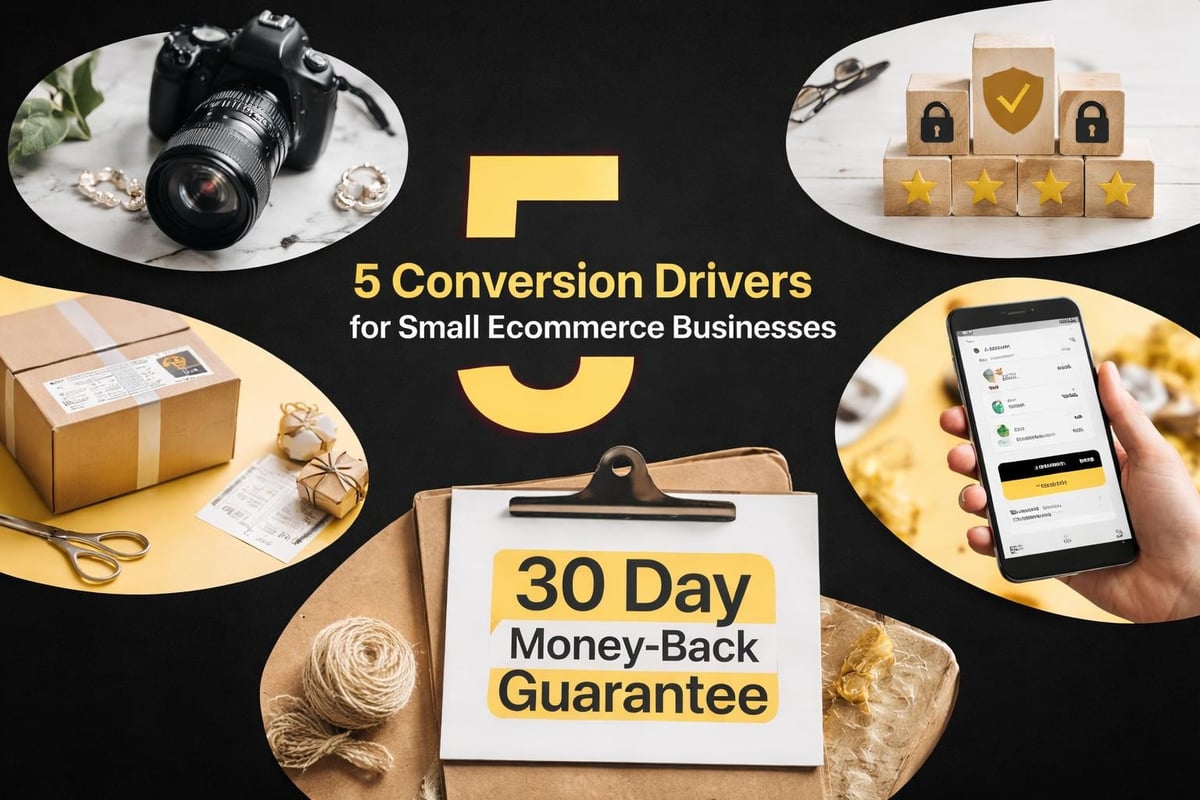
Product photography quality matters more than most small ecommerce businesses realize.
A 2025 study by the Baymard Institute found that 56% of shoppers cite poor product images as their primary reason for cart abandonment. Not price, not shipping costs, but images.
Your phone camera is good enough if you understand basic product photography principles: natural light, clean backgrounds, multiple angles, and scale references.
Trust signals convert browsers into buyers.
Display your ABN, physical address if you have one, clear return policies, and customer service contact methods prominently. Australian consumers shopping from small ecommerce businesses want reassurance they're buying from a legitimate operation.
Shipping transparency eliminates the number one cart abandonment trigger.
Show shipping costs early, offer flat-rate options when possible, and set clear delivery timeframes. "Free shipping over $80" converts better than "shipping calculated at checkout" even when the final cost is identical.
Marketing Channels That Actually Generate ROI for Small Budgets
Small ecommerce businesses can't afford to spray budget across every marketing channel hoping something works.
You need concentrated effort in one or two channels that match your customer behavior and product type.
The 2026 Small Business Marketing Report from Xero Australia found that successful small ecommerce businesses spend an average of 12-18% of revenue on marketing, but concentrate 70% of that budget in their top-performing channel rather than distributing evenly.
Email Marketing Still Dominates for Small Store ROI
Email generates $42 for every $1 spent according to Litmus 2025 research.
For small ecommerce businesses, this represents the highest-return channel available, yet many neglect it in favor of social media that offers ego metrics instead of revenue.
Building your email list from day one creates an owned audience that costs nothing to reach after acquisition.
Pop-up offers, exit-intent captures, and post-purchase automation all contribute to list growth. A store with 1,000 email subscribers at 2% conversion rate and $80 average order value generates $1,600 every time they send a campaign.
That's 20 campaigns per year at $32,000 in attributable revenue from an asset that grows with every sale.
Paid Social Works When Product and Platform Align
Not every product belongs on every platform.
Instagram and Facebook excel for visually-led products with strong lifestyle associations. Pinterest drives purchase intent for home goods, fashion, and craft products. TikTok converts younger demographics on trend-driven or problem-solving products.
Small ecommerce businesses waste budget testing all platforms simultaneously rather than identifying where their specific customers actually shop.
Start with one platform, test systematically with $200-300 in budget, and scale only what proves profitable. Understanding how to build sustainable ecommerce sites includes knowing which traffic sources actually convert for your specific business model.
Inventory Management Without Overstocking or Stockouts
Cash flow kills more small ecommerce businesses than competition ever will.
Tying up $15,000 in inventory that takes six months to sell means six months without that capital for marketing, product development, or operational expenses.
The Australian Small Business Ombudsman's 2025 report identified inventory mismanagement as the second-leading cause of small ecommerce business failure behind undercapitalization.
The Minimum Viable Inventory Approach
Start with smaller quantities across more SKUs rather than deep stock of fewer products.
This applies opposite logic to traditional retail but makes sense for small ecommerce businesses testing market fit. You'd rather have 50 units across 10 products than 500 units of one product that might not sell.
Dropshipping eliminates inventory risk entirely but introduces margin compression and fulfillment control issues.
It works well for market testing new products before committing to bulk orders. Once a product proves demand, transition to held inventory for better margins and customer experience.
Pre-order models shift inventory risk to customers while funding production.
This works particularly well for small Australian ecommerce businesses in fashion, accessories, or limited-run products where scarcity drives value rather than diminishing it.
| Inventory Model | Upfront Capital | Margin | Control | Best For |
|---|---|---|---|---|
| Held Stock | High | High | Full | Proven products |
| Dropshipping | None | Low | Limited | Testing phase |
| Pre-order | Low | High | Full | Limited releases |
| Print-on-demand | None | Medium | Medium | Custom designs |
Customer Service as Competitive Advantage
Large retailers compete on price and selection.
Small ecommerce businesses win on experience and service.
According to Zendesk's 2026 Customer Experience Trends Report, 76% of Australian consumers will pay more to buy from businesses offering superior customer service. That premium averages 13% across product categories.
Response time matters more than response perfection.
Customers contacting small ecommerce businesses expect replies within 24 hours on email and 2 hours on social media during business hours. Meeting these expectations consistently builds trust that drives repeat purchases.
Proactive communication prevents support tickets.
Shipping delays, stock issues, and order problems should be communicated before customers need to ask. A simple email saying "Your order is running one day behind due to courier delays" eliminates frustrated support contacts and maintains goodwill.
Return policies should be clear, fair, and easy to execute.
The easier you make returns, the more confident customers feel buying from you initially. Common challenges faced by small ecommerce businesses often center on customer service infrastructure that scales with growth.
Small stores averaging 50-100 orders monthly can handle customer service through standard email. Beyond 100 monthly orders, dedicated helpdesk software with ticketing becomes necessary to prevent balls being dropped.
Technical Foundations Most Small Stores Get Wrong
Site speed affects conversion rates more than most small ecommerce businesses realize.
Google's 2025 research found that as page load time goes from 1 second to 3 seconds, bounce probability increases by 32%. From 1 to 5 seconds, it increases by 90%.
Your beautiful product images mean nothing if customers leave before they load.
Mobile Experience Isn't Optional in 2026
Mobile commerce represents 67% of all Australian ecommerce transactions according to Australia Post's 2026 eCommerce Industry Report.
If your store doesn't work flawlessly on mobile, you're eliminating two-thirds of your potential market. Building websites for small businesses means mobile-first thinking from day one.
Thumb-friendly navigation, large touch targets, simplified checkout flows, and fast load times on 4G connections separate converting mobile stores from those that frustrate users into competitors' arms.
Security and Trust Signals Matter More for Unknown Brands
Established retailers benefit from brand recognition that implies trustworthiness.
Small ecommerce businesses start with zero trust and must actively build it through visible security signals.
SSL certificates aren't optional; they're baseline requirements.
Browsers actively warn users when visiting non-HTTPS sites, which is instant credibility destruction for small stores. Beyond SSL, display security badges from your payment processor, industry associations, or third-party verification services.
Privacy policies and terms of service might feel like legal busywork, but they signal professional operation.
Customers subconsciously assess legitimacy based on these details, even if they never read them. Missing or poorly written policies trigger doubt.

Data and Analytics That Drive Better Decisions
Most small ecommerce businesses install Google Analytics and never look at it again.
Data only creates value when it informs decisions.
The difference between stores that grow and those that stagnate often comes down to whether founders use data to guide strategy or rely on gut feeling and hope.
Track these metrics weekly at minimum:
Revenue per visitor tells you if your traffic quality and conversion optimization are working together. This metric combines traffic volume, conversion rate, and average order value into one meaningful number.
Cart abandonment rate identifies friction in your checkout process. The Australian ecommerce average sits at 68%, meaning tracking your specific rate against this benchmark shows whether you're above or below standard performance.
Customer acquisition cost determines marketing sustainability. If you're spending $45 to acquire customers with $50 average order value, you're building a business that can't scale profitably without dramatically improving retention.
Repeat purchase rate separates viable businesses from temporary revenue generators. Small ecommerce businesses with repeat rates below 15% are constantly fighting for survival. Those above 30% build compounding growth.
Understanding Your Actual Unit Economics
Profit per product sold matters more than revenue.
A store doing $10,000 monthly revenue with 8% net margin keeps $800. Another doing $6,000 with 22% margin keeps $1,320. The smaller store is actually healthier and more sustainable.
Many small ecommerce businesses celebrate revenue milestones while ignoring whether they're actually making money.
Calculate your true cost per unit including product cost, shipping supplies, payment processing fees, platform costs, and allocated marketing spend. Then compare against your selling price after discounts and refunds.
This reveals which products actually contribute to profit and which ones generate busy work without reward. Choosing the right website builder impacts these economics through both monthly platform costs and transaction fees.
Scaling Challenges Small Stores Hit at $50K and $100K Marks
Growth creates different problems than starting does.
Small ecommerce businesses hitting $50,000 in annual revenue typically encounter their first major operational bottleneck: time. The founder can no longer handle every order, every customer service inquiry, every marketing task, and every product sourcing decision personally.
This transition point requires systematizing repeatable tasks before hiring help.
Document your processes, create standard operating procedures, and identify which tasks generate the highest value per hour of your time.
At $100,000 annual revenue, small ecommerce businesses face a different constraint: capital.
Inventory requirements increase, marketing budgets need expansion to maintain growth rates, and technology needs become more sophisticated. Many stores plateau here because founders lack the financial management skills to navigate working capital requirements.
Planning for these transitions before you hit them prevents the panicked scrambling that derails momentum.
When to Bring in Specialized Help
Founders can't be experts in everything.
Knowing when to outsource or hire specialists separates scaling stores from stagnant ones.
Product photography should be outsourced once you're ordering inventory in bulk rather than one-off testing. Professional images pay for themselves in conversion rate improvement within weeks.
Paid advertising management becomes worth delegating once you're spending $2,000+ monthly on ads. An experienced media buyer charging 15% of spend will typically improve returns enough to cover their fee and increase your profit.
Platform development and technical optimization should be handled by specialists from the start. Understanding why agencies charge $10K for Shopify sites reveals the expertise required and alternative approaches for small ecommerce businesses with tighter budgets.
Small ecommerce businesses in Australia face genuine challenges, but the fundamentals that drive success remain consistent: choose platforms that match your needs, launch quickly to start learning, optimize relentlessly for conversion, and manage inventory and cash flow like your business depends on it (because it does). If you're ready to launch your online store with a strategic, conversion-focused approach that gets you selling in weeks rather than months, Kida Digital specializes in Shopify development for Australian small businesses that need momentum, clarity, and results without agency bloat or DIY overwhelm.


Be the first to comment