

Your website is your digital shopfront, and for small Australian businesses in 2026, getting it right matters more than ever. Between DIY platforms promising instant results and agencies charging five figures for basic builds, the middle ground seems harder to find. Website design for small business doesn't need to be complicated, but it does need to be strategic. This guide cuts through the noise to show you what actually matters when building a site that converts browsers into buyers.
The Real Cost of Getting Website Design Wrong
Most small business owners approach website design for small business backwards. They focus on aesthetics first, functionality second, and strategy last.
The result? Beautiful websites that don't sell.
Here's what happens when design decisions aren't grounded in business outcomes:
- Cart abandonment rates hover above 70% because checkout flows weren't tested
- Mobile users bounce immediately because the site wasn't built mobile-first
- Product pages look identical to competitors, offering no reason to buy from you
- Site speed suffers under heavy imagery, killing conversions before they begin
A 2025 study found that 53% of mobile users abandon sites that take longer than three seconds to load. That's not a design problem, it's a revenue problem.
Your website needs to work as hard as you do. Every element should have a purpose beyond looking nice.
Strategy Before Pixels
Before you touch a template or choose a colour palette, answer these questions:
- Who is buying from you? Not who you hope will buy, but who actually converts.
- What problem are you solving? Your website should make this clear within five seconds of landing.
- What's the desired action? Every page needs a primary conversion goal.
- How will customers find you? SEO isn't an afterthought, it's foundational.
Starting with strategy means your design decisions stem from data, not guesswork. When choosing a website template, you're not picking what looks prettiest but what serves your business model best.

Platform Decisions That Actually Matter
The platform debate for website design for small business has shifted dramatically since 2024. WordPress still powers 43% of the web, but for eCommerce specifically, Shopify has captured over 30% of the Australian market.
Platform choice impacts everything:
- Development timeline and costs
- Ongoing maintenance burden
- Integration capabilities with tools you already use
- Scalability as your business grows
| Platform Type | Best For | Main Drawback | Typical Cost |
|---|---|---|---|
| Shopify | eCommerce-first businesses | Monthly fees add up | $39-$399/month + apps |
| WordPress + WooCommerce | Content-heavy stores | Requires technical maintenance | $50-$200/month hosting |
| Squarespace | Service businesses | Limited eCommerce features | $23-$65/month |
| Wix | Basic online presence | Poor SEO flexibility | $17-$159/month |
For product-based businesses, Shopify eliminates the technical complexity that bogs down WordPress builds. You're not managing hosting, security patches, or plugin conflicts.
The trade-off is less flexibility for custom functionality, but most small businesses don't need custom functionality. They need a site that works reliably and converts consistently.
Choosing the right platform means understanding where your business sits on the complexity spectrum. A single-product store has different needs than a business selling 500 SKUs across multiple categories.
The DIY vs Agency vs Specialist Decision
You've got three paths for website design for small business in 2026.
DIY platforms promise you can build everything yourself with drag-and-drop tools. The reality is different. You'll spend 60+ hours learning systems, troubleshooting issues, and second-guessing design choices. The opportunity cost alone often exceeds what you'd pay a specialist.
Traditional agencies charge $10,000 to $50,000 for Shopify builds. The work takes three to six months. You're paying for account managers, project coordination, and overhead that doesn't directly improve your site. For most small businesses, this doesn't make financial sense.
Specialists sit in the middle, offering structured processes without agency bloat. Done-for-you Shopify builds can launch complete stores in four weeks, covering everything from theme setup to conversion optimization, at a fraction of agency pricing.
The right choice depends on your timeline, budget, and technical confidence. But choosing based on price alone is a mistake that costs more long-term.
Conversion-Focused Design Principles
Website design for small business needs to prioritize conversions above everything else. A site that looks amazing but doesn't sell is an expensive brochure.
These principles drive measurable results:
Navigation should be obvious, not clever. Users shouldn't hunt for your product catalogue or contact details. The average visitor spends 54 seconds on your site, make every second count.
Product imagery needs to sell, not just showcase. That means multiple angles, lifestyle shots showing products in use, and zoom functionality that actually works on mobile devices.
Copy matters more than most businesses realize. Features tell, benefits sell. "Waterproof phone case" is a feature. "Your phone survives the beach, pool, and rainy commutes" is a benefit.
Mobile-First Isn't Optional Anymore
63% of Australian eCommerce traffic now comes from mobile devices. Yet many small business sites still treat mobile as an afterthought.
Mobile responsiveness means more than your site shrinking to fit smaller screens. It means rethinking:
- Touch targets sized for fingers, not mouse cursors
- Forms simplified to minimize typing on tiny keyboards
- Images optimized for fast loading on cellular connections
- Checkout processes designed for one-handed use
Google's mobile-first indexing means your mobile site is now your primary site in their eyes. Poor mobile experience doesn't just lose sales, it tanks your search rankings.
Test your site on actual devices, not just browser developer tools. The experience differs more than you'd expect.

The Elements Every Business Site Needs
Certain components aren't optional for website design for small business. Skip these, and you're leaving money on the table.
Clear Value Proposition
Your homepage hero section has one job: communicate what you sell and why it matters within five seconds of landing. This isn't where you get creative or mysterious.
Strong value propositions follow a pattern:
- Lead with the outcome, not the product
- Address a specific problem your ideal customer has
- Differentiate from competitors in concrete terms
"Premium Australian-made leather goods" is descriptive but not compelling. "Leather bags that survive daily abuse and still look professional after five years" speaks to durability and appearance concerns directly.
Trust Signals That Actually Work
Reviews, testimonials, and social proof matter. But generic five-star ratings and "Great product!" testimonials don't move the needle.
Specific testimonials that address common objections convert better. "I was worried about sizing, but the detailed measurements and fit guide meant I ordered the right size first time" reassures hesitant buyers more than "Love it!"
Trust badges from recognized security providers, clear return policies, and visible contact information all reduce purchase anxiety. Hiding your phone number or making returns difficult signals you don't stand behind your products.
Performance Optimization
Site speed directly impacts revenue. Amazon found every 100ms of latency cost them 1% in sales. For small businesses, the impact is even more pronounced because you don't have the brand recognition to earn patience.
| Speed Metric | Target | Why It Matters |
|---|---|---|
| First Contentful Paint | Under 1.8s | First impression of load speed |
| Largest Contentful Paint | Under 2.5s | Main content becomes visible |
| Time to Interactive | Under 3.8s | Users can actually interact |
| Cumulative Layout Shift | Under 0.1 | Content doesn't jump around |
These Core Web Vitals aren't just Google ranking factors. They're user experience fundamentals. Optimizing for these metrics requires technical knowledge most business owners don't have.
Image compression, lazy loading, code minification, and CDN implementation all contribute to faster sites. The technical details matter less than the outcome: a site that loads instantly and functions smoothly.
Content Structure for Search and Sales
Website design for small business must account for how people actually find and use sites. That means understanding both search behavior and browsing patterns.
SEO-Friendly Architecture
Site structure affects both user experience and search rankings. A flat architecture where every page is within three clicks of the homepage performs better than deep hierarchies requiring multiple navigation steps.
Effective information architecture follows clear patterns:
- Homepage introduces the brand and value proposition
- Category pages organize products into logical groupings
- Product pages provide detailed information and purchasing options
- Content pages (about, FAQ, blog) build trust and target informational searches
Internal linking between related products and content pages helps both users and search engines understand relationships. Research on SEO and content quality shows that well-structured sites with clear hierarchies rank better than complex sites with poor organization.
Category pages deserve more attention than they typically receive. They're often your highest-ranking pages for commercial search terms. Thin category pages with just product grids waste their potential.
Product Page Optimization
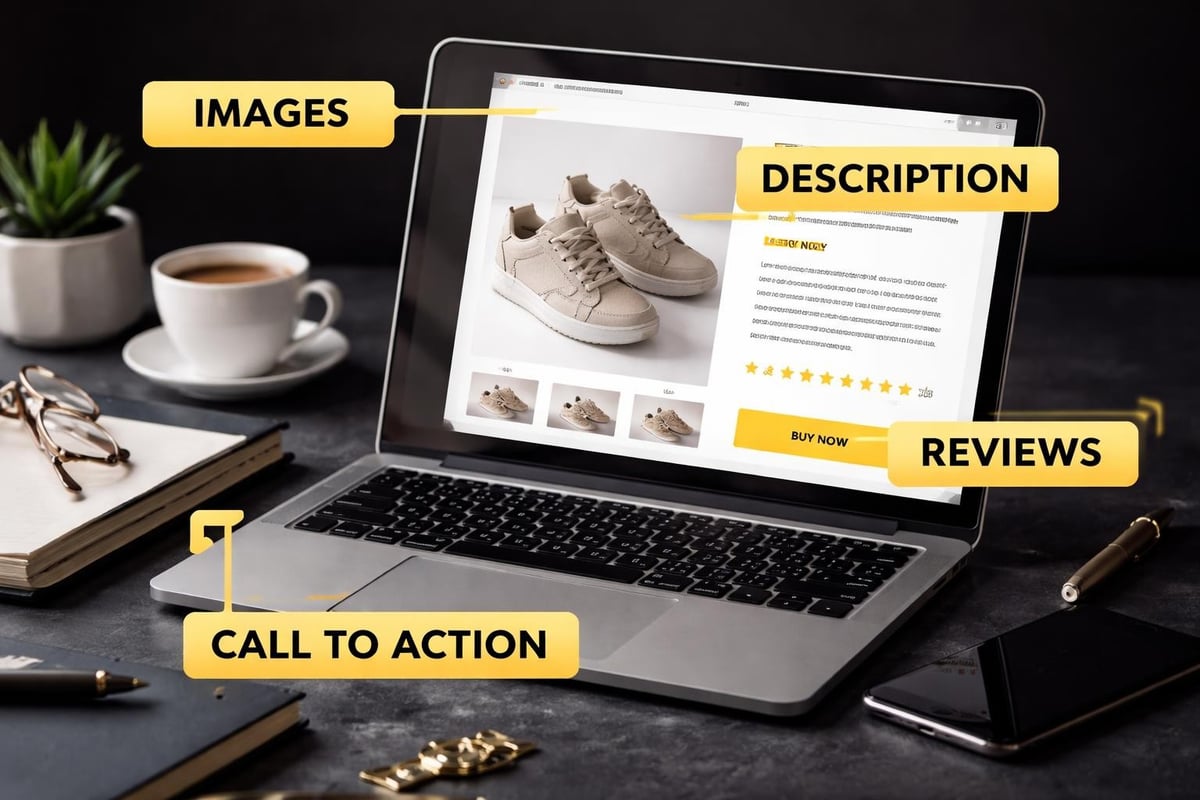
Your product pages carry the conversion weight. Poor product pages kill sales regardless of how beautiful your homepage looks.
Each product page needs comprehensive information:
- Multiple high-quality images from different angles
- Detailed specifications addressing common questions
- Benefits-focused descriptions, not just feature lists
- Size guides, fit information, or usage instructions
- Reviews from verified purchasers
- Clear stock status and shipping timeframes
- Related products to increase order value
Product page optimization balances SEO requirements with conversion priorities. Both matter, neither should dominate at the other's expense.
Common Design Mistakes That Kill Conversions
Even professionally designed sites make mistakes that sabotage conversions. Awareness helps you avoid them in your own website design for small business.
Overcomplicating the Checkout Process
Average cart abandonment sits around 70% across eCommerce. Complicated checkouts are the primary culprit.
Each additional form field increases abandonment rates. Asking for information you don't need costs you sales. Do you really need a phone number for digital products? Does company name matter for B2C transactions?
Guest checkout options are non-negotiable. Forcing account creation before purchase pushes price-sensitive buyers to competitors. You can always encourage account creation post-purchase.
Progress indicators during multi-step checkouts reduce abandonment. Users want to know if they're on step two of three or step two of seven.
Inconsistent Branding Creates Confusion
Consistent branding across your site builds trust and recognition. Wildly different fonts, colours, or styles between pages suggests unprofessionalism or even scam sites.
Your design system should define:
- Primary and secondary colour palettes
- Typography hierarchy for headings and body text
- Button styles and states (normal, hover, active)
- Spacing and layout patterns
- Image treatment and overlay styles
This doesn't mean boring uniformity. It means intentional consistency that feels cohesive rather than scattered.
Ignoring Accessibility Standards
Accessibility isn't just ethical, it's practical. 18% of Australians live with disability. Inaccessible sites exclude paying customers.
Basic accessibility requirements include:
- Sufficient colour contrast between text and backgrounds
- Alt text for all images
- Keyboard navigation for all interactive elements
- Proper heading hierarchy for screen readers
- Form labels clearly associated with inputs
Many AI-generated website designs accidentally implement dark patterns or accessibility issues. Human oversight remains necessary to catch these problems before launch.
Maintaining and Improving Your Site Post-Launch
Website design for small business isn't a one-time project. Sites need ongoing attention to maintain performance and improve conversions.
Analytics That Actually Guide Decisions
Google Analytics shows you what's happening on your site. But raw data doesn't tell you what to fix.
Focus on metrics tied to business outcomes:
- Conversion rate by traffic source (which channels deliver buyers, not just visitors)
- Cart abandonment rate and where in checkout users drop off
- Average order value and products frequently bought together
- Time on page for key content (product pages, landing pages)
- Bounce rate by device type (mobile vs desktop experience gaps)
Heatmaps and session recordings reveal user behavior analytics misses. Seeing actual users struggle with your navigation or overlook calls-to-action provides insights spreadsheets can't.
Set up goals in analytics for each conversion action: purchases, email signups, contact form submissions, quote requests. Track them monthly and investigate when numbers shift unexpectedly.
Continuous Testing and Optimization
A/B testing answers questions your opinions can't. Does a longer product description convert better than a concise one? Do trust badges above the fold increase purchases? Testing shows you.
High-impact elements to test include:
- Product page layouts and image placement
- Call-to-action button copy and colours
- Homepage hero messaging and offers
- Shipping threshold messaging
- Urgency indicators (stock levels, limited offers)
Run tests until you reach statistical significance. Stopping a test after 50 conversions because one variant is winning gives you false confidence. Most tests need hundreds or thousands of conversions for reliable results.
Small incremental improvements compound. A 5% conversion increase doesn't sound dramatic, but it's 5% more revenue with the same traffic and ad spend.
When to Refresh vs Rebuild
Site redesigns aren't inherently good or bad. The question is whether a refresh solves actual problems or just changes things for the sake of changing.
Consider a major redesign when:
- Your current site isn't mobile-responsive
- Your platform severely limits functionality you need
- Your brand has evolved significantly since the current design
- Conversion rates have declined despite optimization efforts
- Technology stack is outdated and causing security or performance issues
Minor refreshes handle most situations better than full rebuilds. Updated imagery, refined copy, improved product pages, and navigation tweaks maintain momentum without starting over.
The businesses succeeding with eCommerce in 2026 treat their sites as evolving assets, not fixed monuments.
The Technical Foundations Nobody Talks About
Website design for small business requires technical infrastructure most business owners never consider until something breaks.
Security isn't negotiable for eCommerce sites. SSL certificates, PCI compliance, regular software updates, and secure hosting prevent breaches that destroy customer trust and expose you to liability.
Backups should be automated and tested. Discovering your backup system doesn't actually work when you need to restore data is too late.
Scalability planning prevents growing pains. Your hosting, platform, and architecture should handle traffic spikes without crashing when you run successful promotions or get featured coverage.
Integration capabilities determine which tools you can use as you grow. Email marketing, inventory management, accounting software, CRM systems all need to connect to your site. Platforms vary dramatically in integration support.
Domain and email configuration seem trivial until they're wrong. Professional email addresses using your domain build more trust than free Gmail addresses. Proper DNS configuration ensures email deliverability and site uptime.
These technical elements rarely excite business owners. They're also the foundations that prevent disasters and enable growth. Getting them right from the start saves expensive fixes later.
Website design for small business in 2026 comes down to strategic choices that prioritize conversions over aesthetics and user needs over personal preferences. Your site exists to serve your business goals, and every design decision should support that purpose. If you're ready to launch an eCommerce store that's built for conversions from day one, Kida Digital can help you build a Shopify store in four weeks without the agency price tag or DIY headaches.


Be the first to comment