

Running a business on Shopify has become the default choice for Australian eCommerce owners who want to sell online without the technical headaches. The platform handles payment processing, inventory management, and security while you focus on what matters – getting products to customers and growing revenue. In 2026, Shopify powers over 4.8 million stores globally, with Australian merchants making up a significant portion of that ecosystem. For small businesses especially, the platform offers a middle path between limited marketplace selling and building custom solutions from scratch. This guide walks through what actually matters when you're operating a business on Shopify, from the initial setup decisions through to the daily operations that drive sales.
Choosing the Right Shopify Plan for Your Business Model
Your subscription choice directly impacts your operational costs and available features.
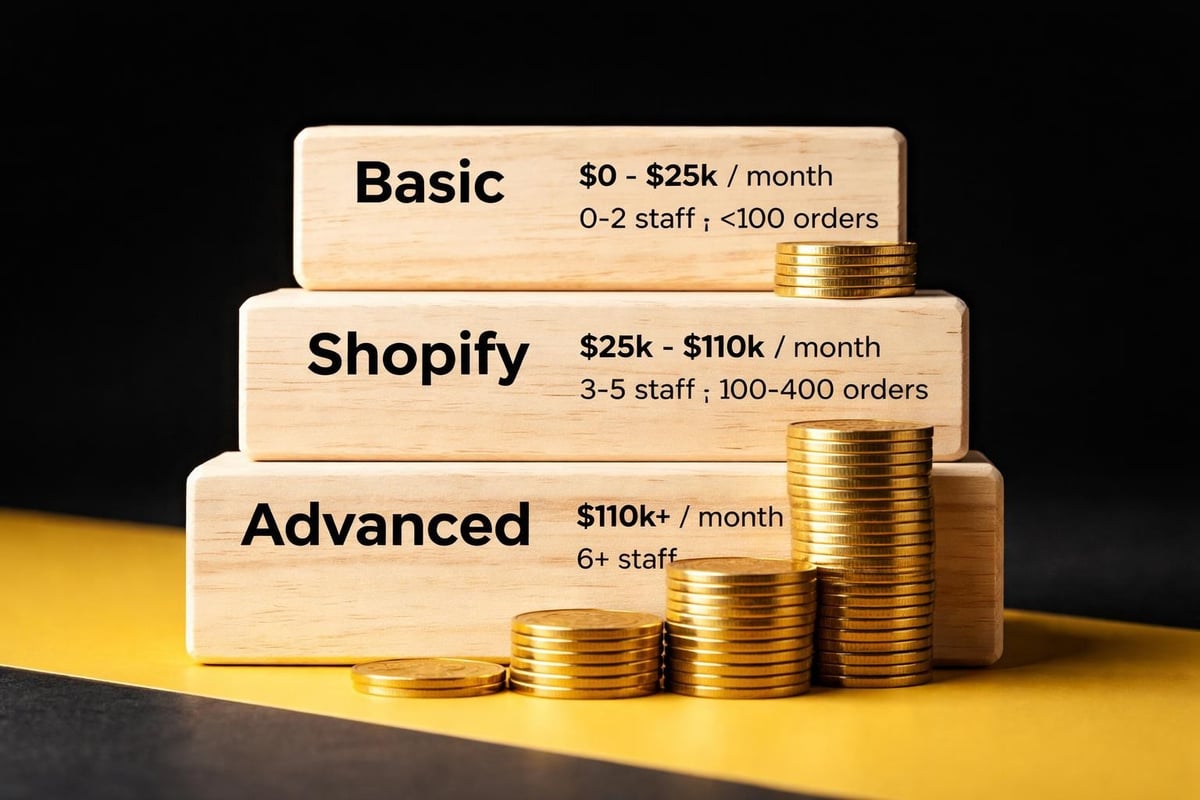
The Basic plan at $47 AUD monthly suits most businesses launching their first store. It includes unlimited products, two staff accounts, and standard reporting. The Shopify plan at $135 monthly adds professional reports, five staff accounts, and lower transaction fees that benefit stores processing over $3,000 monthly. Advanced Shopify at $539 monthly brings advanced report builder and third-party calculated shipping rates.
Most Australian small businesses start on Basic.
They upgrade when staff requirements or transaction volumes justify the shift. A store processing $10,000 monthly saves roughly $60 in transaction fees by moving from Basic to Shopify plan. That's a $75 net cost for enhanced reporting and three additional staff logins.
The TechRadar review of Shopify highlights how the 2026 pricing structure now includes AI-powered design tools at all levels. These weren't available two years ago. The platform continuously adds features without bumping subscription costs, which changes the value calculation over time.
Transaction Fees and Payment Processing
Shopify Payments eliminates the 0.5% to 2% additional transaction fee charged when using third-party gateways.
In Australia, credit card rates through Shopify Payments range from 1.6% + 30c to 2.4% + 30c depending on your plan. A Basic plan store processing $5,000 monthly pays roughly $120 in card fees. Using PayPal or Stripe instead adds another $100 in platform transaction fees on top of their processing costs.
The maths favours Shopify Payments for most stores.
Some businesses need alternatives for specific customer preferences or international markets. That's when the transaction fee becomes a considered cost rather than an accidental expense.
Setting Up Your Store Infrastructure
Product organisation determines how easily customers find what they need.
Collections group products by category, season, price point, or any custom filter you create. Automated collections use conditions – products tagged "summer" or priced under $50 automatically appear. Manual collections give you precise control for curated selections or limited releases.
Most successful stores use both types strategically.
Your navigation menu should reflect how customers think about your products, not how you organise your warehouse. A clothing store might show "New Arrivals," "Best Sellers," and "Sale" in the main menu while keeping "Hoodies" and "T-Shirts" as secondary categories. Understanding Shopify web development fundamentals helps you structure these elements for conversion rather than just organisation.
Theme Selection and Customisation
Free themes cover 80% of what small businesses need.
Dawn, Sense, and Craft offer modern layouts with mobile optimisation and fast loading speeds. They lack some advanced features found in premium themes but remain highly customisable. Premium themes at $200 to $400 add specific features like mega menus, advanced filtering, or industry-specific layouts.
Choose based on functionality gaps, not aesthetics.
A store selling five products doesn't need the complexity of a theme built for 500 SKUs. The wrong theme choice creates maintenance headaches and unnecessary customisation costs. Theme changes later require rebuilding customisations, so the initial decision carries weight.
Managing Products and Inventory
Product data structure affects everything from SEO to fulfilment.
Each product needs a clear title, accurate description, high-quality images, and proper variant setup. Variants handle different sizes, colours, or configurations under one product listing. A t-shirt in three sizes and four colours creates 12 variants from one product entry.
Inventory tracking prevents overselling and stock issues.
Shopify tracks quantities at the location level if you operate multiple warehouses or use third-party fulfilment. The system holds inventory during checkout, releases it if payment fails, and adjusts stock when orders ship. This automation removes the spreadsheet juggling that plagues early-stage businesses.
| Inventory Feature | Basic Plan | Shopify Plan | Advanced Plan |
|---|---|---|---|
| Locations | Up to 4 | Up to 5 | Up to 8 |
| Tracking | Yes | Yes | Yes |
| Bulk editing | Limited | Standard | Advanced |
| Reporting | Basic | Professional | Custom |
Proper inventory management at the product setup phase saves countless hours correcting data later. Clean data from day one compounds into better reporting and fewer operational headaches as you scale.
Order Fulfilment and Logistics
How you ship products directly impacts customer satisfaction and repeat purchase rates.
Australia Post, Sendle, and Aramex integrate directly with Shopify for label printing and tracking. Rates pull automatically at checkout based on product weight, dimensions, and destination. Flat rate shipping simplifies pricing but can eat margins on heavy items or remote deliveries.
Real-time carrier rates shift shipping costs to customers accurately.
A case study from Improving showed how optimised shipping logic increased conversion rates by 12% for a retailer. Customers abandoned carts less often when shipping costs appeared reasonable and arrived before the payment page.

Automated Order Processing
Automation rules handle repetitive tasks without manual intervention.
Orders can trigger notifications to suppliers, tag high-value customers, apply fraud analysis, or route international orders to specific fulfilment locations. A store selling both physical products and digital downloads sets up automation to immediately deliver digital files while queuing physical items for shipping.
This separation prevents bottlenecks during order processing.
Manual order handling works when you're processing ten orders weekly. At 50 orders daily, automation becomes essential for maintaining sanity and reducing errors. The systems you build at small scale either support growth or create breaking points as volume increases.
Converting Visitors Into Customers
Traffic without conversion wastes every dollar spent on marketing.
Product pages need clear images, detailed descriptions, visible pricing, and prominent add-to-cart buttons. Reviews build trust when customers can't physically examine products. Size guides reduce returns for apparel. Shipping information removes purchase friction before it starts.
Every element either moves toward sale or creates hesitation.
Optimising SEO for Shopify product pages requires matching customer search intent with product information. A customer searching "waterproof hiking boots women" needs that exact phrase in your product title, not creative marketing copy that obscures what you're selling.
Checkout Optimisation
Shopify's checkout converts better than most custom solutions because millions of stores test improvements continuously.
The platform added Shop Pay in recent years, allowing customers to save payment information for one-click purchases. Stores using Shop Pay see 1.72x higher conversion rates on average. The feature costs nothing beyond standard processing fees.
Remove optional checkout fields.
Every additional form field drops conversion rates measurably. Company name, apartment number, and delivery instructions should only appear when necessary. A digital product seller asking for shipping addresses creates unnecessary friction.
Growing Your Business on Shopify
Sustainable growth comes from repeatable systems, not one-off wins.
Email marketing drives the highest ROI of any channel for eCommerce businesses. Klaviyo, Omnisend, and Mailchimp integrate directly with Shopify to sync customer data, purchase history, and browsing behaviour. Abandoned cart emails recover 5% to 15% of lost sales automatically.
Segment customers by behaviour, not demographics.
Someone who purchased once needs different messaging than someone who browses weekly without buying. Product recommendations based on actual purchase patterns outperform generic suggestions. The data already exists in your Shopify admin – using it separates growing stores from stagnant ones.
Marketing Channel Selection
Not every platform suits every business model.
Instagram works brilliantly for visual products like fashion, homewares, or food. Google Shopping captures high-intent searchers already looking for what you sell. Facebook's algorithm favours video content and community engagement. TikTok drives awareness but requires consistent content creation.
Match channel to customer behaviour, not personal preference.
A store selling industrial supplies won't find customers on Instagram regardless of how well they photograph drill bits. LinkedIn and Google Ads reach procurement managers actually searching for these products. Resources should flow toward channels that convert, not channels that feel comfortable.
The case studies from Webrex Studio demonstrate how strategic channel selection combined with store optimisation created measurable revenue growth across different industries and product categories.
Technical Maintenance and Updates
Running a business on Shopify requires ongoing attention to technical health.
Apps add functionality but also create dependencies and potential conflicts. A store running 40 apps probably has redundant features and slower page loads than necessary. Regular app audits remove unused tools and identify better alternatives as the ecosystem evolves.
Page speed directly correlates with conversion rates.
Google's research shows 53% of mobile users abandon sites taking over three seconds to load. Shopify's infrastructure handles core performance, but heavy themes, large images, and excessive apps slow things down. Compress images before uploading, limit custom fonts, and defer non-critical JavaScript.
| Performance Factor | Impact on Speed | Difficulty to Fix |
|---|---|---|
| Image optimisation | High | Low |
| App quantity | Medium | Medium |
| Theme code quality | High | High |
| Third-party scripts | Medium | Medium |
Technical debt accumulates slowly through quick fixes and temporary solutions that never get replaced. Scheduling quarterly technical reviews prevents small issues from becoming structural problems.

Analytics and Data-Driven Decisions
Sales numbers tell you what happened, analytics explain why.
Shopify's built-in reports show revenue, traffic sources, top products, and customer behaviour. Google Analytics 4 adds deeper insight into user paths, drop-off points, and campaign performance. The combination reveals patterns invisible in either system alone.
Track metrics that drive action, not vanity numbers.
Total traffic matters less than traffic that converts. Social media followers mean nothing if they don't buy. Focus on conversion rate, average order value, customer acquisition cost, and lifetime value. These metrics directly connect to profitability.
A study from Mastroke analysed how data-informed product positioning and checkout improvements delivered 34% revenue growth for a Shopify merchant. The changes came from understanding where customers hesitated rather than guessing at solutions.
Customer Retention Metrics
Acquiring customers costs five times more than retaining existing ones.
Repeat purchase rate shows what percentage of customers buy again. Customer lifetime value calculates total revenue per customer over their entire relationship with your business. These metrics matter more than first-purchase revenue for long-term sustainability.
Email list growth indicates marketing asset accumulation.
Every new subscriber represents future revenue potential. A list growing 100 subscribers monthly at 2% conversion and $80 average order value generates $1,600 monthly after one year. That's pure margin since the list cost nothing beyond the email platform subscription.
Scaling Operations Without Losing Quality
Growth exposes weaknesses in systems that worked at smaller volumes.
Manual order processing breaks at higher volumes. Customer service becomes overwhelming without proper ticketing systems. Inventory management requires forecasting rather than reactive ordering. These transitions happen gradually, then suddenly when a marketing campaign succeeds beyond expectations.
Build scalable systems before you need them.
Hiring before you're drowning prevents service quality drops. Automating repetitive tasks creates capacity for strategic work. Documenting processes allows delegation without constant supervision. For Australian businesses looking to launch properly from the start, a done-for-you Shopify build establishes these foundations immediately rather than retrofitting them later.
When to Upgrade or Expand
Platform limitations eventually appear as businesses grow.
Shopify handles most businesses well into seven-figure revenue. The jump to Shopify Plus at $2,000+ monthly makes sense when you need advanced automation, custom checkout modifications, or wholesale channels alongside retail. Most small Australian businesses never outgrow standard Shopify.
Third-party apps fill most gaps before platform upgrades become necessary.
Need subscription products? Use Recharge or Seal Subscriptions. Want advanced wholesale features? Use Wholesale Gorilla or Locksmith. Require complex product customisation? Use Infinite Options or Product Customizer. The app ecosystem extends Shopify's capabilities far beyond its core features.
Common Pitfalls to Avoid
New store owners make predictable mistakes that slow growth unnecessarily.
Launching without email capture wastes early traffic that never returns. Poor product photography undermines trust regardless of actual product quality. Complicated navigation hides products from customers ready to buy. Missing size guides or product details create support burden and returns.
Perfectionism delays launch and learning.
A functional store generating sales teaches more than six months of planning. Ship quickly, gather real customer feedback, then improve based on actual behaviour rather than assumptions. The insights from real Shopify case studies show how iteration beats perfection every time.
Budget Allocation Mistakes
Spending everything on advertising with nothing for product photography creates expensive traffic that doesn't convert.
Investing in premium themes before validating product-market fit wastes resources. Hiring agencies for basic tasks you could learn yourself depletes runway without building capability. Understanding why agencies charge premium rates helps you decide when professional help makes sense versus when DIY suffices.
Marketing budget should scale with proven conversion rates.
Spending $5,000 on ads when your store converts at 0.5% generates different results than the same spend at 3% conversion. Fix conversion first, then pour fuel on what works. This sequencing prevents burning through capital before finding product-market fit.
Long-Term Business Sustainability
Running a business on Shopify successfully means thinking beyond the initial launch phase.
Building an email list creates owned marketing assets independent of platform algorithm changes. Developing supplier relationships improves margins and ensures reliable inventory. Creating systems and documentation makes the business less dependent on your daily involvement.
Customer relationships matter more than transactions.
A business built on one-time customers lives or dies by acquisition costs. A business with 40% repeat purchase rates has predictable revenue and sustainable unit economics. Every decision should ask whether it increases customer lifetime value alongside immediate sales.
The difference between a store that survives and one that thrives often comes down to intentional systems versus reactive firefighting. Plan for success by building infrastructure that supports it.
Running a successful business on Shopify requires more than just setting up a store and hoping for sales. The platform provides the foundation, but conversion-focused development, strategic planning, and proper systems separate sustainable businesses from abandoned experiments. Kida Digital helps Australian eCommerce businesses launch properly from day one with conversion-led Shopify builds that handle everything from technical setup through launch strategy in four weeks. If you're ready to build a store that actually sells rather than just exists online, let's talk about getting it right the first time.


Be the first to comment