

Digital ecommerce has moved beyond simply having an online shop. It's now about building systems that convert browsers into buyers, automate what drains your time, and scale without requiring a tech degree. For small Australian businesses, the landscape in 2026 demands clarity over complexity and momentum over perfection. You're competing with brands that have teams and budgets, but you have something they don't: agility. The ability to move fast, test quickly, and adapt without corporate red tape. That's your edge, and digital ecommerce done right amplifies it.
What Digital eCommerce Actually Means in 2026
Digital ecommerce isn't just selling products online anymore.
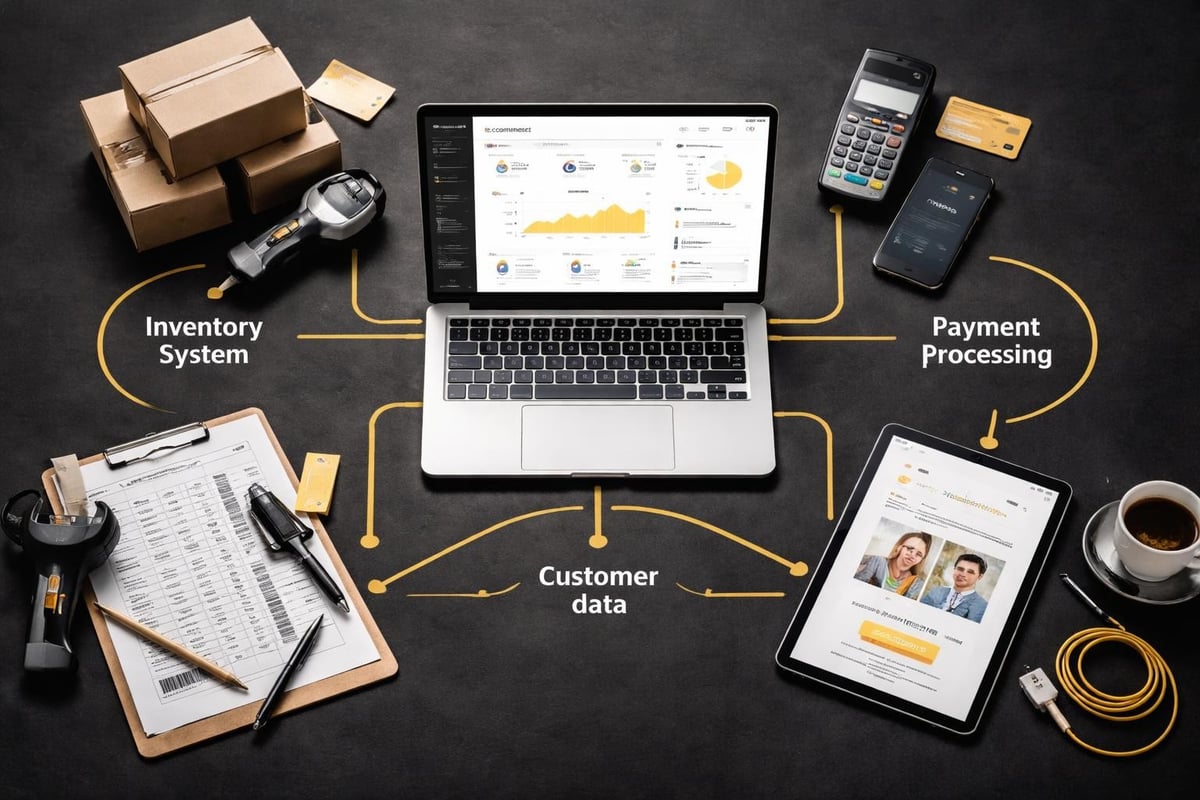
It's the entire ecosystem that connects your product to your customer. Payment gateways, inventory management, email automation, customer service platforms, and analytics tools all working together. The businesses winning right now aren't the ones with the flashiest websites. They're the ones with systems that work while they sleep.
In Australia, we've seen a 23% increase in online retail sales year-on-year according to the ABS. But here's what matters more than that stat: customer expectations have shifted permanently. They want fast checkouts, mobile-first experiences, and personalised recommendations. They'll abandon your cart in seconds if the process feels clunky.
The tech stack you choose matters less than how well it integrates. A Shopify store with three well-chosen apps will outperform a custom-built platform with twenty disconnected tools. Simplicity wins.
The Foundation: Platform Selection
Your platform is your infrastructure.
Shopify dominates the Australian market for good reason. It handles security updates, hosting, and PCI compliance without you lifting a finger. WooCommerce offers more control but requires you to manage everything. BigCommerce sits somewhere in between.
For small businesses launching their first store, the Shopify web development approach removes technical barriers fast.
Most businesses overthink this decision. Pick the platform that gets you live fastest with the features you need today, not the ones you might need in three years. You can always migrate later if you outgrow it.
Integration Over Isolation
Your digital ecommerce success depends on how your tools talk to each other.
Your inventory system needs to update your storefront in real time. Your email platform needs to trigger based on customer behaviour. Your accounting software needs to sync with your sales data automatically.
Here's where most small businesses waste time: manual data entry between systems. If you're copying order details from Shopify into Xero manually, you're bleeding hours every week. That's time you could spend on marketing, product development, or actual customer service.
The Conversion Framework
Traffic without conversion is just an expensive hobby.
You can drive thousands of visitors to your store, but if only 0.5% buy, you're fighting an uphill battle. The average ecommerce conversion rate in Australia sits around 2.8%. If you're below that, fix your conversion issues before spending more on ads.
Product pages are your silent salespeople. They need clear images, benefit-driven descriptions, social proof, and zero friction in the buying process. SEO optimisation for Shopify product pages directly impacts how many qualified visitors find you in the first place.
Testing beats guessing every time. Change one element, measure the result, repeat. Button colours, headline copy, image placement – small changes compound into significant revenue increases.
Mobile-First Isn't Optional
62% of Australian ecommerce transactions happen on mobile devices.
If your store isn't designed mobile-first, you're losing money daily. Not mobile-responsive. Mobile-first. There's a difference. Mobile-first means the entire experience is built for thumbs and small screens, then adapted for desktop.
Check your mobile cart abandonment rate. If it's above 70%, your mobile experience is broken. Common culprits include tiny tap targets, complicated forms, and slow load times.
Page speed matters more than you think. A one-second delay in load time can decrease conversions by 7%. Google's research shows 53% of mobile users abandon sites that take longer than three seconds to load.
AI and Automation in Digital eCommerce
AI isn't replacing businesses in 2026. It's replacing manual tasks.
AI-powered commerce is transforming how customers discover and purchase products through autonomous shopping experiences. For small businesses, this means leveraging AI for customer service chatbots, personalised product recommendations, and predictive inventory management.
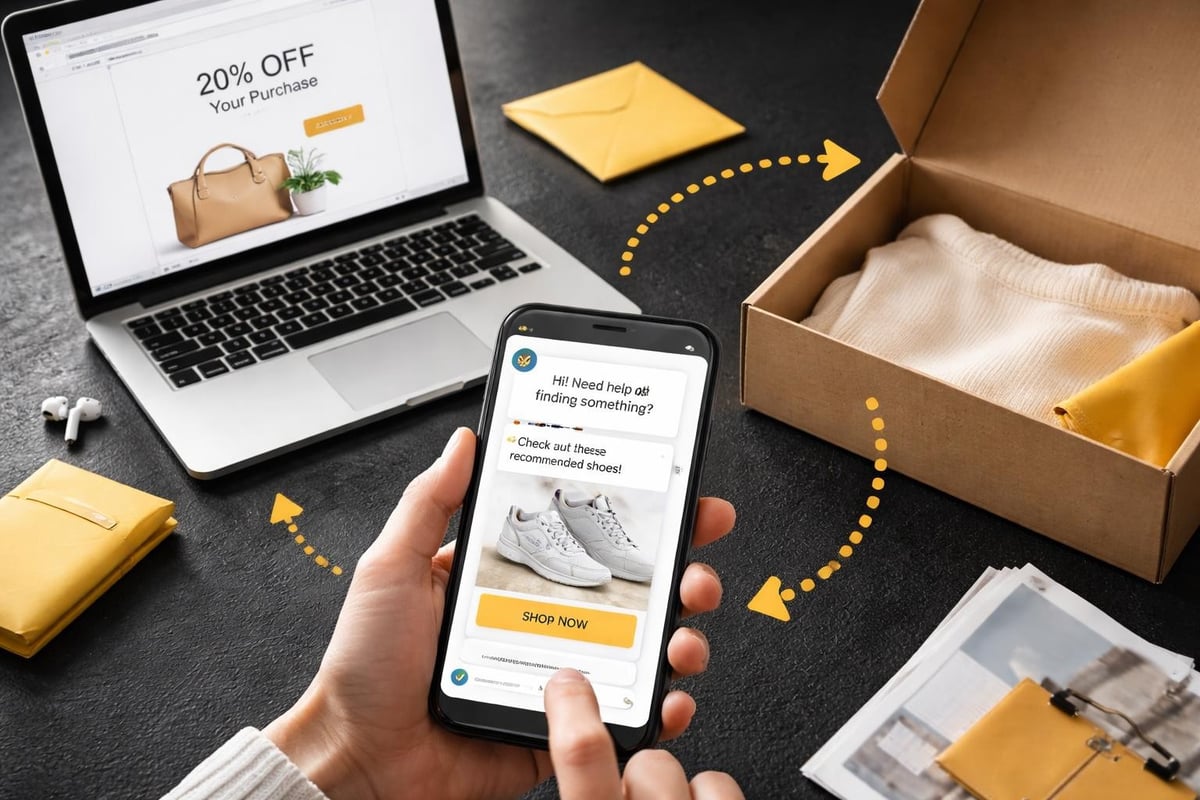
You don't need a data science team to use AI effectively. Tools like Klaviyo use AI to predict customer lifetime value and send automated emails at optimal times. Shopify's built-in features now suggest products to customers based on browsing behaviour without you configuring anything.
What to Automate First
Start with the repetitive tasks eating your time.
Order confirmations and shipping notifications should be automated from day one. Customers expect immediate confirmation, and manual emails create delays and mistakes. Abandoned cart emails recover 10-30% of lost sales on average, but only if they're automated and timed correctly.
Inventory alerts prevent stockouts and overstock situations. Set thresholds that trigger reorder notifications before you run out. This simple automation protects revenue and customer experience simultaneously.
Customer segmentation becomes powerful when automated. Tag customers based on purchase history, average order value, and engagement level. Then trigger different email sequences for each segment. A first-time buyer needs different messaging than a loyal repeat customer.
Multichannel Strategy
Your customers don't live on one platform.
They discover you on Instagram, research you on Google, and might buy from your Facebook shop or website. Digital ecommerce in 2026 means being present where your customers are, but maintaining one source of truth for inventory and orders.
According to current ecommerce trends, social commerce, AI-driven experiences, and unified commerce platforms are reshaping how customers interact with brands across channels.
The mistake most businesses make is treating each channel as a separate entity. Your Instagram shop, Facebook marketplace, Google Shopping, and website need to share inventory. Overselling because your channels don't sync creates customer service nightmares.
Social Commerce Integration
Social media isn't just for brand awareness anymore.
Instagram Shopping and Facebook Shops allow direct purchases without leaving the app. TikTok Shop is gaining traction for certain demographics. But here's the reality: social commerce works best for impulse purchases and discovery, not complex buying decisions.
If you sell products that require detailed specifications or comparison, drive social traffic to your website where you control the experience. If you sell visual, impulse-friendly products, native social shopping can convert quickly.
Video content dominates social platforms now. Affiliate marketing insights show the video-first revolution is reshaping how products are promoted and discovered across alternative channels.
Customer Data and Personalisation
Every interaction generates data.
The businesses using that data strategically are pulling ahead. Not in a creepy surveillance way, but in a "remembering what customers want" way. Amazon's recommendation engine drives 35% of their revenue because they use purchase and browsing data intelligently.
You can implement basic personalisation without being Amazon. Show recently viewed products. Recommend complementary items based on cart contents. Send birthday discounts to customers who've provided that information.
Zero-party data is information customers willingly share. Preferences, interests, and purchase intentions given in exchange for better experiences. Quiz funnels that recommend products based on answers work because customers want personalised results.
Privacy regulations in Australia require transparency about data collection. Make your privacy policy clear and accessible. Use customer data to improve their experience, not just to bombard them with irrelevant marketing.
Retention Over Acquisition
Acquiring a new customer costs five times more than retaining an existing one.
Yet most small businesses spend 80% of their effort on acquisition and 20% on retention. Flip that ratio and watch your profitability increase. Loyalty programs, exclusive access, and VIP tiers keep customers coming back.
Email remains the highest ROI channel for retention. Not promotional blasts, but value-driven content that helps customers get more from their purchase. Post-purchase sequences, educational content, and early access to new products build relationships.
Technical Infrastructure That Scales
Your digital ecommerce infrastructure needs to handle growth without breaking.
Hosting limitations are real. If your store can't handle traffic spikes during promotions or seasonal peaks, you lose sales when you need them most. Shopify scales automatically, which is why it's become the default for businesses that want reliability without DevOps expertise.
Security isn't negotiable. SSL certificates, PCI compliance, and regular security updates protect both you and your customers. A data breach destroys trust instantly and can bankrupt a small business through fines and legal costs.
Backup systems prevent catastrophic loss. If your store goes down or data gets corrupted, how quickly can you restore it? Automated daily backups to external storage should be standard.

Payment Processing and Checkout Optimisation
Checkout friction kills conversions.
Every additional form field, every extra click, and every unexpected cost at checkout increases abandonment. The optimal checkout flow asks for minimum information and shows all costs upfront.
Multiple payment options reduce friction. Credit cards, PayPal, Afterpay, and digital wallets give customers choice. Gen Z and younger millennials increasingly prefer buy-now-pay-later options. 30% of Australian online shoppers have used BNPL services in the past year.
Guest checkout matters more than you think. Forcing account creation before purchase pushes 25% of customers away. Let them buy first, then offer account creation with saved details post-purchase.
| Payment Feature | Impact on Conversion | Implementation Difficulty |
|---|---|---|
| One-click checkout | +15-25% | Medium |
| Multiple payment methods | +8-12% | Low |
| Guest checkout option | +20-35% | Low |
| Auto-fill address | +5-10% | Low |
| Express checkout buttons | +10-18% | Medium |
Inventory and Fulfilment
Digital ecommerce connects your customer to your product, but fulfilment delivers on that promise.
Your inventory management determines whether you can actually ship what you sell. Real-time inventory tracking prevents overselling. Low stock alerts trigger reorders before you run out. SKU management keeps variants organised as your catalogue grows.
Fulfilment options have expanded beyond shipping everything yourself. Third-party logistics (3PL) providers handle storage, packing, and shipping for businesses that want to focus on product and marketing. The break-even point typically hits around 100-200 orders per month.
Shipping strategy directly impacts profitability. Free shipping isn't always free. It's built into product pricing or margin. Transparent shipping costs at checkout perform better than surprise fees. Offering multiple speed options lets customers choose based on urgency and budget.
Analytics and Decision Making
Data without action is just noise.
Your ecommerce platform generates mountains of data. The skill is knowing which metrics actually matter for your business stage. Revenue and profit are obvious. But what about customer acquisition cost, average order value, and repeat purchase rate?
Traffic sources tell you where to focus marketing effort. If 60% of your sales come from organic search, doubling down on SEO makes sense. If Instagram drives awareness but doesn't convert, you need better middle-funnel content.
Cart abandonment analysis reveals friction points. Are people abandoning at shipping cost reveal? Payment information entry? Product page? Each stage tells you what to fix.
Customer lifetime value compared to acquisition cost determines sustainability. If you spend $50 to acquire a customer who buys once for $45, you're burning money. If that customer buys four times averaging $60, you're building a business.
The Four-Week Launch Reality
Most businesses overthink their launch.
They spend months tweaking design, second-guessing product descriptions, and delaying because it's not perfect. Meanwhile, competitors launch, learn, and iterate. For small Australian eCommerce businesses launching their first Shopify store, the core Shopify package covers everything needed to launch within four weeks with clarity and momentum.
Minimum viable store beats perfect someday. Launch with your hero products, clear messaging, and functioning checkout. Add features based on actual customer feedback, not assumptions.
The businesses that succeed are the ones that get live, start selling, and improve based on real data. Not the ones perfecting mockups for six months.
Digital ecommerce success in 2026 comes down to systems that convert, automate what drains your time, and scale without constant intervention. Small Australian businesses have every tool needed to compete – what matters is implementation speed and strategic focus. If you're ready to build a conversion-focused Shopify store without agency bloat or DIY confusion, Kida Digital delivers scalable ecommerce systems from concept to launch in four weeks.


Be the first to comment