

Searching "web developers near me" is often the first move when you need a website built or redesigned. It makes sense on the surface. You want someone local, someone you can meet face-to-face, someone who understands your market. But proximity doesn't always equal quality, and for eCommerce businesses specifically, the stakes are higher than a simple brochure site. Your online store needs to convert visitors into customers, handle transactions securely, and scale as your business grows. The developer you choose will shape how quickly you can launch, how much you'll spend, and whether your store actually makes money. This article cuts through the noise to help you evaluate web developers properly, understand what really matters, and avoid expensive mistakes that slow down your momentum.
What Actually Matters When Searching for Web Developers Near Me
Location used to be everything. Before reliable video calls and project management tools, working with someone local was genuinely important. That's changed dramatically in the past few years.
Modern web development happens asynchronously across time zones. Files sync instantly. Communication happens in real-time or through clear documentation. The geographical distance between you and your developer rarely impacts project quality anymore.
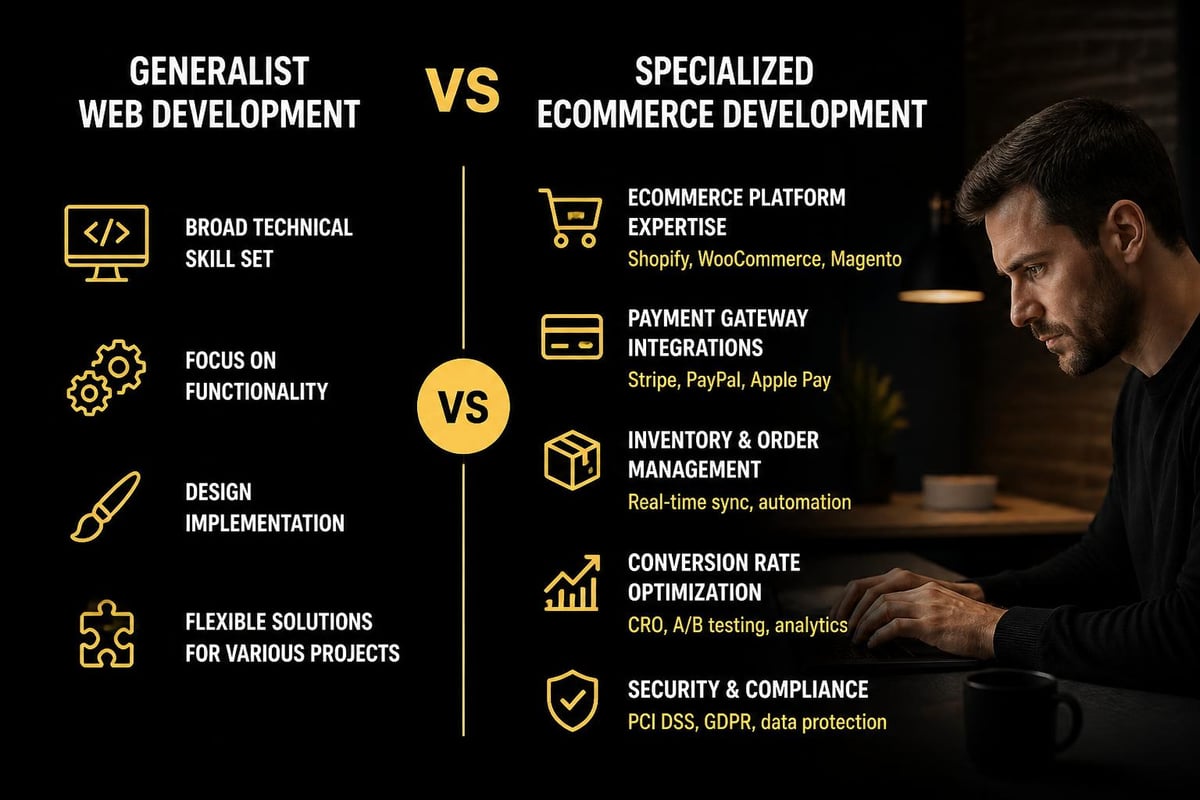
What does matter? Technical expertise in your specific platform. For eCommerce businesses, that means finding someone who specializes in Shopify, WooCommerce, or whatever platform you're building on. A generalist who builds "all kinds of websites" won't have the depth needed to optimize conversion rates or integrate the apps your business needs.
The Real Costs of Choosing Based on Proximity Alone
Hiring the closest web developer often means limiting your options to whoever happens to be nearby. In smaller Australian towns or regional areas, this might mean one or two options maximum. Neither might specialize in eCommerce. Neither might have experience with your industry.
You end up compromising on skills because of geography. The local developer might be excellent at WordPress blogs but have zero experience with inventory management, shipping integrations, or payment gateways. These aren't small gaps you can work around. They're fundamental to whether your store functions properly.
Price becomes another issue. Local developers know they have limited competition in the area. Some charge premium rates simply because they can. Others undercharge because they lack the specialized skills that command higher fees. Neither scenario serves you well.
Key questions to ask any developer:
- How many eCommerce stores have you built in the past 12 months?
- Which platforms do you specialize in?
- Can you show me conversion data from previous projects?
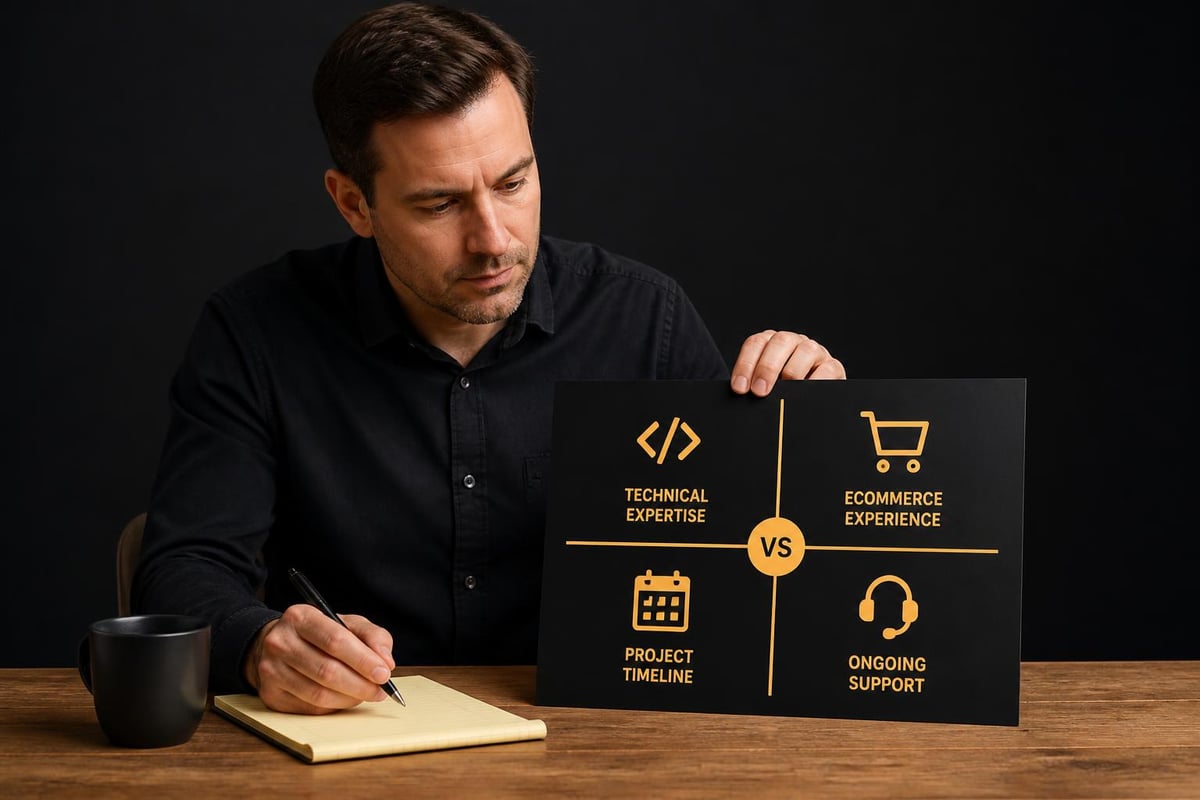
- What's your typical project timeline from concept to launch?
- How do you handle ongoing support and maintenance?
Understanding What eCommerce Development Actually Requires
Building an online store isn't the same as building a website. The technical requirements are completely different. You're not just displaying information, you're processing transactions, managing inventory, handling customer data, and integrating with multiple third-party services.
Your web developer needs to understand conversion optimization from a technical perspective. This means knowing how page speed impacts bounce rates, how checkout flow affects completion rates, and how product page structure influences purchase decisions.
Most generalist web developers don't have this knowledge. They can make a site look nice, but they can't engineer it to convert. That's the difference between a $5,000 website that generates $50,000 in revenue and a $5,000 website that sits idle because nobody can figure out how to buy from it.
Platform Expertise Versus General Development Skills
Shopify development requires specific knowledge. The platform has its own templating language (Liquid), its own app ecosystem, and its own best practices for theme customization. A developer experienced in WordPress won't automatically know how to build a high-converting Shopify store.
The same applies to every eCommerce platform. Each has unique technical requirements. The evolution of software development in the age of AI means developers need continuous platform-specific learning to stay current.
When you search for web developers near me, you're not filtering for this specialized expertise. You're filtering for geography. That's backwards for most eCommerce projects in 2026.
| Generalist Developer | eCommerce Specialist |
|---|---|
| Builds various site types | Focuses exclusively on online stores |
| Basic payment integration | Deep knowledge of payment gateways, fraud prevention |
| Standard templates | Conversion-optimized store structure |
| Limited app knowledge | Expertise in platform-specific integrations |
| Generic timeline | Proven launch process with clear milestones |
Red Flags to Watch for During Your Search
Some warning signs appear regardless of whether a developer is local or remote. Learning to spot these early saves time and money.
Vague timelines are the first red flag. If a developer can't give you a clear project timeline with specific milestones, they either don't have a structured process or they're overbooked. Either way, your project will drag on longer than necessary.
Lack of eCommerce portfolio work is another immediate concern. If someone claims they can build your store but has no examples to show, you're taking an expensive gamble. Ask to see live stores they've built, not just design mockups.
Communication Patterns That Signal Trouble
How quickly does a developer respond to your initial inquiry? If it takes three days to reply to an email when they're trying to win your business, imagine how long it'll take when you need support after launch.
Unclear pricing structures create problems down the line. Some developers quote low initial rates then add charges for essential features like mobile responsiveness, security certificates, or basic SEO setup. Get everything in writing upfront.
Developers who don't ask questions about your business model aren't thinking strategically. They should want to understand your products, your target customers, your revenue goals, and your growth plans. If they're just asking about color preferences and how many pages you need, they're treating your store like a brochure site.
The web development trends shaping 2025 and beyond emphasize performance, security, and user experience. Your developer should be discussing these factors without prompting.
The Case for Specialized eCommerce Developers Over Local Generalists
Small Australian eCommerce businesses face a specific challenge. Most need professional development work but can't afford traditional agency pricing that starts at $15,000 or more for basic builds.
This creates a gap in the market. Local web developers often fill it, but they're not always equipped for eCommerce-specific needs. They might know how to install Shopify and pick a theme, but that's not the same as building a conversion-optimized store with proper structure, essential integrations, and scalability built in.
Specialized developers focus exclusively on eCommerce. They've built dozens or hundreds of stores. They know which apps work well together, which payment gateways have the best approval rates, how to structure collections for SEO, and how to optimize checkout flow for maximum completion rates.
How Specialized Services Deliver Better Value
When you work with an eCommerce specialist, you're buying their accumulated knowledge from previous projects. They've already made the mistakes on someone else's store. They know which shortcuts create technical debt and which optimizations actually move conversion rates.
For businesses launching their first online store, done-for-you Shopify builds offer a middle ground between expensive agencies and risky DIY approaches. These structured packages cover everything needed to launch within four weeks, from theme customization to payment setup to essential app integrations.
The timeline matters enormously. Every week your store isn't live is a week of lost revenue. Specialized developers work faster because they have proven processes, template starting points, and deep platform knowledge.
Benefits of working with eCommerce specialists:
- Faster launch timelines due to streamlined processes
- Built-in conversion optimization from years of testing
- Platform-specific expertise that generalists lack
- Clear understanding of essential versus optional features
- Experience with common eCommerce challenges before they arise
What to Prioritize in 2026 When Evaluating Developers
The eCommerce landscape continues evolving rapidly. What worked two years ago might be outdated now. Your developer needs to stay current with platform changes, new apps, and shifting best practices.
Mobile-first development is no longer optional. Over 70% of eCommerce traffic comes from mobile devices in Australia. If your developer isn't designing mobile experiences first, they're behind the curve.
Page speed directly impacts revenue. Google's research consistently shows that as page load time increases from one to three seconds, bounce rates jump by 32%. Your developer should be discussing performance optimization without you having to ask.
Security and Compliance Cannot Be Afterthoughts
Australian businesses handling customer data face specific privacy obligations. Your developer should understand these requirements and build them into your store from the start.
Payment gateway integration needs to be done correctly. Poor implementation creates security vulnerabilities and affects customer trust. Look for developers who discuss PCI compliance and data encryption as standard practice.
The role of AI in modern web development introduces new security considerations alongside productivity benefits. Your developer should be aware of these emerging tools and their implications.
Making the Final Decision Without Geographic Limitations
Once you stop limiting your search to web developers near me, your options expand significantly. This requires different evaluation criteria since you can't just "drop by the office" to check on progress.
Look for developers who use proper project management tools. Asana, Trello, Monday, or similar platforms keep everything visible and organized. You should be able to see exactly what's happening at any stage of the build.
Regular communication schedules matter more than proximity. A developer who sends weekly update emails with screenshots and progress reports is more valuable than someone local who you can only reach by phone.
How to Assess Technical Capability Remotely
Request specific examples of stores they've built that are similar to what you need. Don't just look at design. Test the checkout process. Check page speed on mobile. See how products are organized. This reveals far more than a portfolio screenshot.
Ask about their revision process. How many rounds of feedback are included? How quickly do they implement changes? What happens if something doesn't work as expected after launch?
References from previous clients provide insight you can't get elsewhere. Contact at least two previous clients. Ask about communication, timeline adherence, and post-launch support quality.
| Question to Ask | Why It Matters |
|---|---|
| How many eCommerce projects completed in 2025? | Recent experience with current best practices |
| What's your average project timeline? | Realistic expectations and process efficiency |
| Which apps do you typically integrate? | Platform knowledge and practical experience |
| How do you handle post-launch support? | Long-term relationship beyond initial build |
| Can I see conversion data from previous stores? | Results-focused approach versus aesthetic-only |
The True Cost of DIY Versus Professional Development
Many small business owners consider building their own Shopify store to save money. The platform markets itself as easy to use. Countless YouTube tutorials promise to walk you through the process. On the surface, it seems viable.
The reality is more complex. You can absolutely install Shopify and pick a theme yourself. You can add products and set up basic payment processing. But can you optimize for conversions? Can you structure your site for SEO? Can you integrate the right apps without creating conflicts? Can you customize the theme to match your brand without breaking functionality?
Most importantly, how long will it take you? If you're spending 40 hours watching tutorials and fumbling through setup, that's a full work week you're not spending on product development, marketing, or actually running your business.
When Professional Help Pays for Itself
Professional developers complete in days what might take you weeks or months. They avoid common mistakes that hurt conversion rates. They set up technical SEO correctly from the start rather than trying to fix it later.
The key trends in web development for 2025 emphasize automation and AI, but these tools still require expertise to implement effectively. A professional knows which automation to add and which creates unnecessary complexity.
For businesses serious about eCommerce revenue, professional development is an investment that generates returns through faster launch times, higher conversion rates, and fewer technical problems down the road.

Evaluating Ongoing Support and Maintenance Requirements
Your relationship with your web developer shouldn't end at launch. eCommerce stores require ongoing maintenance, security updates, feature additions, and optimization based on real customer data.
Some developers include post-launch support in their initial pricing. Others charge separately for ongoing work. Neither approach is inherently better, but you need to understand what you're paying for upfront.
Monthly retainer models work well for businesses that need regular updates and optimization. You get dedicated hours each month for whatever needs attention. This prevents small issues from becoming urgent problems.
What Support Should Actually Include
Basic support means fixing technical issues when they arise. Your checkout stops working? Your developer fixes it. A theme update breaks something? They resolve it.
Strategic support goes further. It includes analyzing your store's performance data, recommending optimizations, testing new features, and implementing improvements based on how real customers interact with your store.
The difference between these support levels significantly impacts long-term success. A store that launches well but never improves will gradually fall behind competitors. Understanding eCommerce site development as an ongoing process rather than a one-time project changes how you approach vendor relationships.
Moving Forward With Clarity and Confidence
Searching for web developers near me might feel like the safe choice, but it's often based on outdated assumptions about how web development actually works in 2026.
Geographic proximity provides minimal advantage when modern tools enable seamless remote collaboration. What matters is finding a developer with deep expertise in your specific platform, proven eCommerce experience, clear processes, and strong communication.
For small Australian businesses launching Shopify stores, the choice often comes down to three paths: expensive agencies that deliver professional work but charge $15,000 or more, DIY approaches that save money upfront but cost time and often produce suboptimal results, or specialized services that offer structured processes at reasonable prices.
The right choice depends on your timeline, budget, and technical comfort level. But in almost every case, geographic location should be far down your list of evaluation criteria.
Key takeaways for your search:
- Prioritize platform expertise over proximity
- Look for conversion-focused development, not just design
- Verify experience through live store examples and client references
- Understand total costs including post-launch support
- Evaluate communication processes and project management tools
- Consider specialized eCommerce developers over local generalists
The most successful eCommerce businesses treat their store as a strategic asset, not a one-time project. They work with developers who think the same way. They invest in proper setup because they understand that a well-built store generates returns far beyond its initial cost.
Your search for web developers near me should really be a search for the right developer for your specific needs. Sometimes that person is local. Often they're not. Either way, expertise matters more than location.
Finding the right developer for your eCommerce store doesn't require geographic proximity, but it does require specialized platform knowledge and a proven process. If you're a small Australian business ready to launch a conversion-optimized Shopify store without agency pricing or DIY complexity, Kida Digital delivers structured four-week builds that cover everything from concept to launch. Skip the endless searching and start building your store with clarity and momentum.


Be the first to comment