

Your website is your digital shopfront. When it's underperforming, outdated, or frustrating your customers, every day you wait is costing you sales. For small Australian eCommerce businesses, professional website redesign services aren't just about aesthetics. They're about building a foundation that converts browsers into buyers and supports your growth without breaking the bank.
When Your Store Actually Needs a Redesign
Not every performance dip requires a complete overhaul.
Sometimes your store just needs targeted optimisation. But certain warning signs indicate it's time for proper website redesign services.
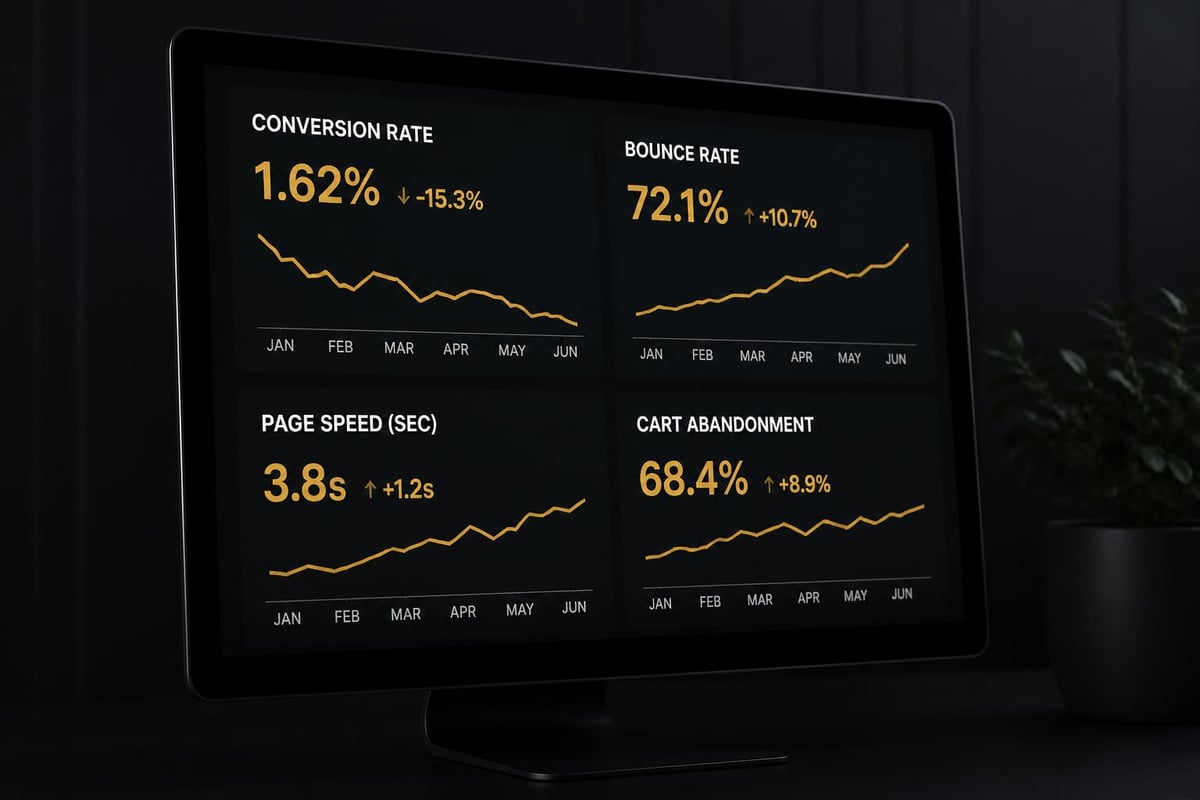
Your bounce rate sits above 60% consistently. Visitors land on your site and leave within seconds because something isn't connecting. Mobile users struggle to navigate your product pages. Your checkout process takes seven clicks when it should take three.
These aren't minor inconveniences. They're revenue killers.
Real indicators that demand attention:
- Conversion rates below 1.5% for more than three months
- Load times exceeding three seconds on mobile
- Design elements from 2019 or earlier
- Customer complaints about finding products or checking out
- Zero mobile optimisation despite 70% mobile traffic
- Competitor sites outperforming yours visually and functionally
The 12-step website redesign process outlined by industry experts emphasises starting with clear business goals. What specific outcome are you chasing? More sales? Lower cart abandonment? Better average order value?
Define that before touching a single pixel.
Understanding What Website Redesign Services Actually Include
The term "website redesign" gets thrown around loosely.
Some providers slap a new theme on your existing structure and call it done. Others rebuild from the ground up, restructuring everything from navigation to checkout flow.
Quality website redesign services for eCommerce stores should address three core layers. Visual design, yes. But also user experience architecture and technical performance.
The Visual Layer
Your brand needs to look current and trustworthy. Outdated design signals outdated business practices to potential customers.
Modern eCommerce design in 2026 prioritises clean product photography, clear hierarchy, and strategic white space. It removes friction and guides attention.
But pretty doesn't pay the bills if it doesn't convert.
The Experience Layer
This is where most DIY redesigns fall apart. Navigation structure, product categorisation, filtering systems, search functionality. These determine whether customers can actually find what they're looking for.
Cart flow matters enormously. Every additional step increases abandonment by roughly 10%.
According to real-world case studies, businesses that prioritise user experience architecture during redesigns see conversion improvements between 25% and 150%.
The Technical Layer
Page speed isn't negotiable anymore. Google's Core Web Vitals directly impact your search rankings. Slow stores don't just frustrate customers. They literally get pushed down in search results.
Mobile responsiveness goes beyond "works on phones." It means thumb-friendly navigation, readable text without zooming, and fast-loading images optimised for mobile networks.
| Redesign Component | DIY Approach Risk | Professional Service Benefit |
|---|---|---|
| Visual Design | Generic templates, amateur aesthetics | Custom design aligned with brand strategy |
| UX Architecture | Copied structures, poor product flow | Research-based navigation and conversion paths |
| Technical Performance | Bloated code, slow loading | Optimised builds, fast page speeds |
| Mobile Experience | Responsive but not optimised | Mobile-first design and testing |
| SEO Preservation | Lost rankings, broken redirects | Proper migration, maintained authority |
The Hidden Cost of Cheap Redesign Options
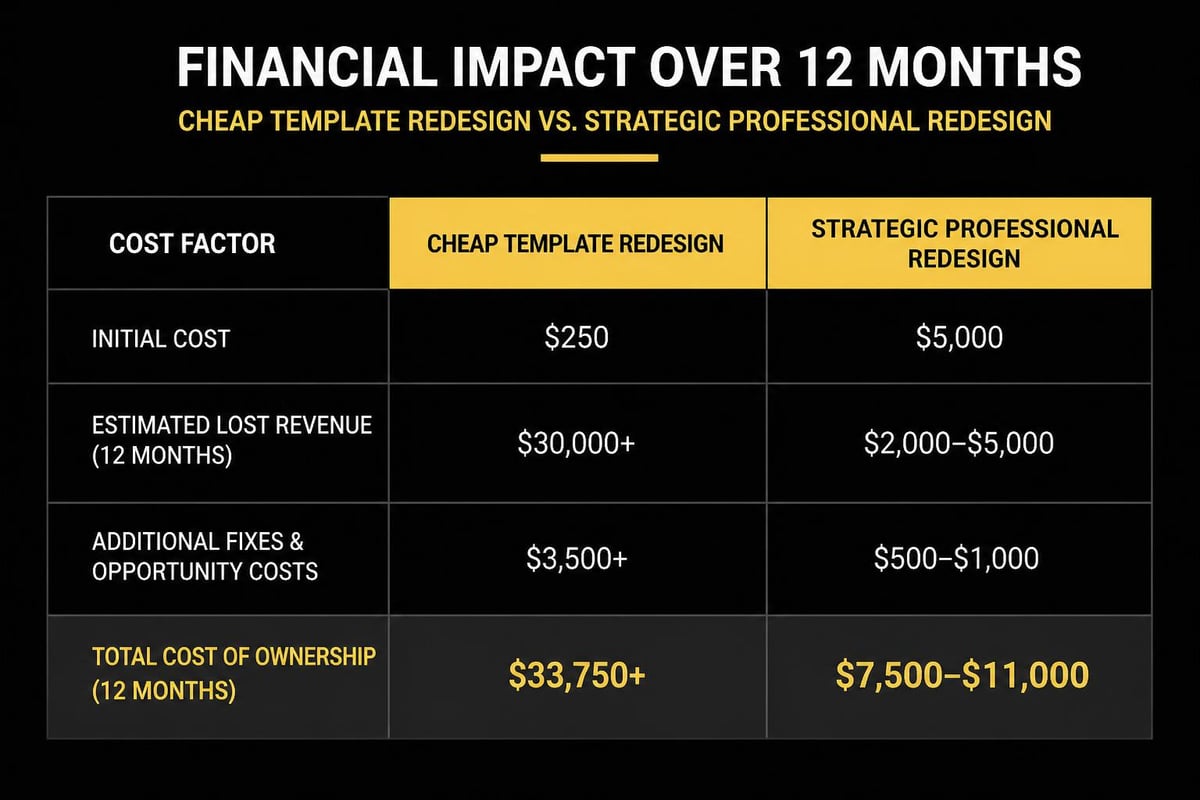
Bargain website redesign services feel tempting when you're watching cash flow.
A $500 redesign sounds brilliant compared to $5,000. Until three months later when your traffic has tanked and your conversion rate is worse than before.
Cheap redesigns typically use pre-built templates with minimal customisation. Your store looks like 47 other Shopify stores selling completely different products. Brand differentiation? Non-existent.
What gets skipped in budget redesigns:
- Proper SEO migration planning
- Custom conversion optimisation
- Performance testing across devices
- Strategic product page layouts
- Checkout flow analysis
- Post-launch support and refinement
The website redesign planning process documented by project management experts shows that successful redesigns require 40-60 hours of strategic work before a single design file gets created.
That planning separates conversion-focused rebuilds from cosmetic updates.
For Australian eCommerce businesses, losing search rankings during a redesign can cost thousands in lost organic traffic. One small business in Melbourne saw their monthly revenue drop 40% after a cheap redesign broke their SEO without proper redirects.
It took six months to recover.
How Strategic Redesigns Drive Revenue Growth
Professional website redesign services pay for themselves through measurable improvements.
Not theory. Not promises. Actual data.
A Sydney-based activewear brand increased their conversion rate from 1.2% to 3.1% after restructuring their product pages and simplifying checkout. Same traffic. Same products. Different presentation and flow.
That's 158% more revenue from existing visitors.
Conversion Rate Optimisation Through Design
Every element on your product pages either moves customers toward purchase or creates friction.
Professional redesigns analyse customer behaviour data to identify exactly where people drop off. Then systematically remove those barriers.
Common friction points include unclear product information, missing trust signals, complicated size guides, and aggressive pop-ups. Fixing these isn't guesswork when you have proper analytics.
Mobile Commerce Performance
Mobile now represents 60-75% of eCommerce traffic for most Australian businesses.
If your mobile experience is clunky, you're literally turning away three-quarters of potential customers. Website redesign services focused on mobile-first design prioritise thumb-friendly navigation, fast-loading images, and streamlined checkout.
One Perth skincare retailer saw mobile conversions jump from 0.8% to 2.4% after rebuilding their store with mobile as the primary design consideration.
That single change added $180,000 in annual mobile revenue.
Page Speed and Technical Performance
Google reported that 53% of mobile visitors abandon sites that take longer than three seconds to load.
Professional Shopify development includes image optimisation, code efficiency, app audit, and proper caching setup. These technical elements directly impact both user experience and search rankings.
The Applied Tech redesign case study demonstrated how proper technical implementation during a redesign can increase organic traffic by 150% within six months while maintaining all existing search rankings.
What Small Australian Businesses Actually Need
Big agency website redesign services aren't built for small eCommerce operators.
You don't need 12-week discovery phases, brand strategy workshops, or $25,000 proposals. You need a conversion-focused store that launches quickly and starts generating returns.
The gap between DIY platforms and expensive agencies leaves most small businesses stuck. Templates lack strategic customisation. Agencies demand budgets that don't make sense for businesses doing under $500K annually.
What actually matters for small eCommerce stores:
- Clean, mobile-optimised product pages that load fast
- Straightforward navigation that helps customers find products
- Streamlined checkout with minimal steps
- Proper SEO structure that preserves existing rankings
- Integration with essential tools (email, reviews, shipping)
- Post-launch support when issues arise
For businesses launching their first proper Shopify store or upgrading from a DIY attempt, affordable web design services designed specifically for Australian eCommerce provide the strategic foundation without agency bloat.
The four-week timeline from concept to launch keeps momentum high and costs predictable.
The Real Timeline for Professional Redesigns
Realistic expectations prevent frustration.
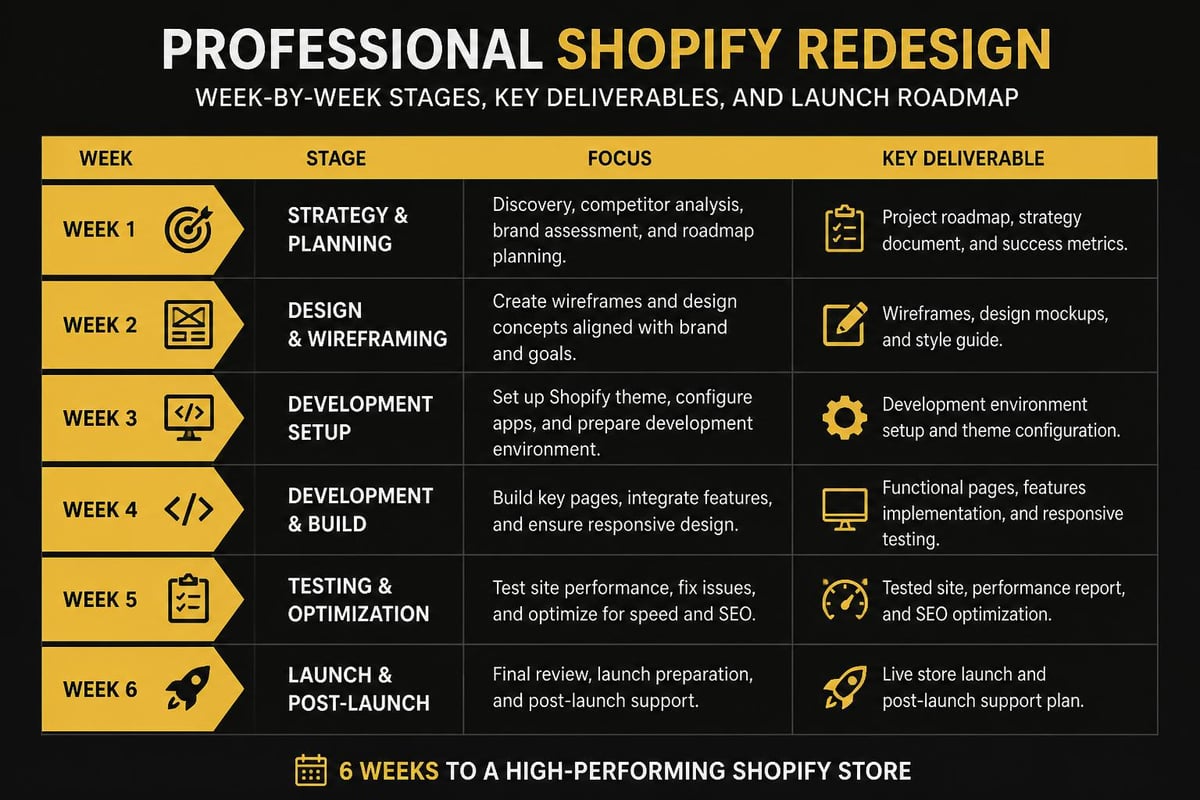
A properly executed Shopify redesign takes 3-6 weeks for most small eCommerce stores. Rushed jobs in 7-10 days skip crucial steps. Six-month projects include unnecessary scope creep.
Week-by-week breakdown:
- Week 1: Strategy, planning, content audit, competitor analysis
- Week 2: Design concepts, homepage and product page layouts, navigation structure
- Week 3: Development, integration setup, content migration, testing
- Week 4: Final testing, SEO migration, launch preparation, handover
Projects extend when businesses don't have content ready, products properly photographed, or clear decision-makers available for feedback. Preparation on your end directly impacts timeline.
Avoiding Common Redesign Mistakes
Most website redesign failures stem from predictable mistakes.
Understanding them upfront saves money and stress.
Redesigning Without Data
Changing things because they "feel outdated" without analysing actual customer behaviour is guesswork. Heat maps, analytics, and user testing reveal what's actually broken versus what just looks dated.
Sometimes your 2021 design converts better than a 2026 template.
Ignoring SEO During Migration
Proper website redesign practices emphasise maintaining search authority through the transition. That means mapping old URLs to new ones, preserving meta data, and maintaining internal linking structure.
One Adelaide retailer lost 60% of their organic traffic overnight because their redesign changed all product URLs without proper redirects.
Recovery took nine months.
Changing Everything Simultaneously
Redesigning your entire site while also switching platforms, rebranding, and changing your product mix creates chaos. Too many variables make it impossible to identify what works and what doesn't.
Change one major thing at a time. Redesign first. Then tackle other improvements with data from the new foundation.
Skipping Post-Launch Optimisation
Your site won't be perfect at launch. Professional website redesign services include post-launch monitoring and refinement.
Traffic patterns reveal issues that testing can't predict. Heat maps show where real customers get confused. A/B testing identifies which variations convert better.
Plan for 2-4 weeks of active optimisation after launch.
Measuring Redesign Success Properly
Judging website redesign services by how pretty your site looks misses the point entirely.
Revenue metrics tell the real story.
Primary success indicators:
- Conversion rate improvement (target: 20-50% increase)
- Average order value changes
- Cart abandonment rate reduction
- Page load speed improvements
- Mobile conversion rate gains
- Organic traffic maintenance or growth
Track these for at least 90 days post-launch. The first two weeks show initial response. Three months reveals sustainable patterns.
Secondary metrics include bounce rate, time on site, pages per session, and returning visitor rate. These indicate engagement quality but don't directly correlate to revenue.
One Brisbane electronics retailer focused solely on conversion rate during their redesign. They went from 1.4% to 2.8% conversion within 60 days of launch. Same monthly traffic of 12,000 visitors suddenly generated an additional $42,000 in monthly revenue.
That's the benchmark. More sales from existing traffic.
Integration and Ecosystem Considerations
Your Shopify store doesn't exist in isolation.
Website redesign services need to account for your entire eCommerce ecosystem. Email marketing platforms, shipping solutions, review apps, inventory management, accounting software.
Breaking these integrations during a redesign creates operational chaos. Professional approaches audit existing tools first, then rebuild with those connections maintained or improved.
Critical integration categories:
- Email marketing (Klaviyo, Mailchimp, Omnisend)
- Reviews and social proof (Judge.me, Loox, Yotpo)
- Shipping and fulfilment (Sendle, Australia Post, ShipStation)
- Analytics and tracking (Google Analytics, Facebook Pixel, TikTok Pixel)
- Accounting and inventory (Xero, QuickBooks, DEAR)
The Teradata global redesign demonstrates how complex enterprise ecosystems require systematic integration planning. While your small eCommerce store is simpler, the principle holds. Map every connection before touching anything.
Platform-Specific Redesign Advantages
Shopify's architecture makes redesigns cleaner than custom-built sites.
Themes separate design from functionality. Apps handle features without custom code. Updates don't break your entire site when implemented properly.
This platform advantage means website redesign services for Shopify stores can focus more on strategy and conversion optimisation rather than fighting technical limitations.
For businesses currently on WordPress, Wix, or legacy platforms, rebuilding on Shopify during your redesign often delivers better long-term results than trying to polish outdated foundations.
Migration complexity depends on product count, custom features, and content volume. Most small stores with under 500 products can migrate cleanly within the standard redesign timeline.
The Investment Range for Quality Work
Transparency around pricing helps you budget properly.
Website redesign services for small Australian eCommerce businesses typically range from $3,000 to $15,000. That spread reflects scope, complexity, and whether you need strategy or just implementation.
Budget tier breakdown:
- $3,000-$5,000: Template-based redesigns with strategic customisation, essential integrations, basic optimisation
- $5,000-$8,000: Semi-custom design, conversion-focused layouts, comprehensive integrations, SEO migration
- $8,000-$15,000: Fully custom design, advanced features, extensive product catalogues, complex migrations
Agencies charging $20,000+ for small store redesigns include unnecessary overhead. Freelancers quoting under $2,000 lack the strategic capability to drive meaningful improvements.
For businesses wanting comprehensive Shopify builds that cover everything from concept to launch, the core Shopify package designed specifically for Australian eCommerce provides the complete foundation within four weeks without agency bloat or missing fundamentals.
The investment pays back when conversion improvements add thousands in monthly revenue.
Preparing Your Business for Redesign
The quality of your website redesign depends heavily on preparation.
Businesses that gather assets, clarify objectives, and prepare content before engaging website redesign services get better results faster.
Content and Asset Preparation
Professional product photography makes enormous difference. Blurry phone photos undermine even the best design work.
Product descriptions need strategic writing that addresses customer questions and includes relevant keywords. Copying manufacturer descriptions wastes the SEO opportunity.
Brand assets like logos, colour palettes, and style guides ensure consistency. If you don't have these documented, create them first.
Clear Business Objectives
"Make it look better" isn't a useful brief.
Specific goals drive strategic decisions. Increase mobile conversion by 50%. Reduce cart abandonment from 75% to 60%. Boost average order value by 20% through better product recommendations.
Measurable targets create accountability and focus.
Stakeholder Alignment
Redesigns stall when decision-makers aren't aligned on direction.
If you have business partners, co-founders, or key team members, get agreement on strategy before starting. Changing direction mid-project wastes time and money.
One Melbourne homewares business spent three extra weeks in redesign because partners couldn't agree on navigation structure. That delay cost them a key selling season.
Finding the Right Website Redesign Partner
Not all website redesign services suit small Australian eCommerce businesses.
Agencies specialising in enterprise clients won't prioritise your $50K annual revenue store. Offshore providers struggle with Australian market nuances, shipping options, and local payment preferences.
Key selection criteria:
- Demonstrated eCommerce conversion expertise, not just design portfolios
- Understanding of Australian eCommerce landscape and customer behaviour
- Shopify-specific technical capability, not general web design
- Clear process and timeline, not vague proposals
- Post-launch support included, not abandoned after launch
- Fixed pricing or clear scope, not open-ended hourly billing
The Miami Country Day School redesign shows how understanding your specific audience and community drives better outcomes than generic templates. The same principle applies to eCommerce. Your partner needs to understand your customers.
Australian businesses benefit from working with local developers who understand AusPost shipping, GST requirements, and local payment gateway preferences. These details matter more than most realise.
Check actual client results, not just pretty portfolio pieces. Did their redesigns increase conversions? Improve mobile performance? Drive measurable revenue growth?
Case studies with numbers reveal capability better than design awards.
Website redesign services transform underperforming eCommerce stores into conversion-focused revenue engines when approached strategically. The difference between cosmetic updates and meaningful improvements comes down to understanding your customers, removing friction, and building foundations that support growth. If your Australian eCommerce store needs more than surface-level changes, Kida Digital specialises in conversion-led Shopify builds that launch within four weeks, providing small businesses with the strategic foundation and technical execution typically reserved for enterprise budgets. Let's build something that actually sells.


Be the first to comment