

Your website isn't decoration. It's your digital shopfront, your sales team, and often your only chance to convince someone to buy from you instead of scrolling to the next option. For small Australian eCommerce businesses, choosing the right website design services means understanding what actually drives results-not just what looks impressive in a portfolio. In 2026, the gap between a functional online store and one that converts consistently comes down to strategic choices, not endless budget.
What Website Design Services Actually Include
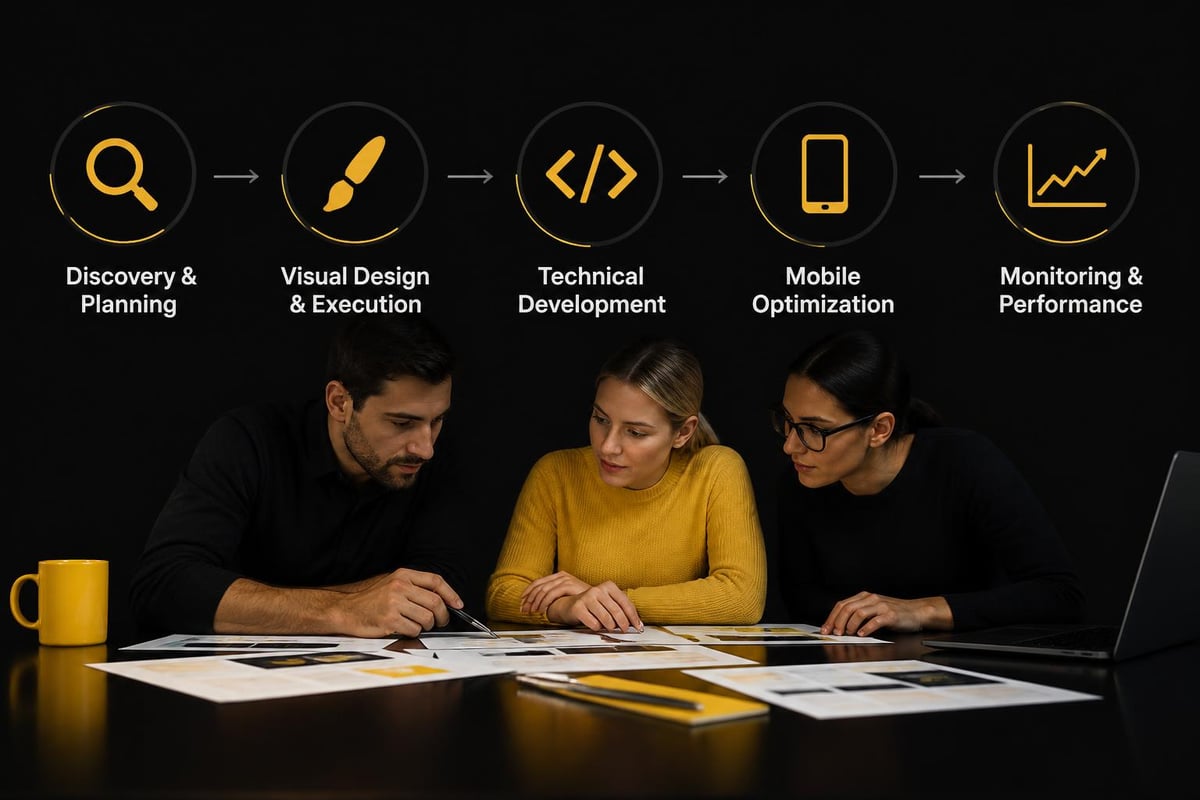
Website design services cover far more than picking colours and fonts.
The scope typically includes strategy and planning before a single pixel gets placed. That means understanding your business model, target customer, and conversion goals upfront.
Then comes the visual design phase-layout, typography, brand application, and imagery. This is where many businesses assume the work ends, but it's barely halfway.
The Technical Layer Most People Overlook
Development takes the design and builds it into a functioning platform. For eCommerce, that includes product catalogues, checkout flows, payment gateways, and inventory management.
Responsive design ensures the site works seamlessly across devices. In 2026, over 70% of eCommerce traffic comes from mobile devices, making this non-negotiable.
Performance optimization reduces load times, which directly impacts both conversions and search rankings. Even a one-second delay in page load can reduce conversions by 7%.
Accessibility compliance matters legally and commercially. Following Web Content Accessibility Guidelines (WCAG) ensures your site works for everyone, expanding your potential customer base.
Agency Bloat vs. Streamlined Execution
Traditional agencies often bundle website design services with months of timeline and extensive teams.
That structure works for enterprise clients with complex requirements. For small eCommerce businesses, it creates unnecessary delays and inflated costs.
A focused approach delivers the same technical quality without the overhead. When you're launching or rebuilding your online store, momentum matters more than endless revision rounds.
| Approach | Timeline | Typical Cost | Best For |
|---|---|---|---|
| Large agency | 3-6 months | $15,000-$50,000+ | Complex enterprise sites |
| Mid-tier agency | 2-4 months | $8,000-$20,000 | Established businesses |
| Streamlined specialist | 3-4 weeks | $3,000-$8,000 | Small eCommerce launches |
| DIY platforms | Varies widely | $500-$2,000 | Very limited budgets |
The right fit depends on your actual needs, not aspirational ones.
If you're selling physical products online and need to launch quickly without missing fundamentals, a specialist Shopify development approach often outperforms both agency bloat and DIY struggles.
Conversion-Focused Design Principles That Matter
Pretty doesn't pay the bills. Conversion does.
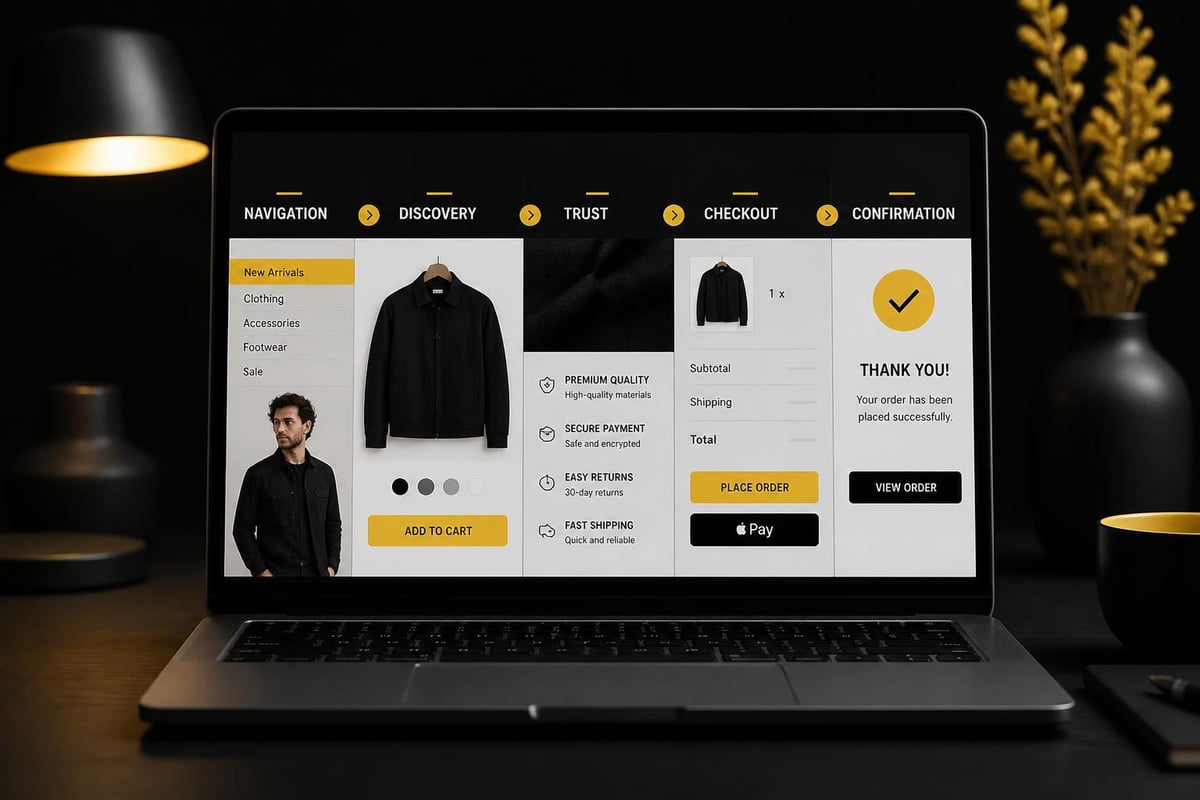
Website design services should prioritize user flow over visual complexity. Every element needs a purpose in moving visitors toward purchase.
Clear Navigation and Product Discovery
Your main navigation should answer one question: "Can customers find what they're looking for in under three clicks?"
Categories need logical structure. Search functionality requires visibility. Filter options must reflect how your customers actually shop-by size, colour, price range, or use case.
Breadcrumb trails help users understand where they are within your site structure. This small detail reduces confusion and bounce rates.
Strategic Use of White Space
Cramming information creates cognitive overload. White space guides attention to what matters most.
Product images need room to breathe. Call-to-action buttons require contrast and spacing. Designing for clarity beats designing for density every time.
Trust Signals and Social Proof
Security badges near checkout reduce cart abandonment. Customer reviews on product pages increase conversion rates by up to 270%.
Clear return policies, shipping information, and contact details build confidence before the purchase decision.
Mobile-First Design in Practice
Designing for desktop first and adapting for mobile is backwards in 2026.
Website design services should start with the mobile experience and expand to larger screens. This forces prioritization of essential elements.
Touch targets need adequate sizing-minimum 44×44 pixels for buttons. Forms should minimize typing with smart defaults and autofill support.
Horizontal scrolling never works on mobile. Ever. Image galleries, product carousels, and comparison tables need vertical alternatives.
Page speed on mobile networks determines whether users wait or leave. Optimize images, lazy-load content below the fold, and minimize unnecessary scripts.
Testing on actual devices reveals issues emulators miss. An iPhone SE shows different constraints than an iPad Pro.
Accessibility Beyond Compliance Checkboxes
Accessible design serves more customers, not fewer.
Colour contrast ratios affect readability for everyone, not just users with vision impairments. Text over images needs sufficient contrast or overlay darkening.
Keyboard navigation allows users who can't use a mouse to browse and purchase. Every interactive element should be reachable via tab key.
Alt text for images helps screen readers and improves SEO simultaneously. Describe what the image shows and its context, not just its literal contents.
Form labels need clear association with input fields. Error messages should explain what went wrong and how to fix it, not just highlight the problem.
Video captions benefit users in sound-sensitive environments like offices or public transport, expanding when your content gets consumed.
Performance Optimization That Drives Results
A beautiful site that loads slowly is just expensive frustration.
Core Web Vitals-Google's speed and user experience metrics-directly impact search rankings in 2026. Website design services need to account for these from the start, not retrofit them later.
Largest Contentful Paint (LCP) measures how quickly the main content loads. Target under 2.5 seconds.
First Input Delay (FID) tracks responsiveness to user interactions. Under 100 milliseconds keeps the experience smooth.
Cumulative Layout Shift (CLS) prevents annoying content jumping as elements load. Score under 0.1 to avoid frustrating users.
Image optimization contributes most to performance gains. Modern formats like WebP reduce file sizes without quality loss.
Critical CSS inlining renders above-the-fold content faster. Defer non-critical JavaScript until after initial page load.
Platform Selection and Its Design Implications
Different platforms impose different design constraints and possibilities.
Shopify excels for product-focused eCommerce with reliable hosting and built-in payment processing. Building an eCommerce site on Shopify means working within its theme system and app ecosystem.
WooCommerce offers flexibility for WordPress users but requires separate hosting management and more technical maintenance.
Custom builds provide unlimited possibilities at significantly higher cost and longer timelines. Most small businesses don't need this level of customization.
The platform choice shapes what's possible within your budget and timeline. Website design services should match platform expertise to your business model.

Template Customization vs. Custom Design
Templates aren't inherently inferior to custom designs.
Quality templates provide tested frameworks that handle responsive design, accessibility basics, and common eCommerce patterns. Customizing website templates effectively can deliver professional results at a fraction of custom costs.
The key is making templates yours through strategic customization, not superficial colour swaps.
Custom typography establishes brand personality. Strategic layout modifications address your specific product presentation needs.
Adding custom sections for unique content differentiates your store from others using the same template base.
Full custom design makes sense when your product requires unusual presentation or when brand positioning demands complete originality. For most small eCommerce businesses launching their first store, strategic template customization delivers better value.
Content Strategy Within Design
Design and content aren't separate disciplines. They work together or fail together.
Website design services should include content planning even if you're writing the copy yourself. Layout decisions depend on content volume and hierarchy.
Product descriptions need scannable formatting-short paragraphs, bullet points for specifications, and clear feature-to-benefit connections.
Homepage messaging should communicate your value proposition within three seconds. Visitors decide whether to stay or leave almost instantly.
Category pages balance SEO requirements with user navigation needs. Descriptive content helps rankings without burying product listings.
About pages build connection and trust. Small business owners have an advantage here-your story matters more than corporate polish.
Ongoing Optimization After Launch
Launch day isn't the finish line. It's the starting line.
Professional website design services should include post-launch review periods. Real user behaviour reveals opportunities invisible during development.
Heat mapping shows where users actually click versus where you intended. Scroll depth reveals if important content sits below where most users stop reading.
A/B testing different call-to-action buttons, product layouts, or checkout flows provides data-driven improvement paths. Small changes compound into significant conversion gains.
Regular performance audits catch slowdowns before they impact sales. As you add products and content, optimization needs adjustment.
Analytics review identifies which traffic sources convert best, informing where to focus marketing effort. Your design should evolve based on what actual customers do, not assumptions.
Budget Realities and Value Assessment
Website design services range from hundreds to hundreds of thousands of dollars.
Understanding what drives cost differences helps evaluate true value. Agency overhead, revision rounds, custom feature development, and ongoing support all impact pricing.
For small Australian eCommerce businesses, affordable web design doesn't mean cheap shortcuts. It means focused scope and efficient execution.
Ask what's included explicitly. Does pricing cover design, development, responsive optimization, basic SEO setup, and training? Or just the visual design with everything else quoted separately?
Revision policies matter. Unlimited revisions sound good but often mean projects never finish. Structured revision rounds create momentum.
Timeline commitments reveal reliability. If you need to launch for a seasonal opportunity, vague "8-12 week" estimates create risk. A four-week build process provides certainty.
| Investment Level | What You Get | What You Don't |
|---|---|---|
| Under $2,000 | Template setup, basic customization | Strategic planning, optimization, support |
| $3,000-$8,000 | Full design, development, launch support | Extensive custom features, content creation |
| $10,000-$25,000 | Custom design, advanced features, ongoing retainer | Guarantee of sales, unlimited revisions |
| $25,000+ | Enterprise features, extensive integrations | Necessarily better results for small stores |
Choosing the Right Website Design Services Provider
Credentials matter less than relevant experience and process clarity.
Look for providers who show previous work in your industry or with similar business models. B2B and B2C eCommerce have different design requirements, as do physical products versus digital goods.
B2B website design best practices differ significantly from direct-to-consumer approaches, particularly around information architecture and trust-building.
Process transparency reveals how the provider works. Do they start with strategy discovery or jump straight to visual design? Do they include you in key decisions or present completed work?
Communication style predicts the working relationship. If initial conversations feel unclear or pushy, the full project will likely amplify those issues.
References provide reality checks. Ask previous clients about timeline accuracy, communication responsiveness, and post-launch support.
Common Pitfalls to Avoid
Many small businesses waste money on website design services that don't match their actual needs.
Over-customization for features you'll never use creates cost without value. Your first store needs selling fundamentals, not enterprise-level complexity.
Skipping mobile testing until launch day reveals problems too late to fix efficiently. Mobile optimization belongs in the design process from day one.
Ignoring page speed during design means expensive performance retrofitting later. Load time affects both user experience and search rankings.
Treating accessibility as optional limits your customer base and creates legal risk. Building it in costs less than adding it later.
Unclear ownership terms can trap you with a provider for ongoing costs. Confirm you own your content, domain, and can migrate if needed.
AI Tools and Modern Website Design Services
AI is changing website design services, but not replacing human strategy.
Tools can now generate design options from text prompts when given proper direction. This speeds initial concept exploration but still requires human judgment to evaluate what actually serves business goals.
Automated accessibility checking catches technical issues but can't assess whether your content makes sense to all users.
AI-powered image optimization, content suggestions, and layout testing provide efficiency gains. The strategic decisions-what to sell, to whom, and why they should buy from you-remain human work.
The best website design services in 2026 blend AI efficiency with human expertise, using tools to handle repetitive tasks while focusing human attention on strategy and conversion optimization.
What Success Actually Looks Like
Measuring website design services success requires specific metrics, not aesthetic opinions.
Conversion rate tracks the percentage of visitors who complete purchases. Industry averages sit around 2-3% for eCommerce, with optimized stores reaching 5% or higher.
Average order value indicates whether your design encourages additional purchases through effective product recommendations and bundle presentations.
Bounce rate shows how many visitors leave immediately. High bounce rates often signal unclear value propositions or poor mobile experiences.
Time on site and pages per session reveal engagement levels. Products requiring research should show higher engagement metrics than impulse purchases.
Customer feedback provides qualitative insight that metrics miss. What do users say is confusing or difficult?
Getting your eCommerce store designed right the first time saves months of frustration and missed sales. The fundamentals-conversion-focused layout, mobile optimization, performance, and accessibility-matter more than trendy animations or complex features you'll never use. If you're launching your first Shopify store and need everything handled without the agency markup or DIY learning curve, Kida Digital builds conversion-ready stores in four weeks with the strategic foundations that actually drive sales.


Be the first to comment