
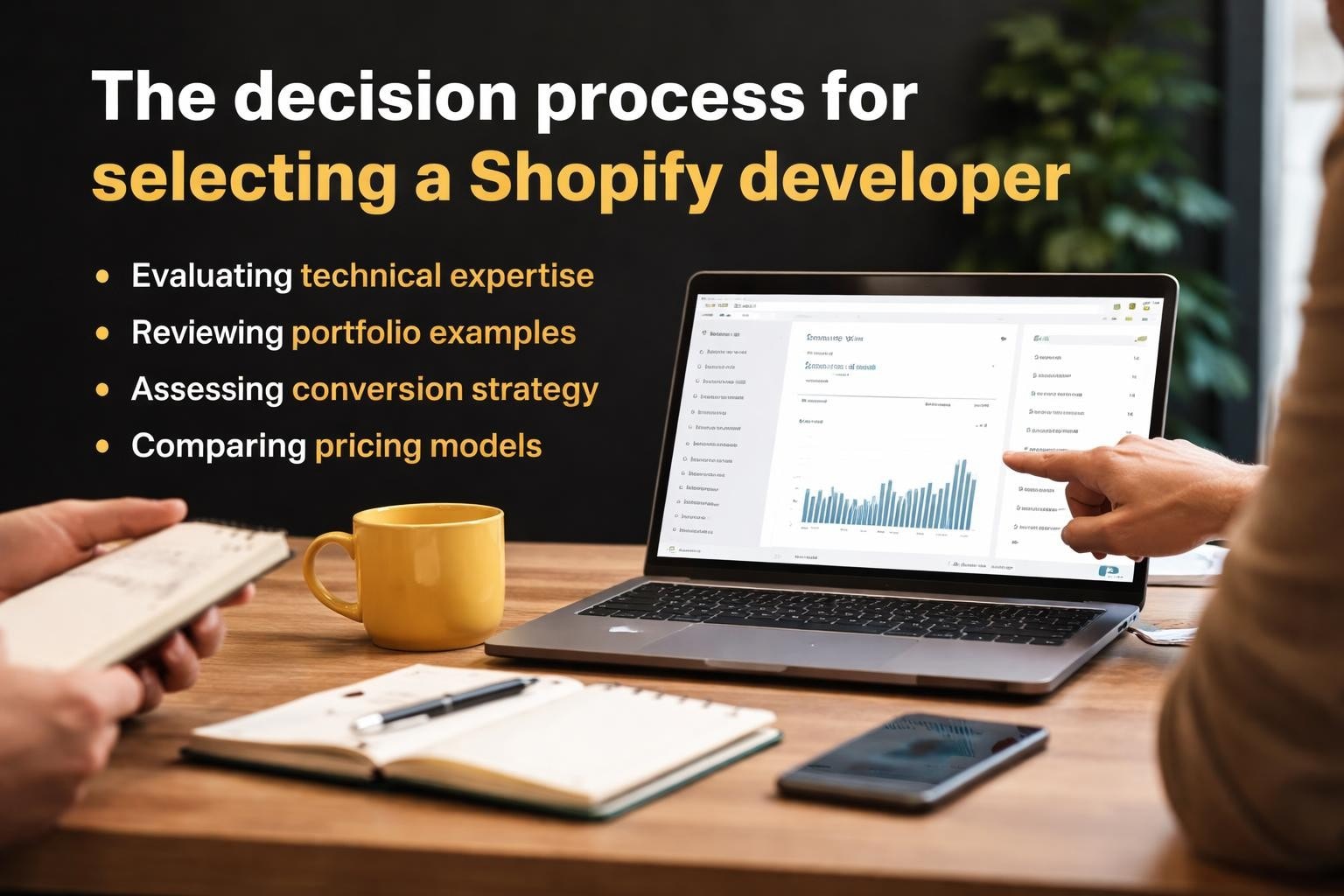
Finding the right developer for your Shopify store can feel overwhelming. You're balancing budget constraints, timeline pressures, and the need for someone who actually understands eCommerce. The wrong choice costs you time, money, and momentum. The right choice becomes a business advantage. This guide cuts through the noise to help you identify what separates genuinely capable developers from those who simply know their way around a theme editor.
What Makes the Best Shopify Developers Stand Out
Technical skill is table stakes. The best Shopify developers bring strategic thinking to every project. They understand conversion principles, not just code. They ask about your customer journey before they touch your homepage. They challenge ideas that might look good but won't drive sales.
Technical Competence vs Business Acumen
A developer who can build custom features is valuable. A developer who knows when a custom feature is unnecessary is more valuable. According to TechRadar’s 2026 Shopify review, the platform's ecosystem has matured significantly, with robust app integrations solving most common business needs without custom development.
The gap between technical and strategic developers shows up in these ways:
- Strategic developers audit your entire sales funnel, not just your design preferences
- They recommend proven app combinations before suggesting custom builds
- They focus on mobile conversion rates from day one
- They build with site speed and SEO fundamentals baked in
- They question requirements that add complexity without revenue impact
A Melbourne skincare brand learned this lesson the hard way. They hired a developer who built an elaborate product configurator that took eight weeks and cost $12,000. Customer analytics later showed 78% of visitors abandoned it in favour of pre-packaged options. A simpler approach would have launched faster and converted better.
Portfolio Quality Over Portfolio Size
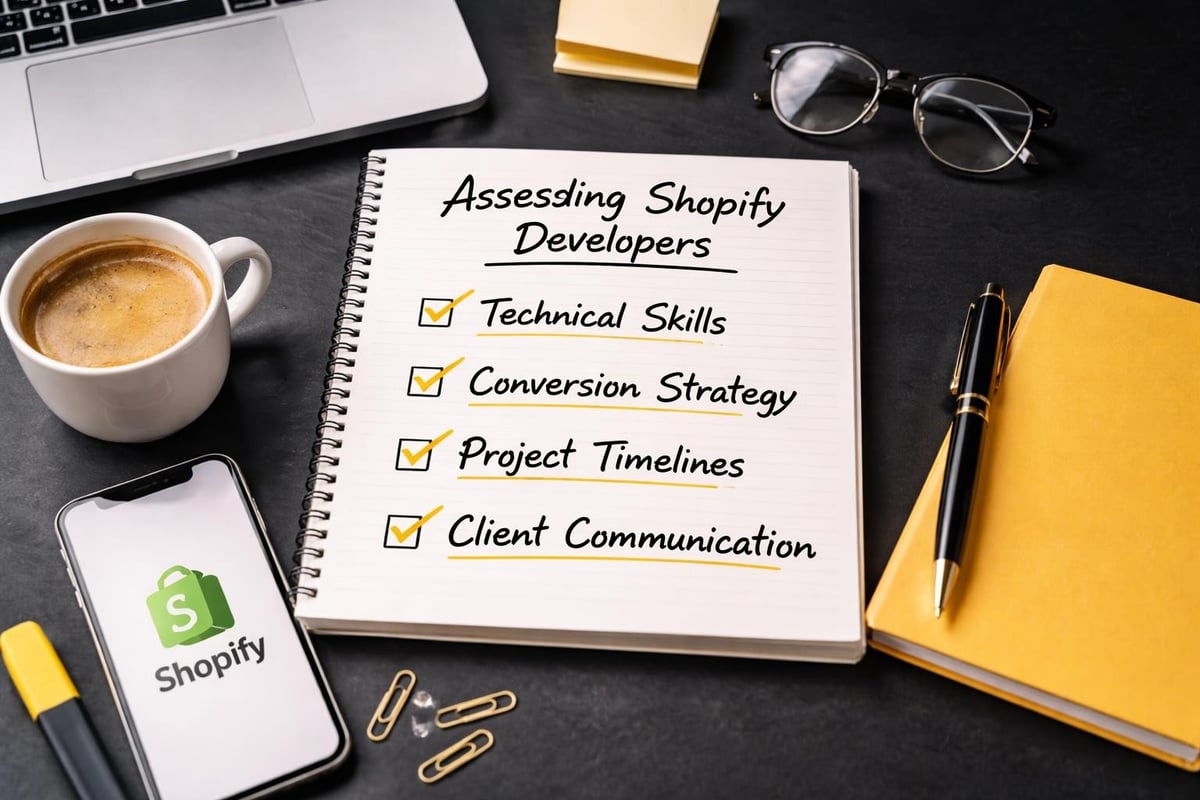
Don't be impressed by a hundred mediocre stores. Look for depth in a handful of excellent projects. The best Shopify developers typically showcase 5-10 strong examples rather than overwhelming you with quantity. Each case study should demonstrate problem-solving, not just aesthetic execution.
When reviewing portfolios, examine:
- Conversion-focused design decisions they can articulate
- Evidence of mobile-first thinking in every project
- Clear before-and-after metrics where available
- Diverse business models (physical products, subscriptions, digital goods)
- Stores that still exist and perform well months or years later
Request store URLs and browse them yourself. Add products to cart. Test the checkout flow. Notice whether forms are unnecessarily complex. Check page load times using Google PageSpeed Insights. A developer's best work should function beautifully, not just photograph well.
Where to Find Qualified Shopify Developers
The platforms you use to find developers matter less than your vetting process. Multiple hiring channels exist, from marketplaces to specialist agencies, but your evaluation criteria should remain consistent.
Freelance Marketplaces and Their Limitations
Upwork, Freelancer, and similar platforms offer access to thousands of developers at varying price points. Rates range from $15 per hour for offshore generalists to $150+ per hour for experienced specialists. This range creates decision paralysis and quality concerns.
The challenge with marketplaces is noise. Anyone can claim Shopify expertise. Reviews can be gamed or reflect project management skills rather than technical ability. According to research by ShopDigest, approximately 60% of Shopify projects started on freelance marketplaces experience scope creep or timeline delays.
Budget-conscious businesses often gravitate to the lowest bidder. This approach backfires when revisions pile up, deadlines slip, or the final product lacks basic conversion optimizations. The apparent savings evaporate quickly.
Shopify Partner Directory and Specialist Agencies
The official Shopify Partner directory lists developers and agencies vetted to some degree by Shopify. Partner status indicates platform familiarity but doesn't guarantee strategic capability or fair pricing. Large agencies often appear here, bringing structure and process but also significant overhead.
| Developer Type | Typical Timeline | Price Range (AUD) | Best For |
|---|---|---|---|
| Freelance Generalist | 6-12 weeks | $3,000-$8,000 | Very simple stores with flexible timelines |
| Specialist Developer | 4-8 weeks | $6,000-$15,000 | Businesses needing specific custom features |
| Mid-Size Agency | 8-16 weeks | $15,000-$40,000 | Established brands with complex requirements |
| Enterprise Agency | 12-24 weeks | $40,000+ | Large catalogues, multi-region, heavy customization |
Understanding why agencies charge premium rates for Shopify sites helps you assess whether that investment aligns with your actual needs. Many small Australian businesses don't require enterprise-level solutions but get sold them anyway.
Referrals and Industry Networks
Word-of-mouth recommendations from other eCommerce operators carry weight. Someone who's successfully launched and scaled a Shopify store knows what actually matters. Their developer recommendations come with context: delivery reliability, communication style, problem-solving ability, post-launch support quality.
Join Australian eCommerce communities, both online and in-person. Ask specific questions about developer experiences. A referral is only useful if the referring business shares your constraints and goals.

Essential Questions to Ask Before Hiring
Your discovery conversation reveals more than any portfolio. The best Shopify developers ask as many questions as they answer. They want to understand your business model, target customer, competitive landscape, and growth plans before proposing solutions.
Questions About Process and Timeline
How a developer structures projects tells you whether they'll deliver on time. Vague timelines or resistance to milestones signals trouble ahead. Clear process indicates experience and professionalism.
Ask these process-specific questions:
- What does your typical project timeline look like from kickoff to launch?
- How do you handle scope changes or additional feature requests mid-project?
- What information do you need from me, and when do you need it?
- How often will we communicate, and through which channels?
- What happens if we miss a milestone due to delays on either side?
A Sydney homewares store interviewed three developers for their store rebuild. Only one provided a detailed project plan with weekly milestones, dependency mapping, and clear client responsibilities. That developer delivered in six weeks while competitors were still clarifying requirements.
Technical Capability Assessment
You don't need to understand code to assess technical competence. Ask scenario-based questions about common eCommerce challenges. Their answers reveal depth of knowledge and practical experience.
Test their understanding with questions like: "How would you approach site speed optimization if our product images are high-resolution?" or "What's your recommendation for handling inventory across multiple sales channels?" Generic answers suggest surface knowledge. Specific, nuanced responses demonstrate real expertise.
Red Flags That Should Make You Walk Away
Some warning signs are subtle. Others are glaring. Trust your instincts when something feels off. Replacing a poor developer choice costs more than waiting for the right one.
Unrealistic Promises and Timelines
If a developer guarantees first-page Google rankings or promises a fully custom enterprise store for $2,000, run. The best Shopify developers set realistic expectations. They discuss tradeoffs honestly. They explain what's achievable within your budget and timeline constraints.
According to industry data on Shopify development timelines, a proper store build with conversion optimization typically requires 4-8 weeks minimum. Anyone promising less either cuts critical corners or uses cookie-cutter templates with minimal customization.
Poor Communication or Vague Answers
Communication quality during sales conversations predicts communication quality during projects. Slow email responses, vague cost estimates, or difficulty explaining technical concepts in plain language all indicate future frustration.
Communication red flags include:
- Taking more than 48 hours to respond to initial enquiries
- Providing ballpark estimates without understanding scope
- Using jargon without explaining it when asked
- Seeming rushed or disinterested during discovery calls
- Inability to provide client references upon request
One Brisbane fashion retailer ignored these signs and hired a developer who went silent for two weeks mid-project. The store launched three months late, missing their peak seasonal window. Lost revenue exceeded the entire development cost.
No Post-Launch Support Plan
Your relationship with a developer shouldn't end at launch. Bugs emerge. Apps need updating. Business needs evolve. Developers who vanish after final payment leave you stranded. The best Shopify developers offer clear support arrangements, whether retainer-based or hourly.
Ask explicitly: "What happens if something breaks two weeks after launch?" and "How do you handle ongoing maintenance and updates?" Documented support terms protect both parties and ensure long-term store health.
Australian Context and Local Considerations
Hiring locally offers advantages beyond timezone alignment. Australian developers understand local payment preferences, shipping expectations, and consumer protection regulations. These details matter more than many businesses realize.
Payment Gateway and Compliance Knowledge
Shopify Payments doesn't support every country equally. Australian stores need developers familiar with local gateway options, GST handling, and ACCC compliance requirements. Shopify’s eCommerce development fundamentals vary slightly by region, and local knowledge prevents costly mistakes.
A Perth supplement company hired an offshore developer who implemented USD pricing and US shipping calculations by default. Fixing these fundamental errors post-launch required another developer and delayed their opening by five weeks.
Time Zone and Communication Benefits
Real-time collaboration accelerates projects. Questions get answered within hours, not the next day. Screen-sharing sessions happen during business hours for both parties. Small issues get resolved before becoming blockers.
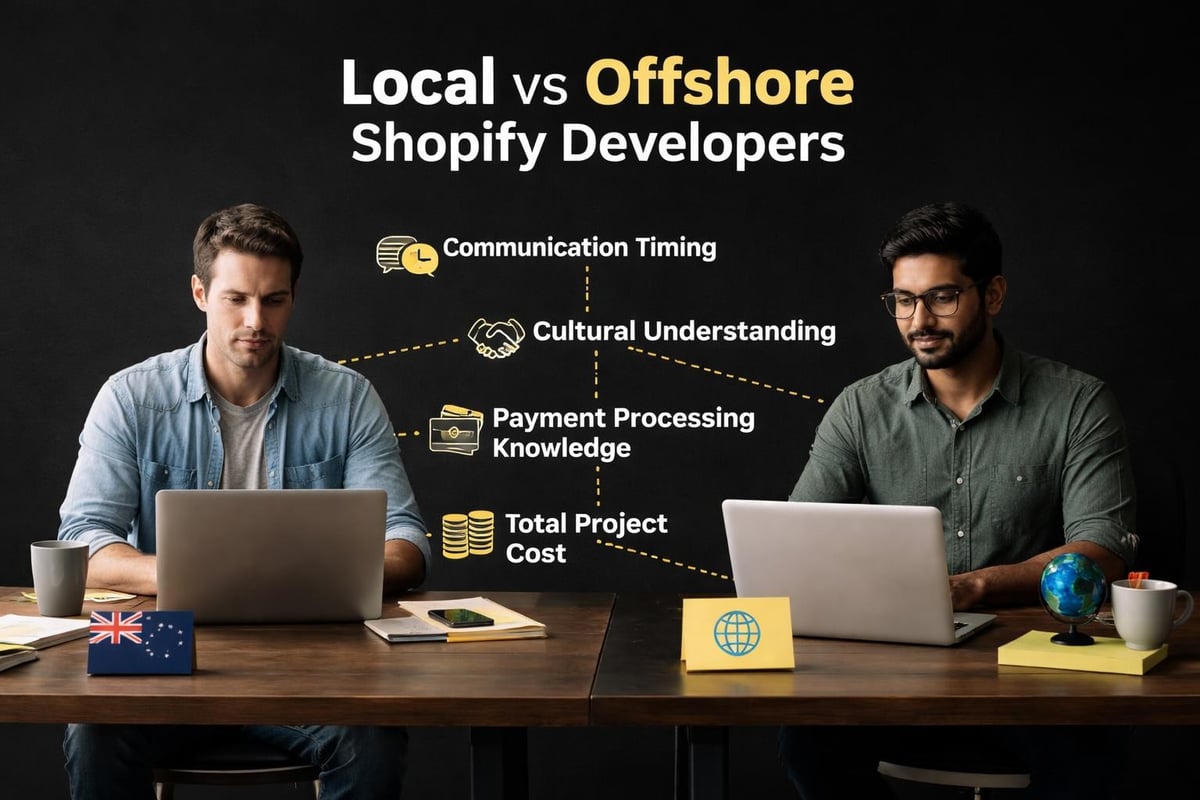
This doesn't mean offshore developers can't deliver quality work. Many do. But the communication overhead and potential misalignment on local market expectations add project risk that budget savings might not offset.
Pricing Models and What You Actually Get
Shopify development pricing varies wildly. Understanding what drives costs helps you evaluate quotes intelligently. The cheapest option rarely delivers the best value. The most expensive doesn't guarantee better results.
Fixed-Price vs Hourly Arrangements
Fixed-price projects suit businesses with clear requirements and defined scope. You know the total investment upfront. The risk shifts to the developer to deliver within budget. This model works when both parties thoroughly discuss requirements before starting.
Hourly billing offers flexibility for evolving projects but creates budget uncertainty. It rewards efficiency poorly since developers earn more by working longer. Use hourly arrangements for ongoing maintenance or small enhancements, not full builds.
Pricing model comparison:
| Model | Best Use Case | Risk Profile | Budget Certainty |
|---|---|---|---|
| Fixed Price | Well-defined new store builds | Shared (scope creep protection needed) | High |
| Hourly | Maintenance, minor updates, unclear scope | Higher for client | Low |
| Value-Based | Strategic partnerships, ongoing optimization | Shared based on results | Variable |
| Retainer | Ongoing development, growth-stage businesses | Low for both parties | Medium-High |
For small Australian businesses launching their first store, done-for-you Shopify builds with transparent fixed pricing remove uncertainty and ensure all core eCommerce functionality gets included from the start.
What Should Be Included in Base Price
A complete Shopify store build includes more than theme installation. The best Shopify developers bundle essential elements that less experienced ones treat as add-ons. Understanding what qualifies as standard versus premium helps you compare quotes accurately.
Standard inclusions in a quality build:
- Mobile-responsive design across all page types
- Essential app integrations (reviews, email capture, analytics)
- Product catalogue setup with optimized descriptions and images
- Payment gateway and shipping configuration
- Basic SEO optimization (meta tags, URL structure, site speed)
- Contact forms and legal page templates
- Launch checklist and basic training documentation
Anything beyond this baseline adds cost. Custom features, advanced integrations, extensive content migration, professional photography, or copywriting all represent legitimate extras. Quotes should itemize these clearly.
Evaluating Developer Specializations
Not all Shopify developers serve all business types equally well. Specialists develop deep expertise in particular niches or technical capabilities. Matching their specialization to your needs improves outcomes.
Industry-Specific Experience
A developer who's built ten fashion stores understands that niche's specific requirements: colour/size variants, lookbook galleries, seasonal collection management, return rate considerations. This experience prevents common mistakes and accelerates decision-making.
Similarly, developers experienced with subscription businesses, digital products, or wholesale models bring relevant perspective. According to expert analysis on custom Shopify development, industry specialization often matters more than years of general Shopify experience.
Technical Specialty Areas
Some developers excel at Shopify Plus enterprise implementations. Others specialize in headless commerce architectures or custom app development. Most small Australian eCommerce businesses don't need these specialized capabilities and shouldn't pay premium rates for unused expertise.
Match technical specialization to your actual requirements. A business selling physical products through a standard Shopify plan needs solid fundamentals, not cutting-edge architecture. Understanding core Shopify web development principles matters more than advanced technical capabilities you won't use.
Making the Final Decision
You've interviewed candidates, reviewed portfolios, and compared quotes. Now comes the decision. Trust data over charm, substance over presentation. The best developer for your project might not be the most impressive salesperson.
Weighting Decision Criteria
Not all evaluation factors carry equal importance. Create a simple scoring matrix to compare candidates objectively. This approach prevents one strong impression from overshadowing concerning weaknesses.
Sample decision framework weights:
- Relevant portfolio examples (25%)
- Process clarity and timeline realism (20%)
- Communication quality and responsiveness (20%)
- Technical capability for your specific needs (15%)
- Pricing and value alignment (10%)
- Post-launch support offering (10%)
A developer scoring well across all categories beats one with perfect technical skills but poor communication. eCommerce success depends on execution, and execution requires collaboration.
Starting Small When Possible
If your budget allows, consider a paid discovery phase before committing to a full build. Some developers offer strategy sessions or store audits as standalone services. This low-risk engagement lets you assess working relationship quality before major investment.
A Canberra outdoor gear retailer paid for a two-hour consultation with three shortlisted developers. One identified conversion issues in their existing store they hadn't noticed. Another asked insightful questions about their customer acquisition strategy. The third focused mainly on their own capabilities. The choice became obvious.
Long-Term Partnership Thinking
Your launch date isn't the finish line. It's the starting line. The best Shopify developers think beyond project delivery to ongoing store evolution and optimization.
Growth Planning and Scalability
Ask candidates how they build for growth. Stores handling 50 orders monthly need different infrastructure than those processing 500. Theme choices, app selections, and technical architecture should accommodate reasonable expansion without requiring rebuilds.
Developers who discuss conversion optimization, customer lifetime value, and retention strategies demonstrate business thinking. Those focused solely on aesthetics or features might deliver a pretty store that doesn't grow with you.
Ongoing Optimization and Support
eCommerce stores require continuous improvement. Customer behaviour shifts. Competitors evolve. Technology updates. A developer who offers structured optimization services or training helps you maintain momentum post-launch.
Some developers provide monthly analytics reviews, A/B testing services, or seasonal optimization packages. Others prefer clean handoffs with ad-hoc support available. Neither approach is wrong, but alignment with your team's capabilities and available time matters.
Finding the best Shopify developers comes down to aligning technical capability with strategic thinking, clear communication, and realistic pricing for your specific business needs. Most small Australian eCommerce businesses don't need enterprise-level agencies but do need more than template installation from a freelancer. If you're looking for a structured, conversion-focused approach that gets your store live in four weeks without agency bloat or DIY overwhelm, Kida Digital specializes in exactly this space for Australian small businesses ready to launch properly the first time.


Be the first to comment