

Choosing website builders for small business is no longer about picking the shiniest tool. It's about matching your actual needs with what a platform can genuinely deliver. In 2026, Australian small businesses face more options than ever, from drag-and-drop builders to specialised ecommerce platforms. The decision you make today will shape how quickly you can launch, how much control you'll have, and whether your site can scale as you grow. Let's cut through the marketing noise and look at what actually matters.
Why Generic Website Builders Fall Short for Ecommerce
Most website builders for small business were designed for brochure sites, not selling products.
They work brilliantly if you need five pages, a contact form, and a blog. But when you add a cart, product variants, inventory management, and payment processing, the limitations show fast. According to TechRadar’s comprehensive guide, many popular platforms struggle with ecommerce scalability despite marketing themselves as all-in-one solutions.
The core problem isn't features. It's that these platforms were retrofitted for online selling. You'll find yourself paying for bloated plans with tools you don't need while missing fundamentals like abandoned cart recovery or proper SEO for product pages.
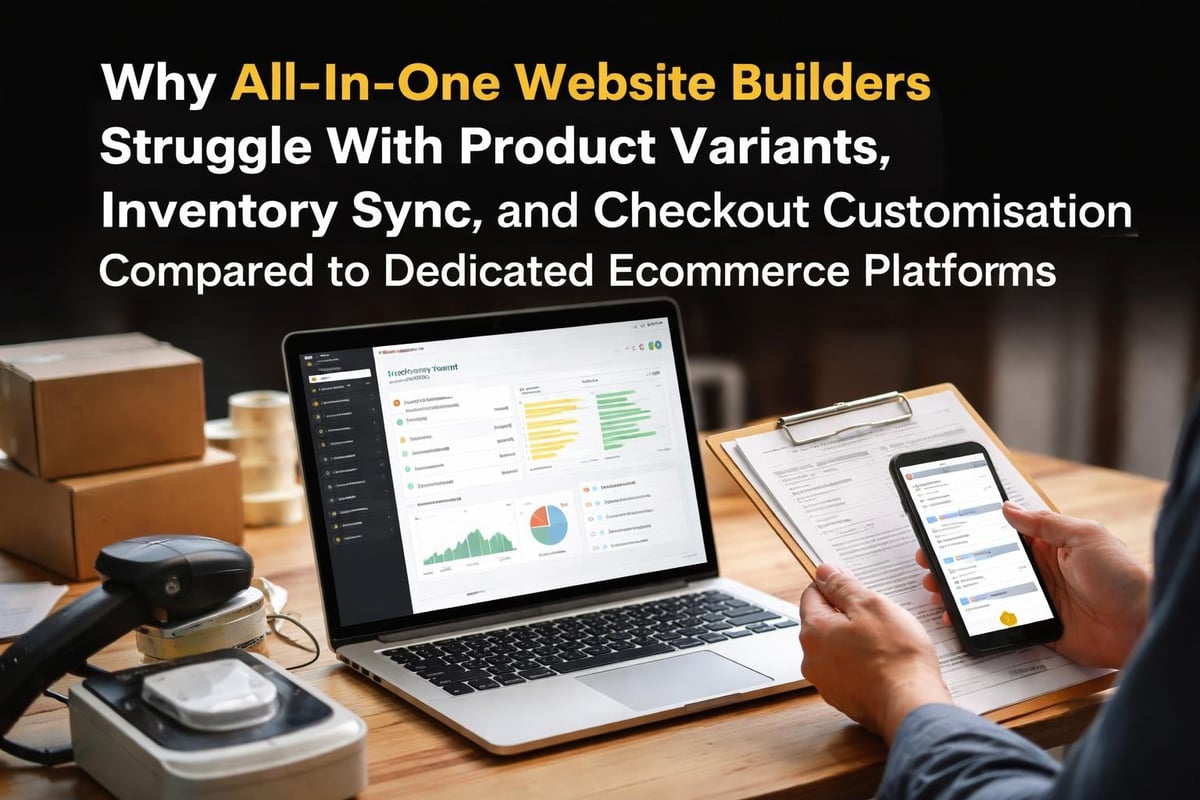
The Hidden Costs of DIY Platforms
Free trials and low monthly fees look attractive until you calculate the actual cost.
Time is your biggest expense. A 2025 study found that small business owners spend an average of 47 hours building their first website on DIY platforms. That's nearly six full working days, not counting the learning curve for apps, integrations, and troubleshooting.
Then there's the subscription creep. You start on a basic plan, then need more products, better bandwidth, an SSL certificate, email marketing integration, and professional templates. Within months, you're paying $80-120 monthly for a site that still feels limited.
The real question isn't whether you can build it yourself. It's whether you should. Your time has a dollar value, and those 47 hours represent real revenue you're not generating while you're watching tutorials.
Platform Comparison: What Actually Matters
When evaluating website builders for small business, most comparison articles focus on features lists. That's backwards. Start with your business model, then find platforms that support it naturally.
Wix: The Template Powerhouse
Wix dominates the DIY market with over 800 templates and an easy editor. Their new Harmony AI website builder launched in late 2025, promising smarter design assistance. For service businesses and portfolios, it's solid. For product-based businesses, it's functional but not purpose-built.
The ecommerce plans start at $27 monthly, but you'll quickly need the $49 Business VIP plan for basic features. Transaction fees apply on lower tiers, eating into margins.
Squarespace: Design-First Approach
Squarespace is where designers and creatives land. The templates are stunning. The learning curve is steeper than Wix but shallower than WordPress. Squarespace’s pricing structure for 2026 shows ecommerce plans from $33 monthly, with better built-in features than Wix for selling physical products.
The limitation? Customisation hits walls quickly. If your business model requires specific checkout flows or complex product options, you'll fight the platform. As highlighted in Tom’s Guide’s analysis, Squarespace excels at making beautiful sites for straightforward selling.
Hostinger: Budget Performance
Hostinger Website Builder entered the Australian market hard in 2024 with aggressive pricing. Plans start at $2.99 monthly, making it the cheapest entry point. The AI tools are surprisingly capable for the price point.
But cheap comes with trade-offs. Customer support is limited outside business hours. The template selection is smaller. It's genuinely good for testing ideas or very tight budgets, less suitable for serious ecommerce growth.
| Platform | Starting Price | Ecommerce Ready | Learning Curve | Best For |
|---|---|---|---|---|
| Wix | $27/month | Moderate | Low | Service businesses |
| Squarespace | $33/month | Good | Medium | Design-focused brands |
| Hostinger | $2.99/month | Basic | Low | Budget testing |
| Shopify | $39/month | Excellent | Medium | Product sellers |
| WordPress | Free + hosting | Variable | High | Content + selling |
When Specialised Platforms Make Sense
Generic website builders for small business try to serve everyone. Specialised platforms serve specific business models exceptionally well.
Shopify exists for one reason: selling products online. Every feature, every app, every template assumes you're building an ecommerce store. This focus creates efficiency. You're not hunting through menus for checkout settings or wondering how to add product variants. It's all there, logically organised.
The platform handles 4.6 million stores globally as of early 2026. Australian adoption has grown 34% year-over-year. That's not marketing hype. It's business owners choosing tools built for their actual needs rather than compromising on all-in-one solutions.
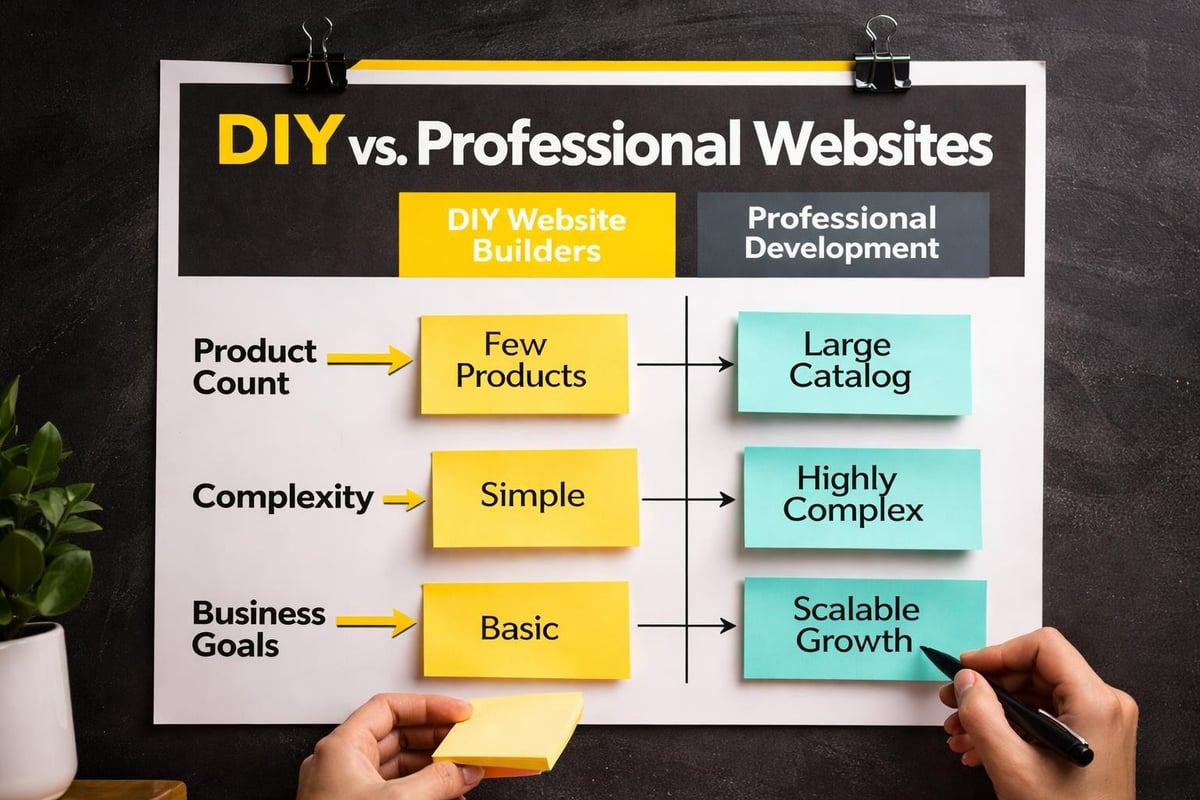
The Development vs DIY Decision
This is where most small Australian businesses get stuck.
DIY saves money upfront. Development costs more initially but delivers a store built around your specific workflows, brand requirements, and growth strategy. Neither is inherently better. The right choice depends on where you are and where you're going.
Consider development when:
- Your product catalogue exceeds 100 SKUs with variants
- You need custom checkout experiences or subscription models
- Brand consistency across touchpoints is non-negotiable
- You're migrating from an existing platform
- Time to launch affects revenue significantly
Stick with DIY when:
- You're testing product-market fit with under 20 products
- Budget is genuinely tight and you have time to learn
- Your business model is straightforward with no special requirements
- You enjoy learning systems and solving technical problems
Understanding the differences between business and ecommerce websites helps clarify which path suits your situation. A service business with three products needs a different approach than a product business with multiple categories.
Real Costs Beyond Monthly Subscriptions
Website builders for small business advertise monthly fees, but that's rarely your total cost.
Typical additional expenses include:
- Domain registration: $15-30 annually
- Email hosting: $5-15 monthly if not included
- Premium templates: $100-300 one-time
- Essential apps/plugins: $20-80 monthly
- Transaction fees: 1.5-3% depending on plan
- Payment gateway fees: 1.75% + 30c per transaction minimum
A $27 monthly plan quickly becomes $85-120 when you add what's actually needed to run professionally. That's not a criticism of the platforms. It's reality. Make sure you're calculating total cost of ownership, not just the base subscription.
The Agency Price Puzzle
Many small Australian businesses receive quotes of $8,000-15,000 for Shopify sites from agencies. That sticker shock sends them straight to DIY builders. But those quotes often include months of back-and-forth, multiple revision rounds, project management overhead, and features most small stores don't need at launch.
There's a middle ground. Done-for-you Shopify builds designed specifically for small Australian ecommerce businesses can deliver everything needed to launch within four weeks, covering the fundamentals without agency bloat or the missing elements common in DIY attempts. This approach bridges the gap between expensive custom work and time-consuming self-builds.
Feature Priorities for Australian Businesses
Not all features matter equally. Focus on what directly impacts your ability to sell and be found.
SEO and Discoverability
Google doesn't care how pretty your site is. It cares about load speed, mobile responsiveness, proper heading structure, and quality content. According to Website Builder Expert’s comparison, most major platforms now handle technical SEO basics adequately, but implementation quality varies wildly.
The SEO essentials your platform must support:
- Custom meta titles and descriptions per page
- Clean URL structures without random strings
- Image alt text editing
- Mobile-first responsive design
- Fast loading speeds under 3 seconds
- Schema markup for products
WordPress with WooCommerce offers the most SEO control but requires the most knowledge. Shopify provides solid SEO foundations with less complexity. Generic builders often oversimplify SEO to the point of losing important optimisation opportunities.
Proper SEO optimisation for Shopify product pages can dramatically impact organic traffic and conversion rates, regardless of which platform you ultimately choose.
Payment and Checkout Experience
Cart abandonment in Australia averages 72% as of 2026. Every friction point in checkout costs you sales.
Your platform needs to support multiple payment methods. Australians expect Afterpay, Zip, and buy-now-pay-later options alongside traditional cards and PayPal. Guest checkout should be simple and fast. Multi-step checkouts increase abandonment.
| Payment Feature | Why It Matters | Platform Support |
|---|---|---|
| Express checkout | Reduces steps by 60% | Shopify, Wix Commerce |
| BNPL integration | 43% of AU shoppers expect it | Shopify, Squarespace |
| Guest checkout | Removes signup friction | All major platforms |
| Abandoned cart recovery | Recovers 10-15% of lost sales | Shopify, premium plans |
| Multiple currencies | Essential for export | Shopify, limited others |
Mobile Performance Cannot Be Optional
63% of Australian ecommerce traffic comes from mobile devices in 2026. If your site doesn't work perfectly on phones, you're losing more than half your potential customers.
Generic website builders for small business often produce mobile versions that technically work but aren't optimised for mobile shopping behaviour. Buttons are too small. Product images don't zoom properly. Forms require too much typing.
Test these mobile elements before committing to a platform:
- Product page navigation and image galleries
- Cart and checkout on screen sizes under 400px
- Form input and autofill functionality
- Page load speeds on 4G networks
- Touch target sizes for buttons and links
Use your own phone for testing. Don't rely on desktop preview modes. Real device testing reveals issues that simulators miss.
Making Your Decision Without Regret
There's no perfect platform. Every website builder for small business involves trade-offs between ease, control, cost, and capabilities.
Start by defining your non-negotiables. Write them down. Be specific. "Easy to use" isn't specific. "I need to add products myself without technical help" is specific. "Good design" is vague. "Mobile-optimised product pages that load under 2 seconds" is measurable.
The 90-Day Reality Check
Most platforms offer trials or money-back guarantees. Use them properly. Don't just click around the interface. Actually build pages. Add real products. Test the checkout process. Try to do the tasks you'll need to do weekly.
Your trial should answer:
- Can I add/edit products without frustration?
- Does the site look professional on my phone?
- Can I find and understand the features I'll use regularly?
- Is support responsive when I hit problems?
- Do the costs make sense as I scale?
If you're hitting walls or feeling confused after 10 hours of use, it's not going to get easier. Trust that friction. The right platform should feel increasingly intuitive, not increasingly complicated.
Support and Community Access
When something breaks at 9pm on a Thursday, platform choice suddenly becomes very real.
Shopify provides 24/7 support across phone, chat, and email. Response times average under 2 minutes for urgent issues. That level of support carries value beyond the monthly fee. WordPress alternatives typically rely on community forums, which can be brilliant or frustrating depending on your problem and timing.
Community size matters too. Larger platforms mean more tutorials, more solved problems, and more developers available if you need help. Shopify's app store has over 8,000 apps. That ecosystem exists because millions of stores create demand for solutions. Smaller platforms offer less choice but sometimes higher quality curation.
Documentation Quality Varies Wildly
Some platforms invest heavily in education. Others treat documentation as an afterthought. Before committing, search for help articles on tasks you'll need to perform. If the documentation is sparse, outdated, or unclear, you'll spend hours searching YouTube for third-party tutorials.
Quality documentation should be:
- Searchable and well-organised by topic
- Updated within the last 6 months
- Written for beginners, not developers
- Supplemented with screenshots or videos
- Including real examples, not just theory
Migration and Exit Strategies
Choosing website builders for small business isn't a lifetime commitment, but switching platforms later is painful and expensive.
Most platforms make it easy to import data but hard to export it. That's intentional. They want switching costs high enough that you'll tolerate problems rather than migrate.
Before signing up, research:
- Can you export product data in standard formats?
- Do URLs redirect automatically or will you lose SEO value?
- Are images stored in accessible formats you can download?
- Can you transfer your domain easily?
- What happens to customer data?
Understanding how to build ecommerce stores efficiently includes planning for potential platform changes down the line. Building on open platforms like Shopify or WordPress provides more flexibility than proprietary closed systems.
Platform Maturity and Longevity
Flashy new platforms launch monthly with bold promises. Some deliver. Most disappear within 18 months, leaving customers scrambling to rebuild elsewhere.
Stick with established platforms unless you have compelling reasons to take risks. Wix, Squarespace, Shopify, and WordPress aren't exciting, but they'll still exist in five years. Your business deserves that stability.
Newer platforms like Hostinger's website builder show promise but lack the track record. If you choose a newer option, have a backup plan and avoid building critical dependencies on platform-specific features.
The right website platform for your small business depends on your specific situation, not generic rankings. If you're building an ecommerce store and need a solution that delivers everything required to launch properly within four weeks, without agency pricing or DIY complexity, Kida Digital specialises in conversion-led Shopify development for small Australian businesses. We handle the technical complexity so you can focus on what matters: selling products and growing your business.


Be the first to comment