

If you're running a small Australian eCommerce business or planning to launch one, you've probably heard the term "shopify partner" thrown around. It's not just industry jargon. Understanding what a Shopify partner actually does can save you thousands of dollars and months of frustration when building or improving your online store. The difference between working with a certified partner and going it alone often determines whether your store launches in weeks or languishes in development purgatory.
What Actually Defines a Shopify Partner
A shopify partner is someone who's been accepted into Shopify’s official partner program, which includes developers, designers, marketers, and agencies who specialise in building and optimising Shopify stores.
This isn't a pay-to-play badge.
Partners need to demonstrate expertise and maintain active client relationships. They get access to development tools, educational resources, and revenue opportunities that aren't available to regular users.
The program exists because Shopify recognises that most merchants need expert help to build stores that actually convert visitors into customers. According to recent platform data, stores built by partners achieve 30% higher conversion rates on average compared to DIY builds in their first year.

The Different Types of Partners You'll Encounter
Not all Shopify partners operate the same way. Some focus exclusively on design, others on technical development, and many offer full-service solutions.
Development partners handle custom functionality, app integration, and theme customisation. They're your go-to when you need features that don't exist in standard templates.
Design partners specialise in visual branding and user experience. They make stores look professional without sacrificing conversion potential.
Marketing partners focus on SEO, paid advertising, and email automation. They help you actually get traffic and sales after launch.
Agency partners bundle everything together, which sounds convenient until you see their $15,000 starting quotes for basic stores.
Then there are specialists like Kida Digital who focus specifically on conversion-led development for small Australian businesses, cutting through the agency bloat to deliver functional stores in four weeks.
Why the Partner Designation Actually Matters
The partner status isn't just a marketing tool. It comes with tangible benefits that directly impact your project.
Partners get access to development stores where they can build and test your site before it goes live. This means you're not paying monthly fees while your store is being constructed.
They receive priority support from Shopify's team. When technical issues arise, partners skip the queue and get direct help from engineers.
Early access to features means your store can incorporate new capabilities before they're available to the general public.
Revenue sharing arrangements incentivise partners to build stores that succeed. Many earn ongoing commissions based on your monthly Shopify fees, which aligns their interests with your growth.
The Financial Structure Behind Partner Relationships
Understanding how Shopify partners get paid helps you evaluate proposals and spot potential conflicts of interest.
| Revenue Source | How It Works | What It Means for You |
|---|---|---|
| Development Fees | One-time payment for build | Standard across most projects |
| Monthly Commissions | 20% of your Shopify fees for 24 months | Partners benefit from your success |
| App Referrals | Commission on recommended apps | Could lead to unnecessary recommendations |
| Retainer Agreements | Ongoing monthly support fees | Predictable costs, ongoing relationship |
Most legitimate partners are transparent about these arrangements. The commission structure actually works in your favour because partners earn more when you stay on Shopify longer, which only happens if your store performs well.
Some partners push expensive apps or higher-tier Shopify plans to boost their commissions. That's why you need to work with developers who prioritise conversion over commission maximisation.
Finding the Right Shopify Partner for Your Business
The Shopify Partner Directory lists thousands of certified partners globally. That's overwhelming, not helpful.
Start by identifying your specific needs. A $50,000 fashion brand launching its first store needs different expertise than a $2 million wholesale operation migrating from WooCommerce.
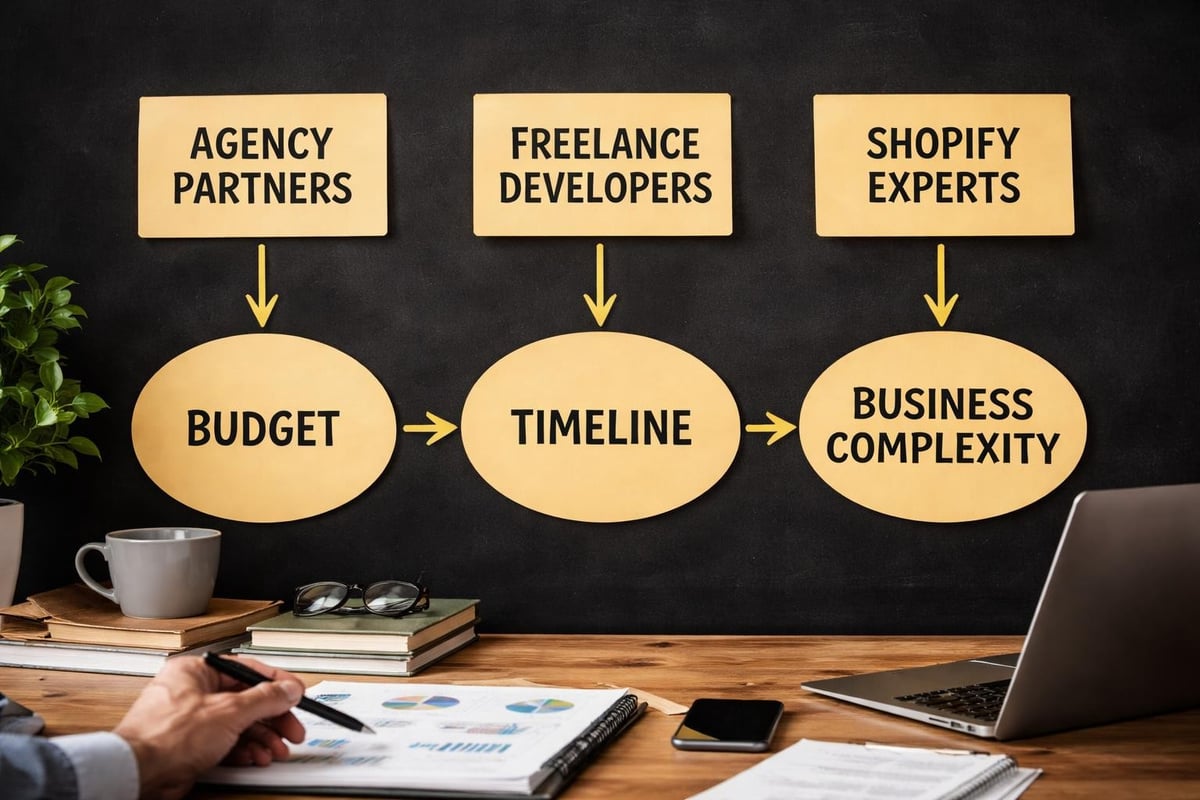
Budget determines which partners will even take your call. Large agencies won't touch projects under $10,000. Freelance partners often deliver better value for small businesses but may lack the team depth for complex projects.
Timeline matters more than most people realise. If you need to launch before Black Friday, you can't work with a partner who's booked three months out.
Industry experience isn't always critical, but it helps. A partner who's built stores for businesses in your eCommerce category understands common challenges and conversion tactics specific to your market.
Red Flags That Signal Partner Problems
Some warning signs indicate you're dealing with the wrong shopify partner before you've even signed a contract.
Vague timelines suggest poor project management. Professional partners provide detailed schedules with specific milestones.
Template-only approaches mean you're paying developer rates for work you could do yourself. Partners should explain how they'll customise your store beyond dropping in a theme.
No discovery process is a massive red flag. How can they quote your project without understanding your products, customers, or business model?
Upfront payment demands for the full project amount leave you with no leverage if things go wrong. Standard practice involves milestone-based payments.
Zero portfolio examples from businesses similar to yours suggests they're learning on your dime.
According to a 2025 survey of Australian eCommerce businesses, 43% who worked with their first-choice Shopify partner ended up switching developers mid-project. Most cited poor communication and missed deadlines as primary reasons.
What You Actually Get from a Shopify Partner
Beyond the obvious task of building your store, qualified Shopify partners provide strategic value that impacts your bottom line.
Technical architecture decisions determine whether your store can scale. Partners understand how to structure products, collections, and variants so your catalogue doesn't become unmanageable at 1,000 SKUs.
App ecosystem navigation saves you from the trial-and-error approach that costs hundreds in monthly subscriptions. Partners know which apps actually work together and which ones conflict.
Conversion optimisation separates professional builds from amateur attempts. This includes checkout flow design, product page layout, mobile responsiveness, and page speed optimisation.
SEO foundations get built into the site structure from day one. Partners familiar with Shopify SEO best practices configure meta data, URL structures, and schema markup correctly the first time.
The Development Process with Professional Partners
Here's what a structured Shopify partner engagement actually looks like when done properly.
- Discovery call where you explain your business model, products, and sales goals
- Proposal delivery with detailed scope, timeline, and pricing breakdown
- Design mockups showing exactly how your store will look before development starts
- Development phase where you review progress at scheduled milestones
- Testing period to identify bugs and optimisation opportunities
- Launch support including final checks and immediate post-launch monitoring
- Handover training so you can manage day-to-day operations independently
The entire process for a standard small business store typically runs between three to six weeks. Some specialised developers can complete builds in four weeks without cutting corners by focusing exclusively on conversion-critical features.
The Partner Advantage for Small Australian Businesses
Working with a local shopify partner brings specific advantages for Australian eCommerce operations that offshore developers can't match.
Time zone alignment means you're not waiting 24 hours for responses to urgent questions. Real-time collaboration happens during your business hours, not theirs.
Local payment gateway expertise matters because Australian merchants deal with specific providers and fee structures. Partners familiar with the local landscape configure these correctly from the start.
GST and tax compliance gets handled properly. Australian partners understand how to set up tax collection for domestic and international orders according to local regulations.
Shipping integration with Australia Post, Sendle, and other local carriers works smoothly when your partner has configured these systems dozens of times before.
Cultural understanding of the Australian market influences design decisions and feature priorities. Your partner gets why certain approaches work here even if they're uncommon globally.

Cost Reality Check for Partner Services
Let's talk actual numbers because pricing transparency is rare in this industry.
Basic store builds from certified Shopify partners typically start at $5,000 for simple catalogues with standard features. That gets you a professionally configured store using a premium theme with minor customisations.
Mid-range projects run $8,000 to $15,000 and include custom design elements, app integrations, and content migration from existing platforms.
Enterprise builds exceed $20,000 and involve custom functionality, multiple integrations, and extensive design work.
Many small Australian businesses get quoted $10,000+ for stores that should cost half that amount. The markup comes from agency overhead, not actual development complexity. Understanding what you're actually paying for helps you negotiate better deals and identify reasonable proposals.
Monthly retainers for ongoing support range from $500 to $2,000 depending on complexity and service level. Some partners bundle this with revenue share arrangements instead.
The DIY Alternative and When It Makes Sense
Not every business needs a shopify partner. Some situations genuinely warrant the DIY approach.
Ultra-tight budgets under $3,000 make professional development unrealistic. You're better off learning the platform yourself and investing that money in inventory and marketing.
Simple product lines with fewer than 20 SKUs and straightforward fulfilment don't require complex configuration. Theme templates handle these well.
Tech-savvy founders who genuinely enjoy learning new platforms can build functional stores using Shopify's documentation and tutorial resources from experts.
Testing business concepts before full commitment makes sense to validate demand before investing in professional development.
The problem with DIY isn't capability. It's time and opportunity cost.
Most small business owners spend 80-120 hours learning Shopify well enough to launch a decent store. That's three weeks of full-time work. Could you generate more revenue spending those hours on product development, supplier relationships, or customer acquisition instead?
When DIY Stores Hit the Wall
Many businesses start with DIY builds and eventually need partner intervention. Common triggers include:
- Conversion rates stuck below 1% despite reasonable traffic
- Technical issues they can't troubleshoot
- Growth requiring features beyond their technical knowledge
- Professional appearance becoming critical for brand credibility
- Time spent managing the store exceeding time spent growing the business
For stores that have already launched DIY but need expert optimisation, services like the Shopify Optimisation Package provide strategic direction without requiring a complete rebuild. This approach makes sense when the foundation is solid but conversion performance needs improvement.
Evaluating Partner Expertise Beyond Credentials
The partner badge proves Shopify approved someone. It doesn't prove they're right for your project.
Portfolio quality matters more than portfolio size. Review actual live stores they've built, not just screenshots. Test the checkout process, browse on mobile, check page load speeds.
Client references from businesses similar to yours provide insight into working relationships and outcomes. Ask specifically about communication, deadline adherence, and post-launch support.
Technical knowledge shows up in how partners discuss your requirements. Can they explain technical trade-offs in plain language? Do they ask about your customers and conversion goals, or just talk about features?
Strategic thinking separates order-takers from valuable partners. The best developers challenge assumptions and suggest alternatives when your initial ideas don't align with eCommerce best practices.
Support approach determines your experience after launch. What happens when you need help? Do they charge hourly, offer monthly retainers, or provide limited free support?
According to research on the benefits of working with certified partners, businesses report 2.5x faster time-to-market and 40% fewer post-launch technical issues compared to self-built stores.
The Platform Knowledge Advantage
Shopify partners stay current with platform changes because their business depends on it. The platform updates constantly, introducing new features, deprecating old ones, and shifting best practices.
Checkout extensibility launched in 2024 fundamentally changed how partners build custom checkout experiences. Stores built by partners updated quickly while DIY merchants struggled to understand the migration.
Markets feature for international selling requires configuration knowledge that partners possess from implementing it repeatedly. Getting it wrong means incorrect pricing or failed transactions in international markets.
Shop Pay integration optimisation affects conversion rates significantly, but proper implementation involves technical nuances that aren't obvious from Shopify's documentation.
API updates and deprecation timelines matter when you're running apps or custom code. Partners monitor these changes and proactively update client stores.
This ongoing knowledge accumulation has real business value. Your store stays current without requiring you to become a Shopify expert yourself.
Making the Partnership Work
Finding the right shopify partner is only half the equation. Successful projects require active collaboration.
Clear communication about expectations, timelines, and budgets prevents most common conflicts. Document everything in writing, even informal agreements.
Responsive feedback keeps projects moving. When your partner requests input on design decisions or content, providing timely responses prevents delays.
Realistic scope means accepting that every feature has trade-offs. The $8,000 budget won't deliver the same functionality as a $20,000 build.
Trust the expertise you're paying for. If your partner suggests a different approach than you envisioned, understand their reasoning before overriding the recommendation.
Plan for growth by discussing how your store will scale. Partners can architect solutions that support future expansion without requiring complete rebuilds.
The best client-partner relationships continue long after launch. Your partner becomes a trusted advisor who understands your business and provides strategic guidance as you grow.
Businesses that work with the same Shopify partner for more than two years report 60% higher satisfaction rates and achieve revenue goals 40% faster than those who switch providers frequently, according to 2025 industry benchmarks.
Working with the right shopify partner transforms your eCommerce journey from overwhelming to achievable. The expertise, platform knowledge, and strategic guidance they provide accelerates your path to profitability while avoiding costly mistakes that plague DIY builds. If you're a small Australian business ready to launch a conversion-focused Shopify store without agency bloat or months of trial and error, Kida Digital specialises in getting profitable stores live in four weeks with clarity, momentum, and a clear strategy.


Be the first to comment