

You've decided it's time to start a Shopify store, but the gap between idea and execution feels overwhelming. Between product selection, platform setup, design choices, and marketing strategy, launching an online store demands clarity on multiple fronts. This guide walks through the practical steps Australian small businesses need to move from concept to live store, cutting through the noise of generic advice and focusing on what actually matters for sustainable eCommerce growth.
Understanding the Real Cost Before You Start
When you start a Shopify store, the platform subscription is just the beginning.
Shopify's basic plan sits at $39 USD per month in 2026 (approximately $55 AUD), but your actual monthly overhead includes apps, payment processing fees, and potential theme costs. According to Shopify's own data, the average store uses between 6-10 apps, adding anywhere from $50-300 AUD monthly to your operating costs.
Payment processing through Shopify Payments charges 1.9% + 30 cents per transaction on the basic plan. If you're processing $10,000 monthly, that's $190 in fees before considering GST implications. Many Australian businesses underestimate these transaction costs when building initial projections.
Critical startup costs to factor:
- Domain name: $15-30 AUD annually
- Premium theme: $0-$500 USD one-time (free themes work fine initially)
- Essential apps: $50-150 AUD monthly minimum
- Product photography: $200-2000 depending on approach
- Initial inventory or supplier costs: highly variable
The real financial pressure isn't the platform. It's the working capital needed for inventory, the time investment in setup and learning, and the ongoing cost of customer acquisition once you launch.

Choosing Your Product Direction and Market Position
You cannot start a Shopify store without a clear answer to what you're selling and why someone would buy it from you specifically.
This isn't about finding a "perfect niche." It's about understanding market demand, competition reality, and your actual capacity to source, stock, and ship products.
Product Validation Before Platform Setup
The mistake most first-time store owners make is building the store before validating the product. You need evidence of demand before investing weeks in setup.
Test demand through:
- Pre-selling on Instagram or Facebook Marketplace with basic photos
- Running small paid ad tests to landing pages before building the full store
- Selling on existing marketplaces (eBay, Facebook) to understand customer questions and objections
- Surveying your existing audience if you have one
According to the Australian Bureau of Statistics, 23% of new eCommerce businesses fail within their first year, with product-market fit issues being a primary cause. You cannot build your way out of selling something nobody wants.
The Supplier Relationship Question
Australian eCommerce businesses face unique supplier challenges. Overseas shipping from China adds 3-5 weeks to delivery times. Local suppliers often have higher costs but faster fulfillment and better quality control.
Your supplier decision impacts everything: margins, customer experience, return handling, and brand positioning. Dropshipping works for testing products but creates margin pressure and quality uncertainty that makes scaling difficult.
For physical product businesses, having at least initial stock on hand gives you control over shipping speed and product quality, both critical for building early customer trust and positive reviews.
Setting Up Your Shopify Store Structure
Once you've validated demand and secured product sourcing, the technical setup can happen efficiently.
Starting an online store involves more than just adding products to pages. You're building a conversion system that guides visitors from discovery to purchase.
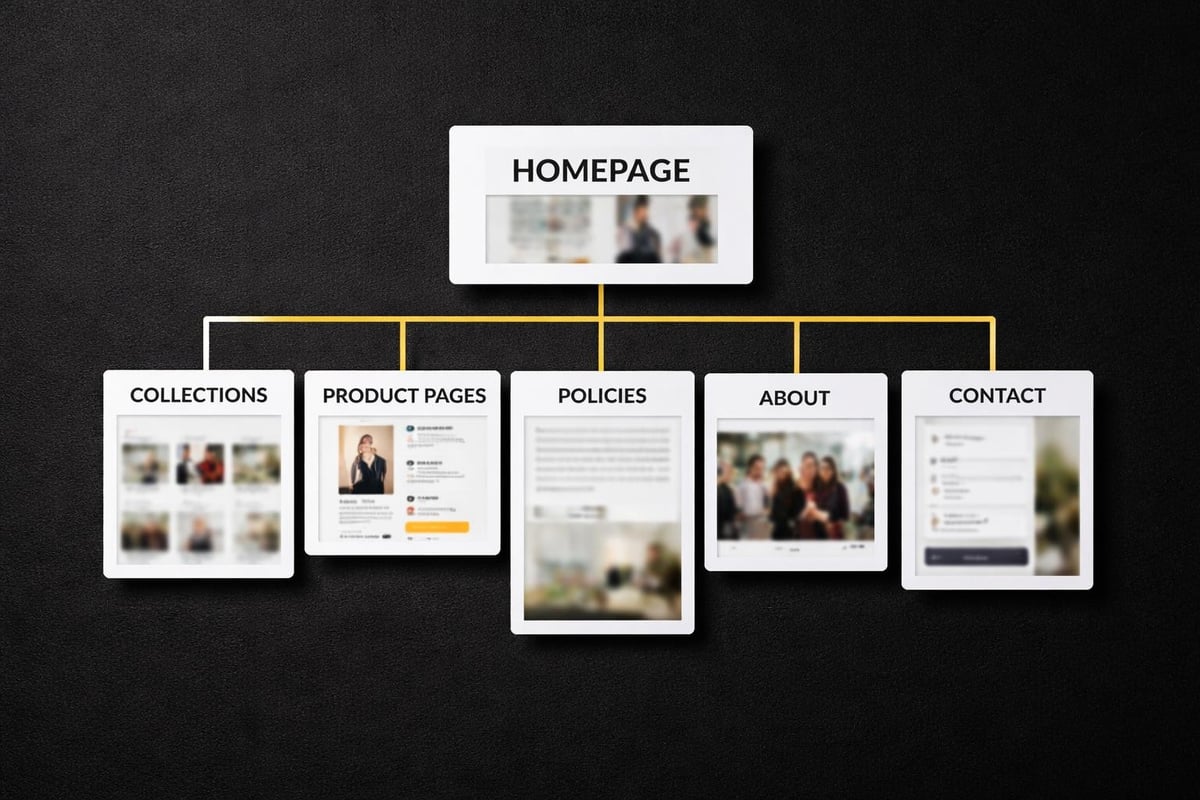
The Essential Page Architecture
Every converting Shopify store needs these foundational pages:
- Homepage with clear value proposition and featured products
- Collection pages organized by customer intent
- Individual product pages with detailed descriptions and multiple images
- About page explaining your story and building trust
- Contact page with multiple options (email, phone, chat if possible)
- Shipping and returns policy page
- FAQ page addressing common purchase objections
Your navigation menu structure determines whether visitors can find what they need. Keep primary navigation to 5-7 links maximum. Use dropdown menus sparingly, only when you have extensive product catalogs requiring organization.
Theme Selection Reality
Free Shopify themes like Dawn, Refresh, and Sense are genuinely capable of supporting six and seven-figure stores. The idea that you need a premium theme to succeed is primarily pushed by theme developers with commercial interests.
What matters more than theme choice:
- Mobile responsiveness (60-70% of eCommerce traffic is mobile in Australia)
- Page loading speed (affects both conversion and SEO)
- Customization flexibility without requiring code knowledge
- Clear product presentation with good image galleries
If you're not comfortable with basic theme customization, that's where working with Shopify specialists becomes valuable rather than attempting complex customizations yourself.
Product Listing Optimization for Search and Conversion
When you start a Shopify store, how you present products directly impacts both search visibility and purchase decisions.
Product titles should include:
- Primary keyword customers actually search
- Key product attributes (size, color, material)
- Brand name if relevant
- Clear, scannable format
Avoid keyword stuffing. "Organic Cotton T-Shirt – Men's Crew Neck – Black" works better than "Organic Cotton T-Shirt Men's Black Crew Neck Short Sleeve Sustainable Eco-Friendly."
Writing Descriptions That Convert
Product descriptions need to accomplish two jobs simultaneously: ranking in search and convincing humans to buy.
The structure that works:
Opening paragraph addressing the primary benefit or problem solved. This is what appears in search snippets and mobile previews.
Detailed feature section explaining specifications, materials, sizing, and technical details. Use bullet points for scannability.
Social proof section incorporating customer testimonials or usage statistics if available.
Care instructions, shipping details, and guarantee information building confidence in the purchase.
According to research from Baymard Institute, 20% of purchase abandonment happens because product information is insufficient. More detail generally converts better than less, particularly for higher-priced items or technical products.
SEO optimization for product pages extends beyond just descriptions. Image alt text, URL structure, and meta descriptions all contribute to search visibility for Australian customers actively searching for what you sell.
Essential Apps and Integrations
The Shopify app ecosystem contains over 8,000 apps. Most stores need fewer than 10 to function effectively.
The Core App Stack
| Function | Why It Matters | Options to Consider |
|---|---|---|
| Reviews | Social proof increases conversion 15-30% | Judge.me, Loox, Stamped |
| Email marketing | Lowest cost customer acquisition channel | Klaviyo, Omnisend, Shopify Email |
| Analytics | Understanding what drives sales | Google Analytics 4, Lucky Orange |
| Inventory management | Prevents overselling and stockouts | Built-in Shopify, Stocky |
Additional apps depend on your specific business model. Subscription products need subscription apps. Digital products need delivery automation. The goal is solving actual business problems, not collecting apps because they seem useful.
Every app adds monthly cost, potential site speed impact, and technical complexity. Start minimal. Add apps when you encounter specific problems they solve, not preemptively.
Design Customization Without Overcomplicating
Visual design matters less than most new store owners believe. Clean, professional, and functional beats elaborate and slow every time.
Your design priorities:
Brand consistency. Logo, color palette, and typography should be consistent across all touchpoints. This builds recognition and trust.
Loading speed. Every second of load time decreases conversion. Compress images before uploading. Limit apps. Choose lightweight themes.
Clear calls to action. Every page should have an obvious next step. Add to cart buttons should be unmissable. Navigation should be intuitive.
Trust signals. Security badges, money-back guarantees, Australian business verification, and clear contact information reduce purchase anxiety.
The TechRadar review of Shopify highlights that the platform's strength is making professional eCommerce accessible without requiring design expertise. Use that advantage rather than fighting it with excessive customization.
For Australian small businesses launching their first store, the core Shopify package from Kida Digital covers everything needed to launch within four weeks with clarity and momentum, avoiding both DIY overwhelm and agency bloat.
Payment and Shipping Configuration
Your checkout process determines whether interested visitors become paying customers.
Payment Gateway Decisions
Shopify Payments is the path of least resistance for Australian stores. It integrates directly, has competitive rates, and supports all major payment methods including Apple Pay and Google Pay.
If you cannot use Shopify Payments (restricted industries, specific business requirements), PayPal is the most trusted alternative. Third-party gateways like Stripe work but add transaction fees on top of Shopify's payment processing fees.
Payment method priorities for Australian customers:
- Credit and debit cards (universal expectation)
- PayPal (particularly for new stores without established trust)
- Buy now, pay later options like Afterpay (increases average order value 20-40%)
- Bank transfer for high-value B2B transactions
According to Square's 2025 Future of Commerce report, 68% of Australian online shoppers abandon carts if their preferred payment method isn't available. Offering multiple options reduces friction.
Shipping Strategy and Pricing
Shipping cost is the second most common reason for cart abandonment after unexpected fees at checkout.
Your options:
Free shipping with minimum order. Increases average order value but requires careful margin calculation. Works well when your average order value is already close to your desired threshold.
Flat rate shipping. Simple and predictable. Best when products are similar in size and weight.
Calculated shipping. Shows actual carrier rates. Most transparent but can shock customers with high costs for bulky or remote delivery.
Local pickup. Eliminates shipping costs and delivery delays if you have a physical location.
Australian eCommerce faces unique shipping challenges. Distances are vast. Carrier options are limited compared to the US or Europe. Australia Post handles most small business shipping, but their pricing structure heavily penalizes larger or heavier items.
Build shipping costs into your pricing strategy from the start. Offering "free shipping" while raising product prices 10% often converts better than showing separate shipping charges, even when the total is identical.

Pre-Launch Testing and Quality Assurance
Before you announce your store to the world, you need to verify everything functions correctly.
Critical testing checklist:
- Complete a test purchase yourself on desktop and mobile
- Verify all email notifications send correctly (order confirmation, shipping updates)
- Check every link in navigation works
- Test contact forms and ensure you receive submissions
- Review every product page for typos and formatting issues
- Confirm payment processing works with different cards
- Test shipping calculations for various addresses and product combinations
- Review the checkout process on mobile devices
The average Australian online shopper encounters 3-4 technical issues across eCommerce sites in any given month, according to customer experience data. Every issue you catch before launch prevents lost sales and damaged credibility.
Have someone unfamiliar with your store attempt to make a purchase. Watch where they hesitate or get confused. These friction points are exactly what you need to fix.
Launch Strategy and First Customer Acquisition
The moment you start a Shopify store and remove the password protection, you're live.
But being live doesn't mean anyone knows you exist.
Your First 100 Visitors
Unless you have an existing audience, your first traffic comes from:
-
Personal network. Email your contacts. Post on personal social media. This generates initial visits and potentially first sales.
-
Paid advertising. Facebook and Instagram ads let you target specific Australian demographics. Start with small budgets ($10-20 daily) testing different audiences and creative.
-
Organic social media. Post consistently on platforms where your target customers spend time. This builds awareness but rarely drives immediate sales.
-
SEO groundwork. Optimizing your eCommerce site for search takes months to show results, but the work you do at launch compounds over time.
-
Partnerships and collaborations. Other businesses serving your target market might promote you in exchange for commission or reciprocal promotion.
Expecting significant sales in your first week is unrealistic unless you're launching to an existing audience or running substantial paid advertising. Most successful stores build momentum gradually through consistent effort across multiple channels.
International Market Considerations
If you're planning to sell beyond Australia, optimizing for international markets requires specific setup. Currency conversion, international shipping rates, and localized checkout experiences all impact conversion rates for overseas customers.
For most new Australian stores, focusing on domestic customers first simplifies operations and reduces complexity. International expansion can happen after you've proven the model locally.
Ongoing Operations and Improvement
Launching isn't the finish line. It's the starting line.
Your post-launch priorities:
Customer service responsiveness. Reply to inquiries within 24 hours maximum. Fast, helpful support builds loyalty and positive reviews.
Order fulfillment consistency. Ship orders promptly. Include tracking information. Package products well to prevent damage.
Data analysis. Review your Shopify analytics weekly. Identify which products sell, which traffic sources convert, and where customers abandon carts.
Continuous testing. Try different product photos. Test pricing. Experiment with description formats. Small improvements compound significantly.
Email list building. Every visitor is a potential future customer. Capture emails through exit-intent popups, lead magnets, or post-purchase sequences.
The Australian eCommerce market grew 22% in 2025 despite economic headwinds, according to Australia Post's eCommerce Industry Report. The opportunity exists, but execution determines which stores capture it.
Successful store owners treat their Shopify store as a system requiring ongoing attention and refinement, not a project with a completion date. Building your eCommerce business means committing to learning what works for your specific products, audience, and market position.
Common Mistakes That Stall Progress
Perfectionism before launch. Your first version won't be perfect. Launch with "good enough" and improve based on real customer feedback.
Insufficient product photography. Poor images kill conversion faster than anything else. Invest in decent product photos even if everything else is basic.
Ignoring mobile experience. Over half your visitors use phones. If your store doesn't work well on mobile, you've eliminated half your potential customers.
Copying competitors exactly. Inspiration is fine. Direct copying signals lack of originality and rarely works because you don't understand their full strategy.
Neglecting policies and legal requirements. Australian Consumer Law requires specific terms and conditions, return policies, and privacy policies. Missing these creates legal risk and erodes trust.
Underpricing products. Many new store owners price too low trying to compete on cost. This destroys margins and positions you as a discount brand rather than building sustainable business.
When you start a Shopify store, you're building a business, not just a website. Business fundamentals matter more than platform features or design trends. Understanding your costs, knowing your customer, and delivering consistent value determines success far more than which theme you chose or how many apps you installed.
Starting a Shopify store in 2026 requires clarity on costs, product validation, strategic setup, and commitment to ongoing improvement. The platform provides the foundation, but your execution across product selection, customer service, and marketing determines results. If you're ready to launch without the overwhelm of DIY tutorials or the expense of traditional agencies, Kida Digital specializes in conversion-led Shopify development that gets Australian small businesses from concept to launch in four weeks with all the fundamentals in place.


Be the first to comment