

When you type "web designers near me" into Google, you're not just looking for someone who can make a website. You're looking for someone who understands your business, your customers, and the reality of operating in your local market. The search itself reveals an instinct: there's something reassuring about working with people nearby, having conversations without timezone juggling, and knowing they get the Australian business landscape.
But proximity doesn't guarantee quality. And in 2026, with remote work normalised and collaboration tools seamlessly integrated into daily operations, the "near me" part of your search needs reframing. This article walks you through what actually matters when evaluating web designers, whether they're down the street or across the state.
Why Small Businesses Search for Web Designers Near Me
The impulse to search locally makes sense. Face-to-face meetings feel more tangible. You can pop in if something goes wrong. There's an assumed shared understanding of the market, customer expectations, and business culture.
For many small Australian business owners, particularly those launching their first online store, the thought of handing over such a critical project to someone they've never met feels risky. The "near me" qualifier acts as a proxy for trust.
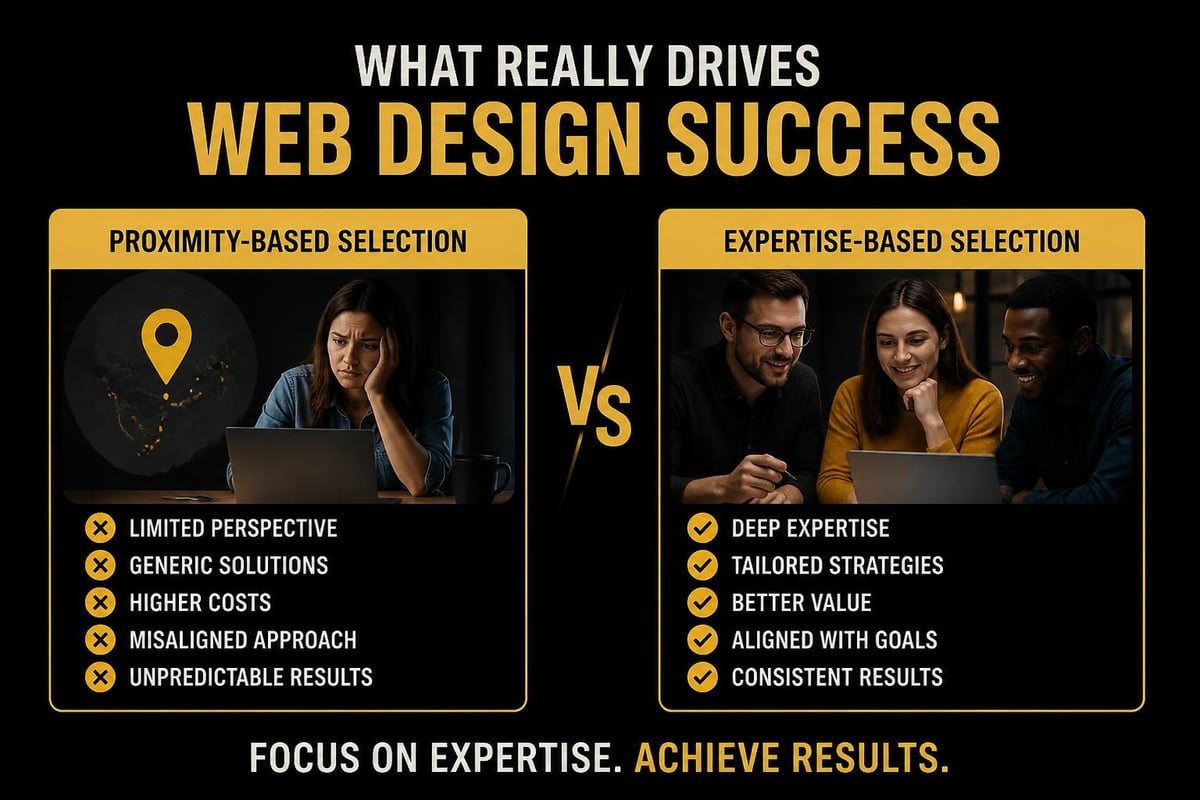
But here's what that search often misses: the best designer for your project might not be in your suburb. They might be two hours away, operating with systems that make distance irrelevant. What matters more than postcodes is alignment on process, expertise in your platform, and a proven track record with businesses like yours.
In the eCommerce space specifically, platform expertise trumps location every time. A designer who specialises in Shopify development but works remotely will deliver better results than a generalist down the road who dabbles in every platform.
What to Look For Beyond Location
When you're vetting designers, location should be one factor among many, not the deciding one. Start by clarifying what you actually need. Are you launching a brand new store? Fixing a DIY build that isn't converting? Scaling an existing business?
Your platform choice matters more than you think. If you're running an eCommerce store, you need someone who lives and breathes that platform. Generic web designers often treat Shopify, WordPress, and Wix as interchangeable, but they're not. Each has different capabilities, limitations, and optimisation strategies.
According to expert opinions on selecting website builders, scalability and SEO capabilities rank among the most critical factors. A designer who doesn't understand how your chosen platform handles growth will cost you later.
Questions to Ask Every Designer
- How many projects have you completed on my specific platform?
- Can you show me stores you've built that are similar to mine?
- What's your process from brief to launch?
- How do you handle revisions and feedback?
- What happens after launch if something breaks?
These questions cut through marketing fluff. You want specifics, timelines, and evidence. Anyone can claim expertise. Fewer can demonstrate it with real examples and clear processes.
The best designers will also ask you questions. What are your revenue goals? Who's your target customer? What's your budget for ongoing maintenance? If they're not curious about your business, they're not the right fit.
The Real Cost of Choosing Poorly
Hiring the wrong web designer is expensive, but not always in obvious ways. The initial quote might seem reasonable. The designer might be friendly and local. But six months later, you're stuck with a slow site, poor mobile experience, and no clear path to fixing it.
Time is the hidden cost. Every week your store underperforms, you're losing sales. Every confused customer who can't find your checkout is revenue walking away. Every poorly optimised product page is a missed opportunity for organic traffic.
Many small businesses end up paying twice: once for the initial build, again to fix it properly. I've seen stores that need complete rebuilds within twelve months because the original designer didn't understand conversion optimisation or basic eCommerce fundamentals.
Beyond the financial hit, there's the emotional toll. Frustration with a project that drags on for months. Stress over communication breakdowns. Regret about not doing more research upfront. These outcomes are avoidable with better vetting.
Understanding Web Design Standards and Quality Markers
Not all websites are created equal, and the differences often come down to whether designers follow established standards. The web standards model emphasises accessibility, performance, and interoperability across browsers and devices.
In practice, this means your site should load quickly, work on every device, and be navigable by people with disabilities. These aren't nice-to-haves. They're fundamentals. Yet many designers skip them to save time or because they simply don't know better.
Accessibility deserves special attention. The Web Content Accessibility Guidelines (WCAG) set clear benchmarks for inclusive design, but compliance remains inconsistent across the industry. A designer who doesn't mention accessibility in their process likely isn't considering it.
Research from Orbit Media on web design standards shows that common design elements like clear navigation, fast load times, and mobile-first layouts directly correlate with user satisfaction and conversion rates. These aren't subjective preferences. They're proven best practices.
Key Quality Indicators
| Indicator | What It Means | Why It Matters |
|---|---|---|
| Mobile-first design | Site built for phones first, then scaled up | Over 60% of web traffic is mobile |
| Page load speed under 3 seconds | Optimised images, clean code, proper hosting | Every second of delay reduces conversions by 7% |
| WCAG compliance | Accessible to users with disabilities | Legal requirement in many jurisdictions, broader audience reach |
| SEO fundamentals in place | Proper headings, meta descriptions, schema markup | Determines whether customers can find you organically |
Ask potential designers how they address each of these. Vague answers are a red flag.

Specialist vs Generalist: Why It Matters for eCommerce
When searching for web designers near me, you'll encounter two types: specialists who focus on specific platforms or industries, and generalists who do a bit of everything. For eCommerce businesses, specialists almost always deliver better results.
A Shopify specialist understands the platform's native features, knows which apps integrate well, and can optimise for conversion without custom coding everything from scratch. They've solved the same problems dozens of times and have refined processes that work.
Generalists, by contrast, treat each project as a learning opportunity. That might sound positive, but you're essentially paying for their education. They'll spend time researching solutions that specialists already know. They'll make mistakes that could have been avoided with platform-specific experience.
The difference shows up in timelines and outcomes. A specialist can often deliver a fully functional Shopify store in four weeks because they're not figuring out basics as they go. A generalist might take three months and still miss critical features.
This doesn't mean generalists are incompetent. Many are talented designers. But if you're running an eCommerce business, you need someone who speaks your platform's language fluently.
Evaluating Portfolios and Case Studies
Every designer has a portfolio. Not every portfolio tells you what you need to know. Look beyond aesthetics. Yes, the sites should look professional, but pretty design doesn't guarantee business results.
Ask for metrics. Did the site increase conversion rates? Improve average order value? Reduce cart abandonment? If a designer can't speak to business outcomes, they're focused on the wrong things.
Case studies are more valuable than portfolio screenshots. A good case study walks you through the problem, the solution, and the results. It shows decision-making, problem-solving, and strategic thinking.
Pay attention to the types of businesses in their portfolio. If you're selling physical products and their portfolio is full of service businesses or blogs, that's a mismatch. eCommerce requires different skills than brochure sites.
Red Flags in Portfolios
- Stock photos everywhere with no real products
- Slow load times on their showcase sites
- Broken links or outdated content
- No mobile optimisation evident
- Generic designs that all look the same
These suggest either inexperience or lack of attention to detail. Both are problems.
The Software and Tools Your Designer Uses
The tools a designer uses reveal their capabilities and limitations. When reviewing web design software options, you'll notice some are geared toward professionals, others toward beginners.
For eCommerce specifically, designers should be proficient in your platform's native features before reaching for custom solutions. Shopify, for example, has robust built-in capabilities that many designers overlook in favor of paid apps or custom code.
The best designers use the simplest solution that works. Overengineering is common among inexperienced developers who want to showcase technical skills. But complexity introduces more points of failure and makes future updates harder.
Ask what apps or plugins they typically recommend and why. A designer who suggests five paid apps for basic functionality either doesn't know the platform well or is getting kickbacks from app developers.
Process, Communication, and Project Management
A designer's process matters as much as their technical skills. How do they gather requirements? How often do they communicate updates? What happens if you're unhappy with a design direction?
Clear processes indicate experience and professionalism. You should know exactly what happens at each stage, what approvals you'll need to provide, and what the timeline looks like.
Communication style is predictive of the working relationship. If they're slow to respond during the sales process, they'll be slow during the project. If they use jargon without explaining it, they'll do that throughout. Pay attention to these early signals.
Project management tools like Asana, Trello, or ClickUp should be part of their workflow. You should have visibility into progress without needing to chase updates. Transparency builds trust and keeps projects on track.
Typical Project Phases
- Discovery and strategy where goals, audience, and features are defined
- Design and feedback with visual mockups and revision rounds
- Development and testing where the site is built and debugged
- Launch and handover including training and documentation
- Post-launch support for the inevitable questions and tweaks
Each phase should have clear deliverables and approval gates. If a designer can't outline this process, they're winging it.
Remote vs Local: Making the Right Choice
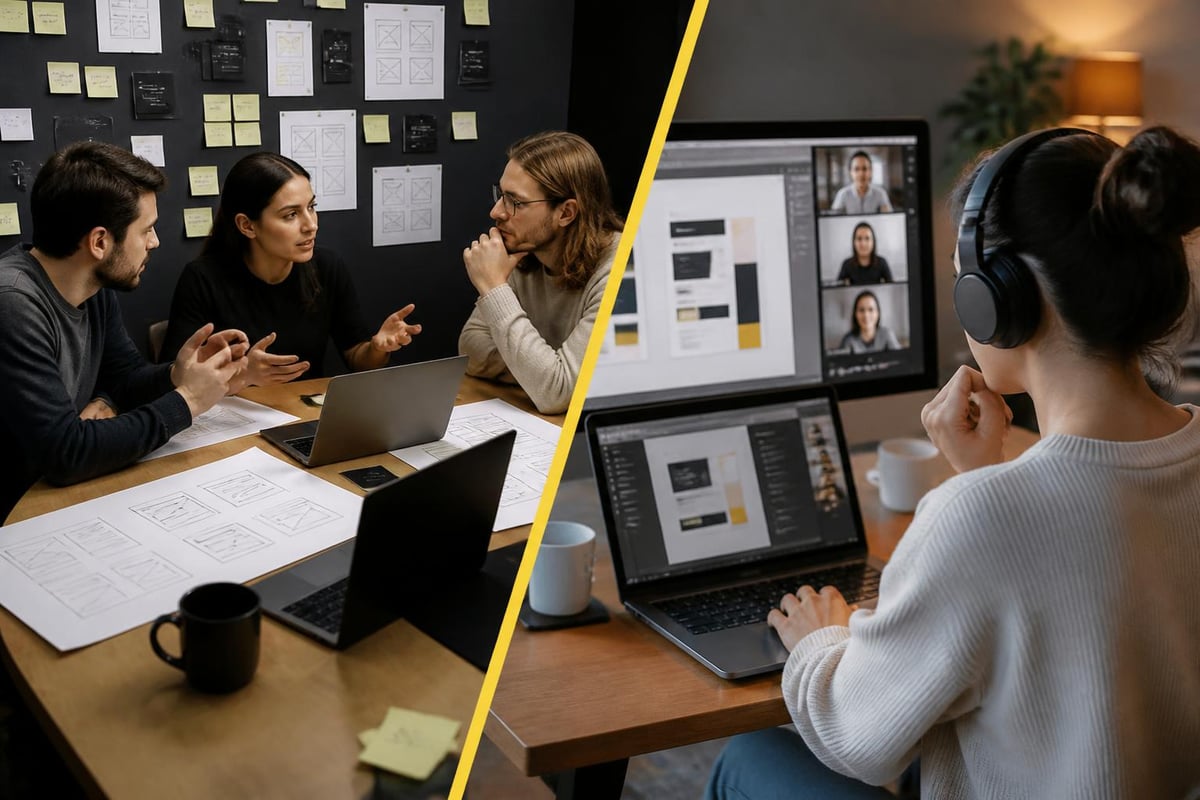
The "web designers near me" search assumes local is better, but in 2026, remote collaboration is standard practice. The question isn't whether they're local, but whether they have systems that make distance irrelevant.
Video calls replace in-person meetings. Shared documents replace printouts. Project management software replaces status update emails. Done properly, remote work is often more efficient than local because everything is documented and accessible.
What you're actually looking for is responsiveness and clarity. A designer two states away who replies within hours and communicates clearly is more "available" than someone local who takes days to respond.
That said, some businesses simply prefer local relationships. If that's you, own it. Just don't compromise on the other criteria to satisfy the location preference. A mediocre local designer will cost you more than a great remote one.
For Australian eCommerce businesses specifically, working with designers who understand the local market, shipping realities, and customer expectations matters more than physical proximity. Someone in Melbourne building stores for Brisbane clients has relevant experience. Someone in your suburb who's never built an online store doesn't.
Budget Realities and Value Alignment
Price is always part of the conversation, but it shouldn't be the first question. What you're willing to invest should align with what you're trying to achieve and the revenue potential of your store.
A basic Shopify store might cost $3,000 from a freelancer or $15,000 from an agency. The agency version isn't necessarily five times better. Often, you're paying for overhead, account managers, and processes designed for corporate clients, not small business needs.
Understanding why agencies charge premium rates helps you make informed decisions. Sometimes that cost is justified. Often it's not, especially for straightforward builds.
Value isn't just about the initial build. Consider ongoing costs: hosting, app subscriptions, maintenance, updates. A designer who builds with expensive dependencies creates recurring costs you'll pay forever.
The right investment balances upfront costs with long-term sustainability. A $5,000 store that generates consistent revenue and requires minimal maintenance is better value than a $2,000 store that constantly breaks and never converts.
When DIY Platforms Aren't the Answer
Many small business owners start with DIY website builders, attracted by low monthly fees and promises of simplicity. For some businesses, this works fine. For eCommerce, it rarely does.
The limitations become apparent quickly. Template restrictions. Plugin compatibility issues. Performance problems as inventory grows. SEO capabilities that can't compete with dedicated platforms.
Building an eCommerce site requires specific features: inventory management, payment processing, shipping calculations, tax handling, and customer accounts. DIY builders often handle these clumsily or not at all.
More importantly, you're trading time for money. Every hour spent watching tutorials, troubleshooting broken features, or redesigning pages is time not spent on your actual business. For most small business owners, that time is worth more than the cost of hiring a professional.
The sweet spot is working with a developer who provides structure without overengineering. You need someone who can deliver a functional eCommerce store in weeks, not months, with all the fundamentals in place and room to grow.
Red Flags and Warning Signs
Knowing what to avoid is as important as knowing what to look for. Certain behaviors and claims should immediately raise concerns about a designer's professionalism or capability.
Unrealistic timelines are a major red flag. A fully custom eCommerce store in one week isn't feasible unless significant corners are cut. Conversely, a basic Shopify build that takes six months suggests inefficiency or poor project management.
Vague contracts without clear deliverables leave you exposed. You should know exactly what you're getting, when you'll get it, and what happens if deadlines are missed or requirements change.
Designers who won't provide references or can't explain their process are gambling with your investment. Transparency should be standard, not something you have to demand.
Common Warning Signs
- Require full payment upfront with no milestones
- Can't explain technical decisions in plain language
- Show reluctance to sign clear contracts
- Have no recent work examples
- Promise guaranteed rankings or instant results
- Use aggressive sales tactics or create artificial urgency
Trust your instincts. If something feels off during initial conversations, it won't improve once money changes hands.
Making Your Final Decision
After researching, comparing, and interviewing potential designers, you'll need to make a decision. This often feels harder than it should because you're weighing factors that don't fit neatly into spreadsheets.
Start by eliminating anyone who failed the basics: poor communication, lack of relevant experience, unclear processes, or concerning red flags. This usually narrows the field significantly.
Among the remaining options, compare not just on price but on total value. Consider the timeline, the level of support, the quality of their previous work, and how well they understood your specific needs during initial conversations.
The designer who asks the best questions often delivers the best results. Someone who wants to understand your customers, your competition, and your growth plans is thinking strategically, not just aesthetically.
For eCommerce businesses specifically, if you're looking for a done-for-you Shopify build that covers all the fundamentals without agency bloat, that option exists. Four-week timelines with clear deliverables, no missing features, and built specifically for Australian small businesses running online stores.
Finally, remember that this relationship extends beyond launch. You want someone who'll be responsive when you need support, transparent about what changes require, and invested in your long-term success.
Platform-Specific Considerations for Shopify
If you've chosen Shopify for your eCommerce store, you need a designer who genuinely understands the platform's ecosystem. This isn't just about technical proficiency. It's about knowing which features to use, which apps to avoid, and how to structure your store for both current needs and future growth.
Shopify specialists understand theme architecture, liquid templating, and the platform's API limitations. They know how to optimise checkout flows, set up proper collection structures, and integrate essential business tools without creating dependency nightmares.
They also understand Shopify's update cycle. The platform evolves constantly, with new features, deprecations, and best practices emerging regularly. Specialists stay current. Generalists often work with outdated knowledge.
For businesses selling physical products, digital products, subscriptions, or running dropshipping operations, Shopify offers purpose-built solutions. A designer who knows how to leverage these native features will deliver a faster, more stable, more cost-effective store than one who builds everything custom.
The Australian eCommerce landscape has specific considerations too: GST handling, Australia Post integration, local payment preferences, and customer service expectations that differ from US or UK markets. A designer familiar with these nuances saves you from costly mistakes.
Searching for web designers near me starts with an understandable instinct toward local relationships, but the best outcomes come from prioritising expertise, process clarity, and platform specialisation over postcodes. Whether your ideal designer is in your suburb or a different state matters far less than whether they understand your platform, your market, and your business goals. If you're ready to launch a conversion-focused Shopify store without the complexity of agency processes or the gaps of DIY platforms, Kida Digital delivers streamlined four-week builds designed specifically for small Australian eCommerce businesses ready to sell with confidence.


Be the first to comment